
You can walk into a hot-desking office at 8.30 on a Monday and tell within thirty seconds whether the cleaning plan is working. The bins are full, the kitchen sink has a ring of yesterday's coffee, keyboards feel tacky, and someone has already wiped their own desk because the cleaner didn't get to it. That's the test of daily office cleaning in a hybrid workplace, it's not whether the space looks passable at a glance, it's whether people can start work without dealing with the mess left behind.
The awkward part is that many offices still treat cleaning as a cosmetic reset instead of an operational routine. In practice, that shifts time and frustration onto staff, and it weakens the case for a tidy, healthy workplace. In UK offices, that burden shows up in lost working time, shared-touchpoint hygiene, and avoidable complaints that often surface only when the room already feels neglected.
Table of Contents
- Why Daily Office Cleaning Matters More Than You Think
- What to Include in a Daily Office Cleaning Routine
- Building an Effective Daily Cleaning Workflow
- Staffing and Equipment Decisions for Daily Cleaning
- Health and Safety Compliance in Daily Office Cleaning
- Measuring Cleaning Quality and Holding Providers Accountable
- Getting Started with a Professional Daily Cleaning Service
Why Daily Office Cleaning Matters More Than You Think
A facilities manager I worked with described the same Monday problem every week. The office had a cleaner, but only some areas were consistently done, so the first people in ended up clearing mugs, wiping crumbs, and finding somewhere else to sit before they could even start. That's not a small annoyance, it's a sign that cleaning has drifted out of rhythm with how the building is used.
The UK data makes the point plainly. One survey found employees lose 13 working hours per year cleaning their own office or workspace, even though 85% said their company employs a cleaner, and 85% were asked to clean desks every week. The same survey reported weekly requests to clean kitchens or communal food-preparation spaces at 52%, and weekly vacuuming at 47%.[^1] When staff are doing that work themselves, the office is paying twice, once for cleaning and once in lost focus.
The productivity problem is practical, not abstract
That lost time matters because hybrid offices depend on smooth handover between users. If a desk gets used by one person on Tuesday, another on Thursday, and nobody is sure who cleaned it on Wednesday, the office manager ends up firefighting instead of managing standards. A stable daily routine reduces that uncertainty and stops minor grime from becoming a constant distraction.
It also changes how the workplace feels to visitors and new starters. A clean reception, usable kitchen, and clear desk policy send a better signal than a polished sales pitch ever will. If you want the wider business case, this breakdown of dirty offices and employee wellbeing is a useful companion piece.
Practical rule: if staff are repeatedly wiping down the same shared areas, the cleaning schedule is too light, too vague, or happening at the wrong time.
The lease and compliance angle matters too. A well-kept office is easier to hand back, easier to inspect, and less likely to trigger complaints about standards. In other words, daily office cleaning protects time, morale, and the building itself.
What to Include in a Daily Office Cleaning Routine
The right routine in a hybrid office is not a long checklist copied from a generic template. It's a risk-based list that separates what must happen every day from what can wait. Shared desks, kitchens, washrooms, reception counters, and entry points deserve the daily pass, because those are the places that collect use from multiple people and create the quickest hygiene problems.

Start with the high-touch zones
Office hygiene guidance has been pushing managers toward this risk-based mindset for years. One source notes that only 35% of respondents said their desk is cleaned at work every day, while more than 30% said their keyboard is not cleaned at all and 36% said their mouse is not cleaned.[^2] The same source reports the common office desk was found to be 400% dirtier than a toilet, and that a telephone can harbour 760% more bacteria than a keyboard.[^2] Another related benchmark says a typical work surface may carry roughly 10 million bacteria, and keyboards can contain 70% more bacteria than a toilet seat.[^2] Those figures are exactly why keyboards, mice, handsets, door handles, and shared appliance controls belong in the daily plan.
For a hot-desking office, the list should be split into two groups:
- Must-clean every day: shared desks, keyboards, mice, telephones, reception counters, kitchen touchpoints, washroom fixtures, bin lids, and entry handles.
- Detail-clean on a scheduled basis: vents, cable runs, chair bases, tracks, tops of cabinets, and under-desk areas.
Don't waste the daily route on low-risk clutter
The mistake I see most often is a checklist that treats every surface equally. That sounds thorough, but it usually means the cleaner runs out of time before reaching the actual problem areas. A smarter route starts with the shared contact points, then moves through the rest of the occupied space in a consistent order.
Shared spaces fail first. If the kitchen, reception, and washrooms are clean but desks and peripherals are ignored, the office still feels unmanaged.
Hybrid working changes the brief. A desk that changes user every few days needs more than a quick dust, and a meeting room used by different teams all day needs more frequent attention than a private office. If you want a broader practical reference for service scope, this office cleaning page shows the kind of routine a provider should be able to support.
Building an Effective Daily Cleaning Workflow
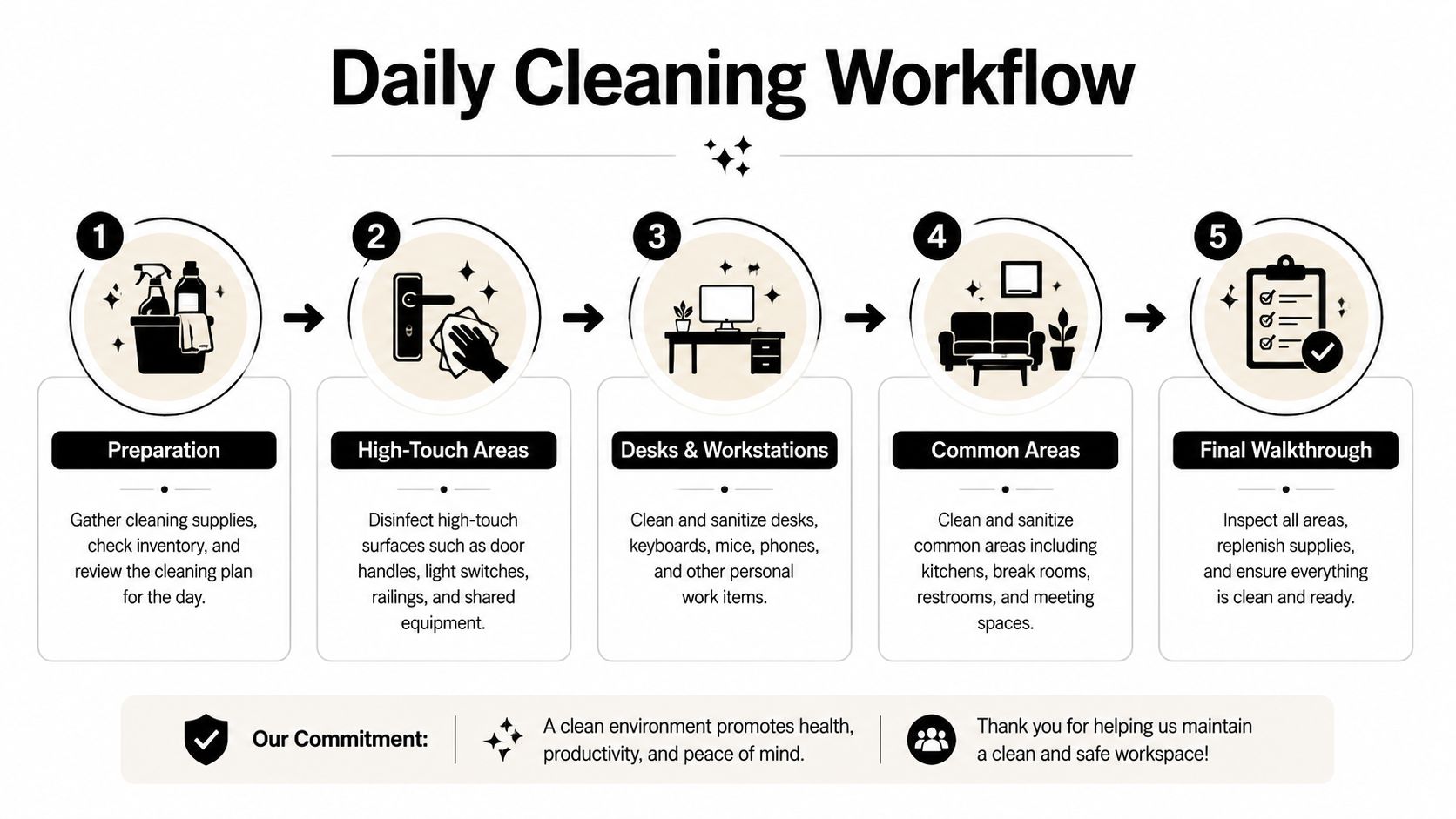
A good daily workflow is boring in the best way. It repeats the same sequence every day, which means fewer misses, less rework, and less risk of a cleaner undoing their own progress by touching a dirty area after a clean one. The sequence below is the one I'd expect from a well-run office team or contractor.
Follow the same order every day
The workflow should begin with PPE and tools, then waste removal, then cleaning from top to bottom and clockwise, before finishing with damp-wiping, disinfection, glass, floors, and a final inspection. That order matters because dust and debris fall, and you don't want a clean shelf ruined by a dirty light fitting or a freshly mopped floor tracked up by a late pass through the room.[^3]
The practical toolset is straightforward:
- Microfiber or lint-free cloths: for most dusting and wiping tasks.
- Cleaner applied to the cloth, not directly to surfaces: especially around screens and electronics, to avoid over-wetting.[^3]
- Separate clean cloths for glass: to reduce streaking and cross-contamination.[^3]
- Dry microfiber for monitors: to protect equipment and stop residue building up.[^3]
What not to do
The common errors are predictable. Dusting low surfaces before high ones creates recontamination, and using the same cloth across washrooms, kitchen counters, and desks spreads problems rather than solving them. Electronics need particular care, because too much liquid around sockets, keyboards, and screens causes more damage than dirt ever did.
A cleaner who rushes the route usually leaves evidence behind, streaks on glass, sticky handles, and missed corners around shared devices.
The final inspection is not optional. That last walk-through catches bins that were missed, paper towels left in washrooms, and contact points that still feel damp or tacky. For a manager, that final check is the difference between a routine that looks tidy on paper and one that actually works.
Staffing and Equipment Decisions for Daily Cleaning
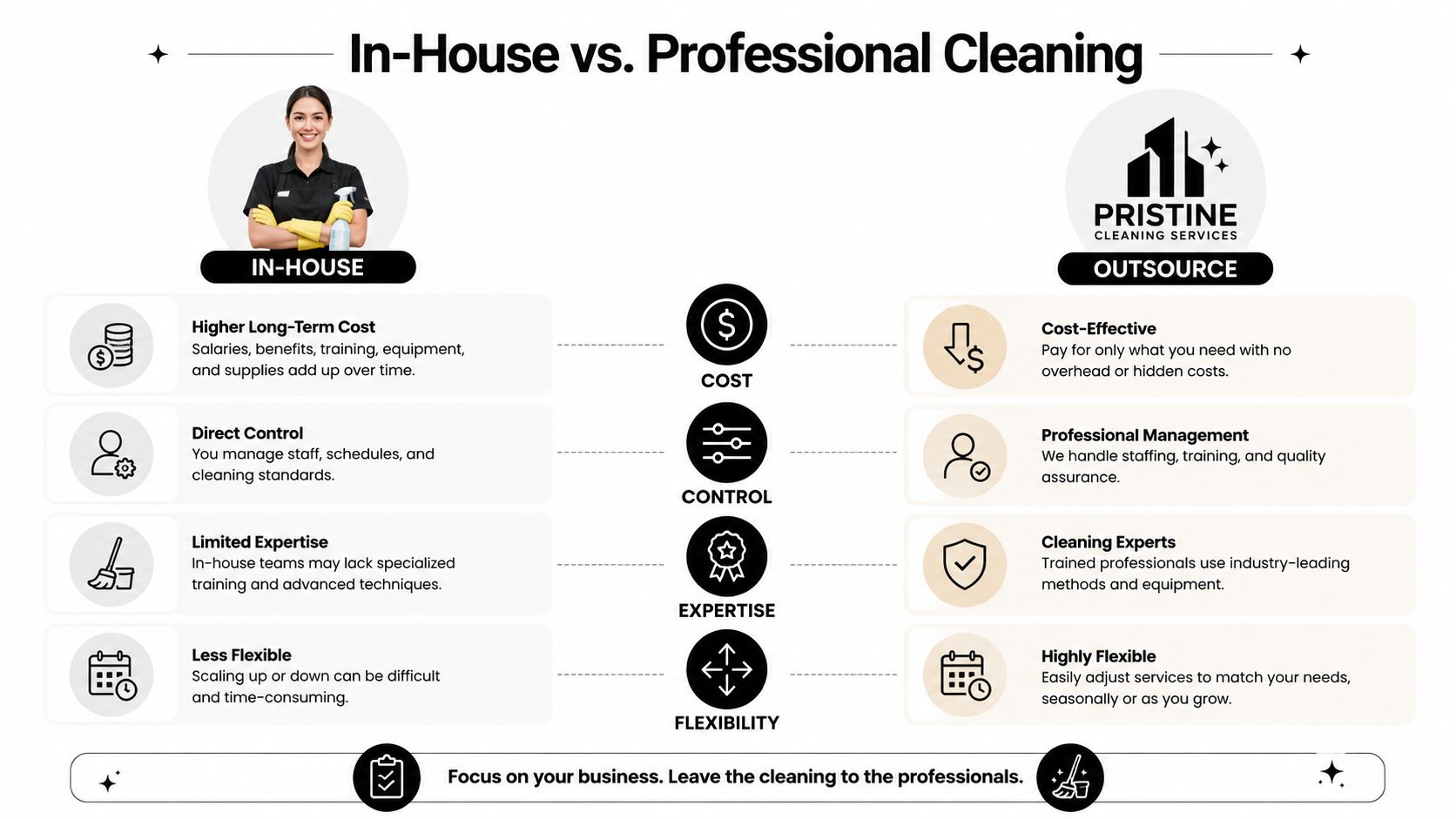
The in-house versus outsourced decision usually comes down to control, consistency, and how much management time you want to spend chasing standards. In a small office, an internal arrangement can work if the team is disciplined and the scope is narrow. In a busier hybrid office, a contracted provider is often easier to hold accountable because you're buying a defined service rather than trying to build a cleaning function around someone else's day job.
Compare the two models honestly
In-house cleaning gives you direct control over timing and task lists, but it also means recruiting, training, supervising, and covering absences. That extra management load is easy to underestimate. Outsourcing is more predictable because the provider should supply the staffing, equipment, and rota structure, though you still need a clear specification and proper inspections.
A practical decision usually depends on three questions:
- Who owns the standard: a line manager, facilities lead, or external account manager?
- Who covers absence: your own team or the contractor's relief cover?
- Who supplies the equipment: your budget or the provider's kit?
For equipment, don't settle for domestic-grade tools in a workplace that sees heavy turnover. Professional vacuums, colour-coded microfiber systems, and periodic deep-clean equipment such as hot water extraction machines are part of a serious programme, especially when carpets, upholstery, or reception flooring need occasional recovery work. Atticus Cleaning Services, for example, uses Sebo professional vacuums and hot water extraction equipment as part of its broader commercial cleaning offer, which is the kind of specification worth asking any provider to match if they're cleaning shared office environments.
Build for flexibility, not just price
The cheapest daily arrangement often becomes expensive once missed cleans, complaints, and restart visits are added. That's why out-of-hours access, clear start and finish times, and a proper handover matter more than a headline rate. If the office opens early or runs hot-desking across multiple teams, a provider should be able to clean around that rhythm instead of forcing the building to adapt to theirs.
Practical rule: pay for the right equipment and the right schedule first, then worry about polishing the routine later.
A good onboarding process should include access details, room priorities, sensitive surfaces, and escalation contacts. That's the point where a service becomes reliable rather than theoretical.
Health and Safety Compliance in Daily Office Cleaning
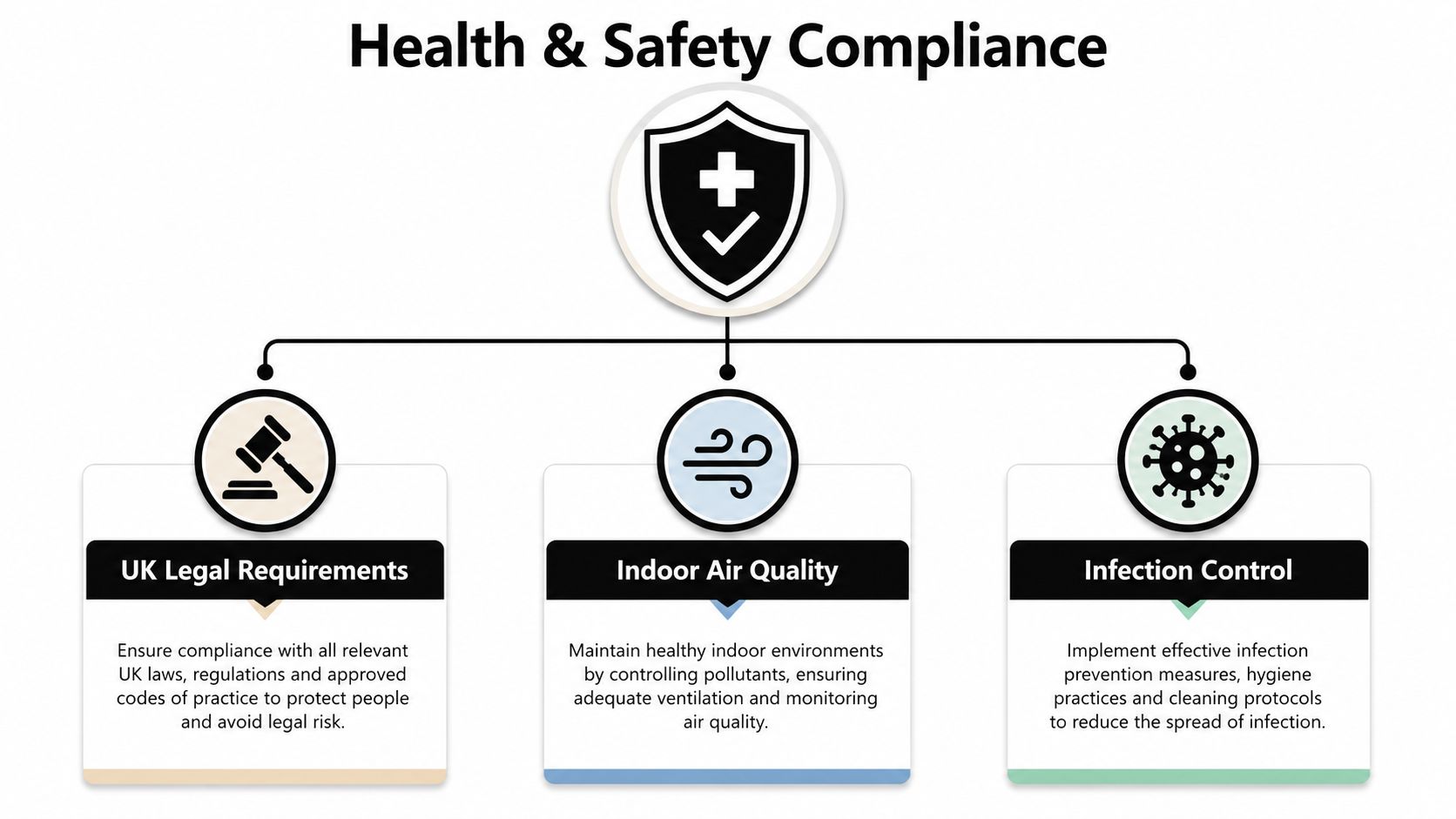
Cleaning and compliance overlap more than most managers expect. The Health and Safety Executive requires employers to maintain a clean workplace and provides separate guidance on ventilation, which means the cleaning plan can't be just about empty bins and nice-smelling spray.[^4] In a real office, hygiene, air movement, and safe chemical handling all sit in the same risk picture.
Risk-based cleaning is easier to defend
Blanket disinfection sounds reassuring, but it's not always the smartest use of time. A risk-based plan is more defensible because it focuses daily effort on the touchpoints people share, the washrooms people use, and the kitchen controls that get handled all day. That approach lines up better with the practical reality of sickness absence and staff confidence, both of which remain material business issues for UK employers.[^5]
The health and safety side also includes how you handle chemicals and waste. Cleaning products need sensible storage, clear labelling, and COSHH awareness, and waste must be removed in line with local rules and the building's own procedures. A service that treats rubbish as an afterthought usually creates problems elsewhere, especially in shared kitchens and washrooms.
Document the routine properly
A clean office is easier to defend when there's evidence behind it. Keep a simple record of what was cleaned, when it was done, and who checked it, especially for washrooms, kitchens, reception, and high-touch areas. If there's a complaint or a near miss, those notes help you see whether the issue was missed cleaning, poor timing, or a weak handover between shifts.
This is also where ventilation ties back into the cleaning plan. If a room feels stale, dusty, or damp, the answer isn't always more fragrance or more product. Sometimes the cleaner needs better sequencing, better waste removal, or a separate inspection of the area's airflow and occupancy pattern.
Measuring Cleaning Quality and Holding Providers Accountable
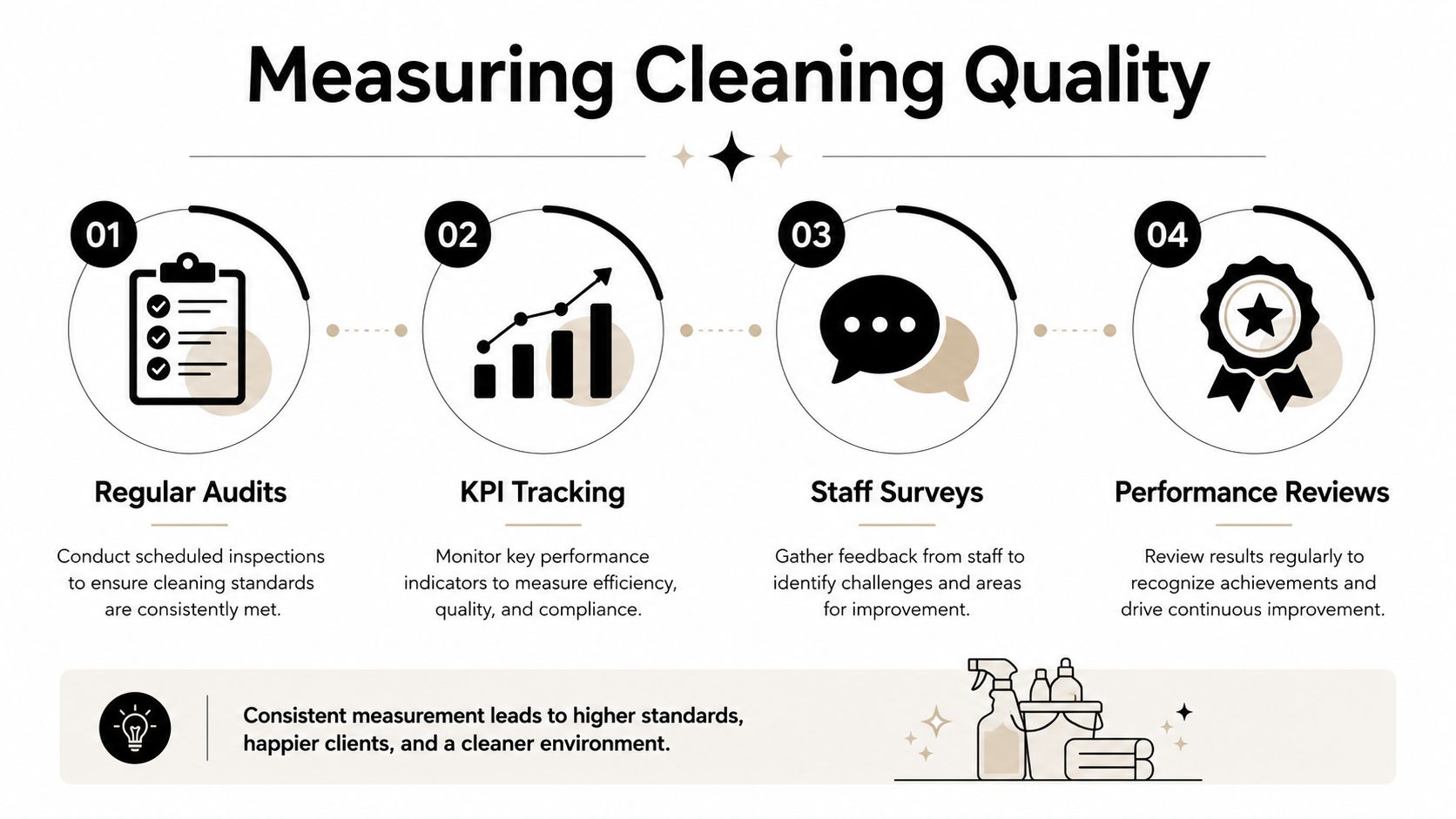
A daily routine only holds its shape if somebody checks it. In practice, the best offices use a short list of visible standards, then inspect them often enough to catch drift before staff start complaining. You don't need a complicated dashboard to do that, you need a few reliable indicators and the discipline to act on them.
Use simple standards people can actually inspect
Set standards for the areas that matter most. For example, desks should feel dry and free of residue, washroom fixtures should be visibly clean and stocked, kitchen touchpoints should not be sticky, and reception should look ready for visitors at the start of the day. If you can't tell in a quick inspection whether the clean has happened, the standard is too vague.
Useful inspection methods include:
- Spot checks: quick walk-throughs of washrooms, reception, kitchens, and hot desks.
- Periodic audits: a structured review of recurring misses, such as handles, bin lids, and under-desk dust.
- Staff feedback: brief comments from people using the space every day.
- Provider review meetings: a monthly or termly conversation about what's slipping and why.
Make service levels specific
The conversation with a cleaning provider gets easier once the standard is measurable. Instead of saying the office needs to be “cleaner”, describe the tasks that matter most and the areas that keep failing inspection. That gives the provider something they can act on, and it gives you a fair basis for escalation if the service slips.
Use the complaint trail as evidence, not emotion. If people keep raising the same issue, the cleaning plan or the provider's route needs to change.
A decent provider should welcome that feedback, not fight it. If performance doesn't improve after clear feedback, documented checks, and a fair review, it's time to challenge the service level or switch supplier. Consistency matters more than apologies.
Getting Started with a Professional Daily Cleaning Service
The easiest way to buy the right cleaning service is to walk the site with someone who understands how offices run. A proper visit should cover occupancy patterns, shared desks, washrooms, kitchens, reception, access windows, and anything sensitive such as screens, server areas, or client-facing rooms. Once that's clear, a quote can be built around the actual workload instead of a generic room count.
A transparent proposal should spell out what's included, when the work happens, who owns the account, and how issues are escalated. If you're comparing options, ask how the provider handles hybrid usage, out-of-hours access, and changes in headcount, because those are the details that usually break a daily routine if they're not agreed at the start. The onboarding should feel organised, with a named contact, a confirmed start date, and a clean handover process.
For offices in Greater Manchester and North Cheshire, that kind of structure matters because the building's use can shift quickly across the week. If you want a clear example of what a professional service should cover, this guide to what to expect from a professional office cleaning service is a useful benchmark before you speak to any provider.
The business case is simple. A good daily plan reduces the load on staff, supports hygiene in shared spaces, and keeps the workplace ready for clients and teams without constant intervention. If you're ready to tighten up standards, request a site visit, compare the scope properly, and choose a service that matches how your office works.
Atticus Cleaning Services provides premium office cleaning across Manchester and North Cheshire, with flexible scheduling, trained staff, and a satisfaction-led approach that suits hybrid and hot-desking workplaces. If you want a practical daily cleaning plan that focuses on shared touchpoints and real-world office use, visit Atticus Cleaning Services to arrange a quote and start shaping a routine that holds up on the ground.
[^1]: UK office cleaning survey data on lost time and weekly cleaning requests
[^2]: Office surface contamination summary and desk cleanliness findings
[^3]: UK office cleaning workflow guidance and sequence recommendations
[^4]: HSE guidance on maintaining a clean workplace and ventilation
[^5]: UK government sickness absence statistics