

You're staring at a van full of boxes, the keys are due back, and the place still doesn't look ready for handover. That's the normal end-of-tenancy scramble in Hale. The mistake many make is treating cleaning as a final tidy, when it's really the last piece of evidence that decides whether a deposit gets returned cleanly or dragged into a dispute.
For end of tenancy cleaners Hale, the right standard isn't about making a property look nice for five minutes. It's about matching what the inventory shows, removing the stuff that triggers deductions, and leaving a clear paper trail. In a market where around 4.7 million tenancy deposits are protected across England and Wales, with a total value of about £5.53 billion, the stakes are real, and formal adjudication happens in only 1.00% of deposits, with cleaning the most common dispute trigger at 54% (Renters Rights Act statistics).
Table of Contents
- Why End of Tenancy Cleaning Matters in Hale
- The Legal Reality of Deposit Deductions
- The Room-by-Room Cleaning Checklist
- Essential Add-Ons and Specialist Services
- Choosing a Local Hale Cleaning Provider
- Preparing the Property for a Professional Clean
- Securing Your Deposit and Next Steps
Why End of Tenancy Cleaning Matters in Hale
A move in Hale rarely happens in a neat, calm sequence. One minute you're sorting removals, redirecting post, and chasing final bills, the next you're looking at a kitchen that still has grease around the extractor hood and a bathroom with limescale on the glass. That's exactly when people underestimate the clean and overestimate how forgiving a letting agent will be.


The practical reality is simple, inventory clerks compare the check-out condition against the check-in record, not against your idea of “clean enough”. A quick wipe-down usually misses the details that matter most, such as internal glass, skirting, grout, oven residue, and carpet staining. Those are the things that land on the deduction sheet.
What local landlords actually look for
Hale landlords and agents want the property back at the same standard it left in, allowing for fair wear and tear. They are not impressed by a surface tidy if the oven still smells, the taps still have scale, or the carpets hold an obvious mark. A proper end-of-tenancy clean is less about presentation and more about removing the friction that causes arguments later.
Practical rule: If a surface, fixture, or floor area looks different at check-out than it did on the inventory, assume it needs documented cleaning, not just a visual pass.
That's why a professional-grade clean pays for itself quickly. It doesn't just improve the look of the property, it reduces the chances that the landlord or agent can justify a deduction. In a tight rental market, that matters because everyone wants the next tenancy to start without delay.
The Legal Reality of Deposit Deductions
Many tenants still think they have to pay for a professional clean no matter what. That's wrong. Under the Tenant Fees Act 2019, a landlord in England can't require a tenant to pay for a professional clean as a condition of getting the deposit back, and the legal test is whether the property is returned to the same cleanliness standard shown in the check-in inventory, allowing for fair wear and tear (Tenant Fees Act guidance).
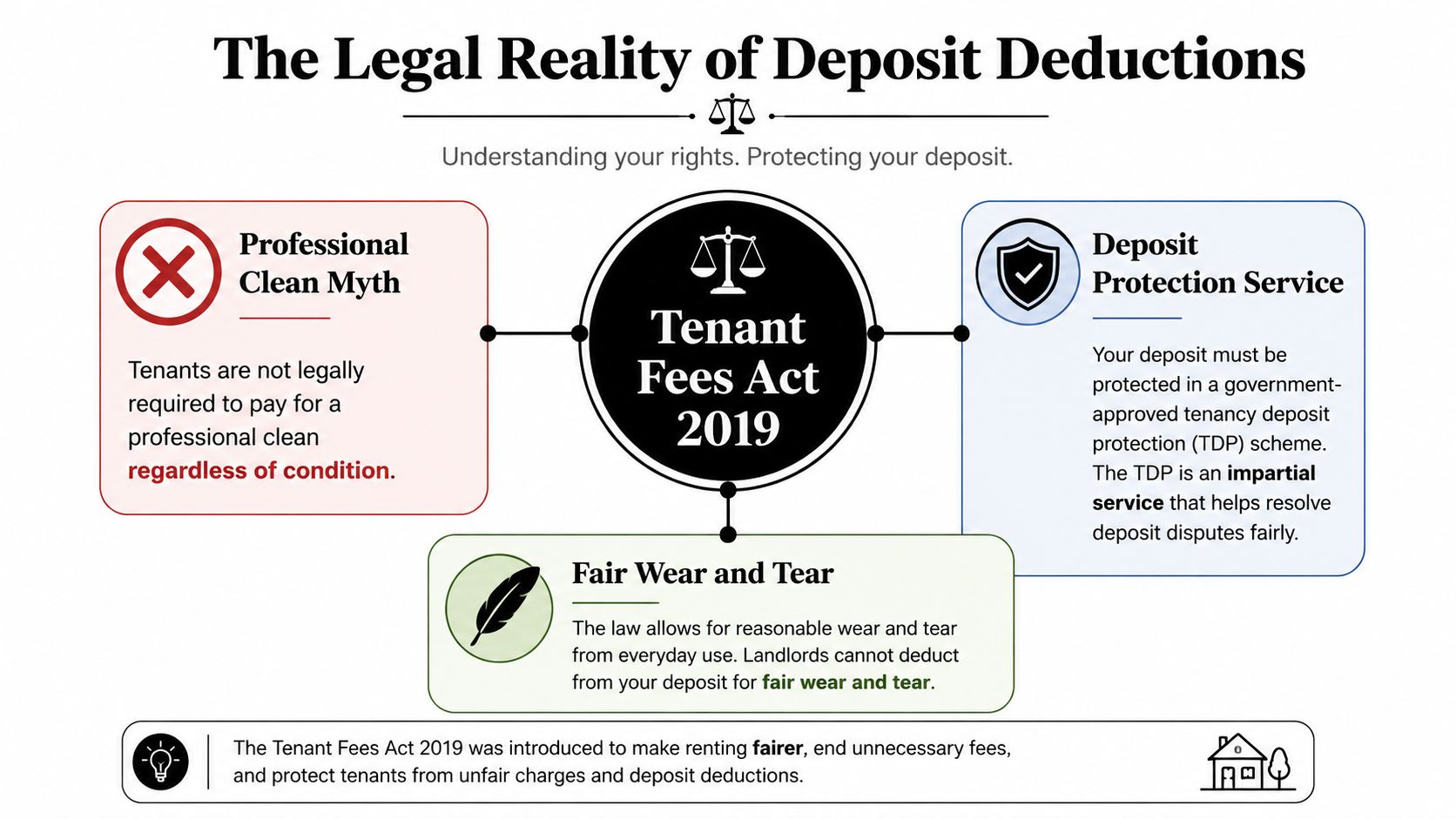
What wins disputes is evidence. The strongest case is built on dated photos, the inventory, a check-out report, and proof of any actual work completed. If a landlord claims the oven or carpet was left dirty, they need to show the condition, not just make a vague complaint.
Condition matching beats generic promises
A lot of tenants get caught out. A “professional clean” sounds reassuring, but the legal question isn't whether you bought a service, it's whether the property matches the recorded baseline. That's why a cleaning workflow should target the areas that end disputes, especially kitchen degreasing, bathroom restoration, carpets, and internal windows.
If you want a straightforward breakdown of what landlords usually expect from a handover clean, see what landlords expect from end-of-tenancy cleaning. The point is not to chase a perfect-looking property, it's to create a defensible one.
A tenant can clean it themselves or hire a cleaner, but receipts and photos matter more than marketing language when a deposit claim lands.
The smart move is to document everything before keys are handed back. If the property is clean, prove it. If something was already marked, damaged, or affected by wear, the inventory trail needs to show that too. That's how you stop a cleaning disagreement becoming a money problem.
The Room-by-Room Cleaning Checklist
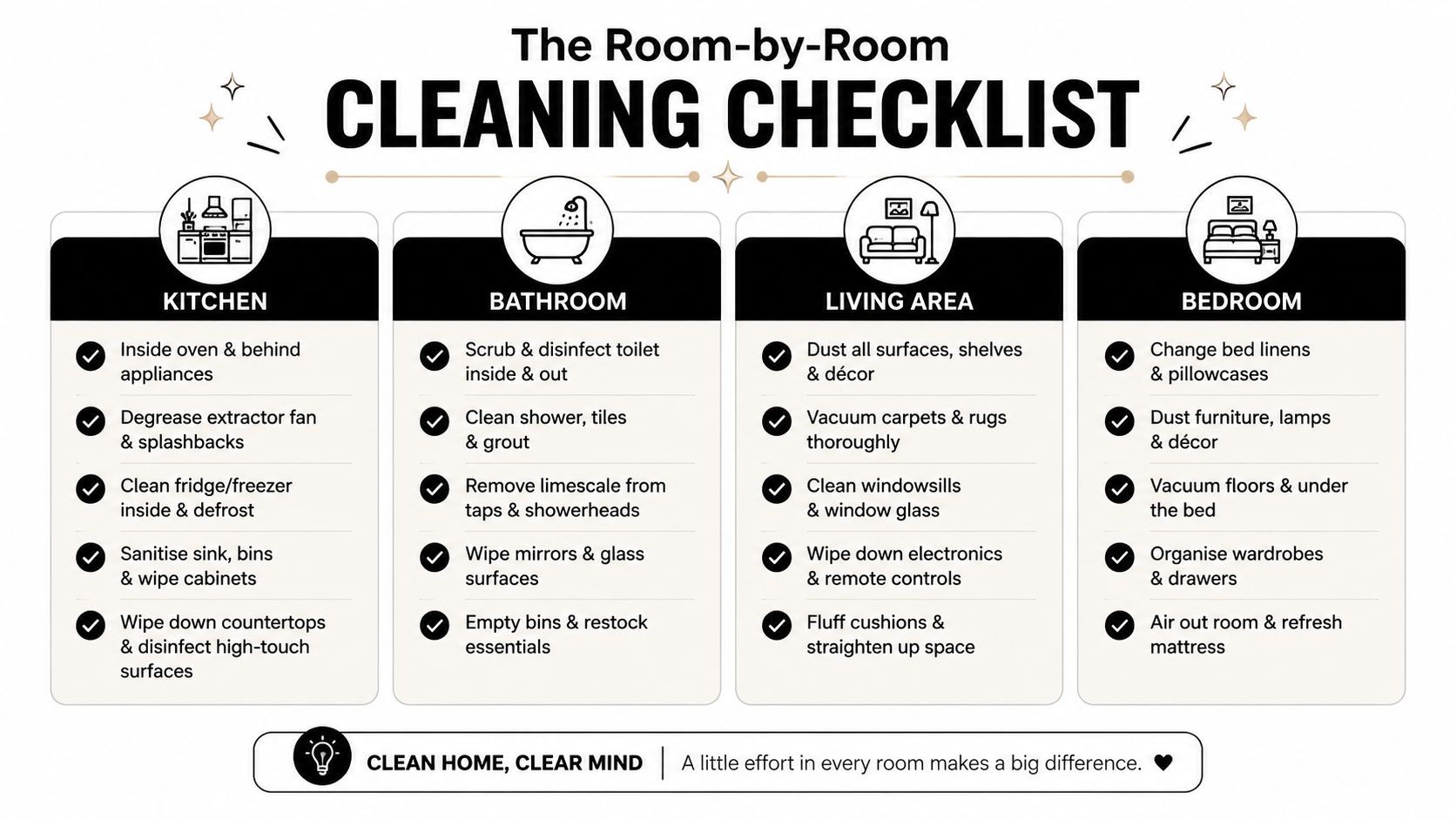
End-of-tenancy cleaning fails when people only clean what they can see at shoulder height. Inventory check-outs go deeper than that. They look at the grime behind appliances, the dust on door frames, the smears on switches, and the marks that show up once the furniture is gone.
Kitchen first because it causes the most trouble
The kitchen usually creates the biggest dispute because it collects grease, limescale, food residue, and odours. Start with the oven, hob, extractor fan, splashbacks, sink, cupboard fronts, fridge seals, and the spaces behind or under appliances. If the oven is left with baked-on residue, you're inviting a deduction.
A solid kitchen clean should also include descaling taps, wiping inside cabinets, sanitising bins, and cleaning the refrigerator interior if it's part of the tenancy agreement. Don't skip the small things. Agents notice finger marks on handles and build-up around light switches because those details signal whether the whole property was treated properly.
Bathrooms need more than bleach and hope
Bathrooms are judged on scale, soap scum, and mildew as much as on basic cleanliness. Shower screens, tiles, grout, silicone seals, taps, sinks, toilets, and mirrors all need proper attention. If there's mould staining, remove what's superficial, but don't pretend cleaning alone fixes an underlying damp problem.
Living rooms and bedrooms still need detail work
Vacuuming the floor isn't enough in the main rooms. Dust skirting boards, wipe internal windows, clean door frames, clear light switches, and check shelves and wardrobes for marks. Once furniture leaves the room, every neglected patch becomes more obvious, so corners matter more than ever.
The same applies to hallways and entrances. These areas pick up scuffs quickly, and they're often the first thing an inventory clerk sees. If the first impression is dirty, the rest of the inspection starts from a weaker position.

Essential Add-Ons and Specialist Services
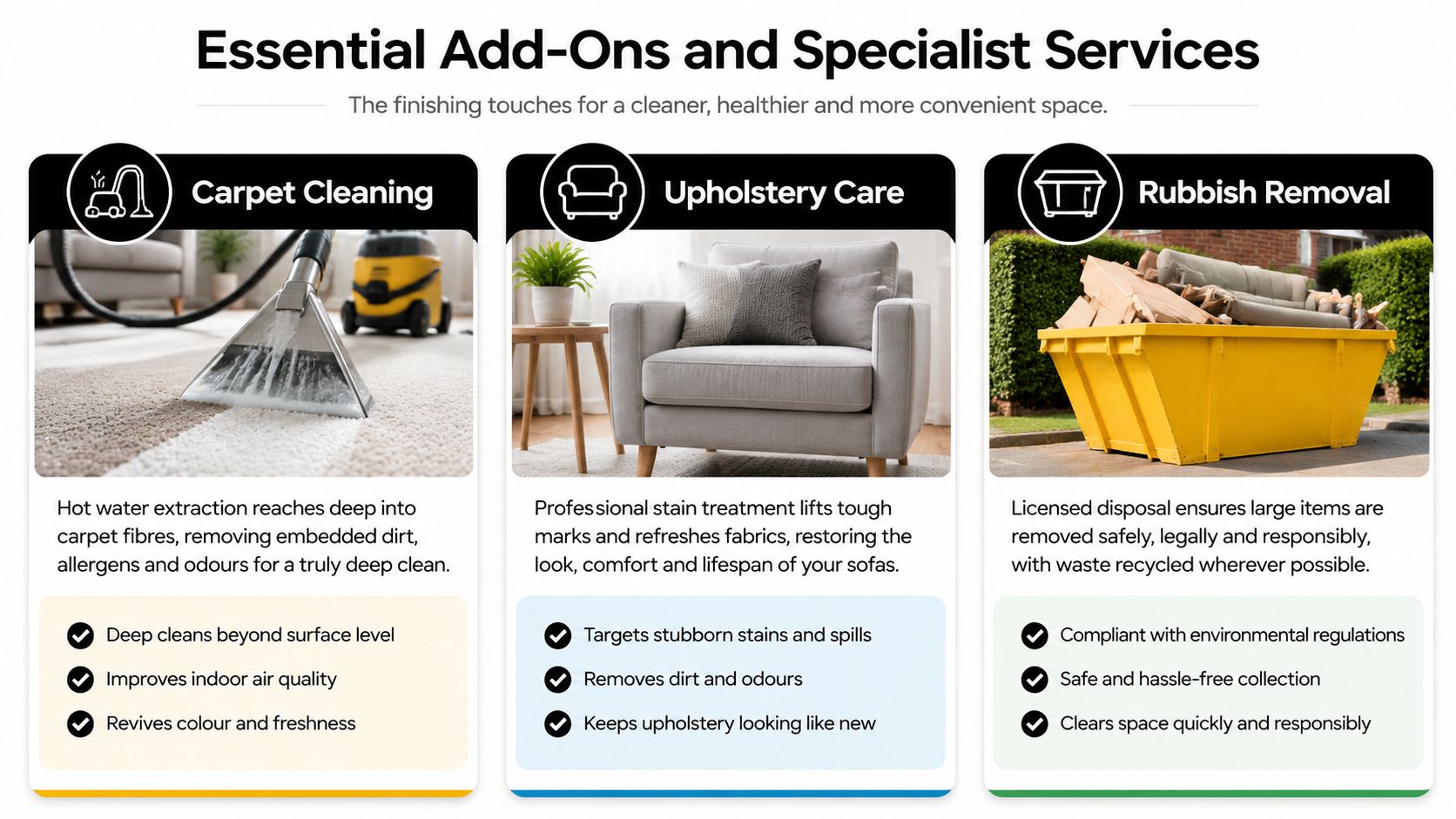
Some tenancies need more than a standard clean. Carpets, upholstery, and bulky waste are the usual extras, and they're where a lot of moving-day arguments get resolved or avoided. The mistake is treating every add-on as optional when some of them directly affect the property's return condition.
Carpet cleaning needs proper extraction
For carpets, hot water extraction is the professional standard. It pushes heated solution deep into the pile, loosens embedded soil, then extracts the contamination rather than moving it around. One UK service reference notes typical drying of about 3 to 6 hours depending on ventilation and room temperature (carpet cleaning guide).
That matters because standard vacuuming only handles surface debris. If the carpet has a visible stain, odour, or heavy traffic pattern, it usually needs more than a domestic pass. If you want to judge cost against value, use this carpet cleaning pricing guide and compare it with the likely cost of a deposit deduction.
Upholstery and soft furnishings need different handling
Sofas, dining chairs, and fabric headboards hold smells and spot marks that don't lift with a cloth. They need fabric-safe treatment, careful stain identification, and the right cleaning chemistry for the material. A cheap wipe-down can make the fabric look worse, not better.
Rubbish removal is not a last-minute bin bag job
Loose rubbish, unwanted furniture, and leftover packaging should be removed properly, not left in communal areas or dumped in a skipped corner. Licensed disposal matters because the wrong carrier can create legal and practical problems for the landlord or tenant. If you need a cleaner to bundle the job, make sure waste removal is handled with the same discipline as the interior clean.
Damp and mould need a different response
Surface staining from moisture is not the same as a cleaning problem. If a wall still smells musty or mould keeps returning, cleaning alone won't solve it. Government-backed tenant research shows damp or mould is the most common issue renters report, and official housing data indicates 10% of private rented homes had damp in 2024 (private rented sector tenants research report).
If the property is clean but still affected by moisture damage, document it. Don't let a hygiene issue get confused with a building-condition issue.
Choosing a Local Hale Cleaning Provider
A local cleaner isn't automatically better, but a local provider with the right equipment, scheduling, and tenancy knowledge is usually the safer choice. Hale properties get inspected against local agent expectations, and a team that does this work regularly understands where disputes usually start. That's worth more than a generic “deep clean” promise.
One option that fits that brief is Atticus Cleaning Services, which carries out end-of-tenancy cleaning across Hale, Altrincham, and the surrounding area, uses Sebo vacuums and hot water extraction equipment, and includes internal window cleaning as standard on end-of-tenancy work. It also offers rubbish removal in line with regulations, which keeps the turnaround workflow tighter and less fragmented.
What to insist on before you book
Don't hire on price alone. Ask whether the service includes the oven, internal windows, carpet care, and the corners that inventories catch. Ask whether the team is insured, whether they can work around key handover times, and whether they'll treat the job as a deposit-risk task rather than a quick refresh.
A good provider should also be comfortable with evidence. That means clear before-and-after photos, a sensible scope of work, and a finish that aligns with the inventory record. A vague promise is useless once a deduction is raised.
Why bundled work usually makes more sense
Piecemeal cleaning is where time disappears. One person does the kitchen, another comes later for carpets, and rubbish clearance gets left until the end, which slows the handover and creates gaps. A bundled service keeps the sequence tight and makes it easier to prove that the property was dealt with systematically.
That approach is especially useful if a viewing or new tenancy is already booked. Landlords and agents don't want cleaning stretched across several days. They want the property back in a lettable state, with less back-and-forth and fewer excuses.
Preparing the Property for a Professional Clean
A professional clean works best when the property is cleared properly before the team arrives. If boxes, clothes, and loose items are still spread through the rooms, cleaners have to work around them, and missed spots become predictable. That's how handovers get messy.
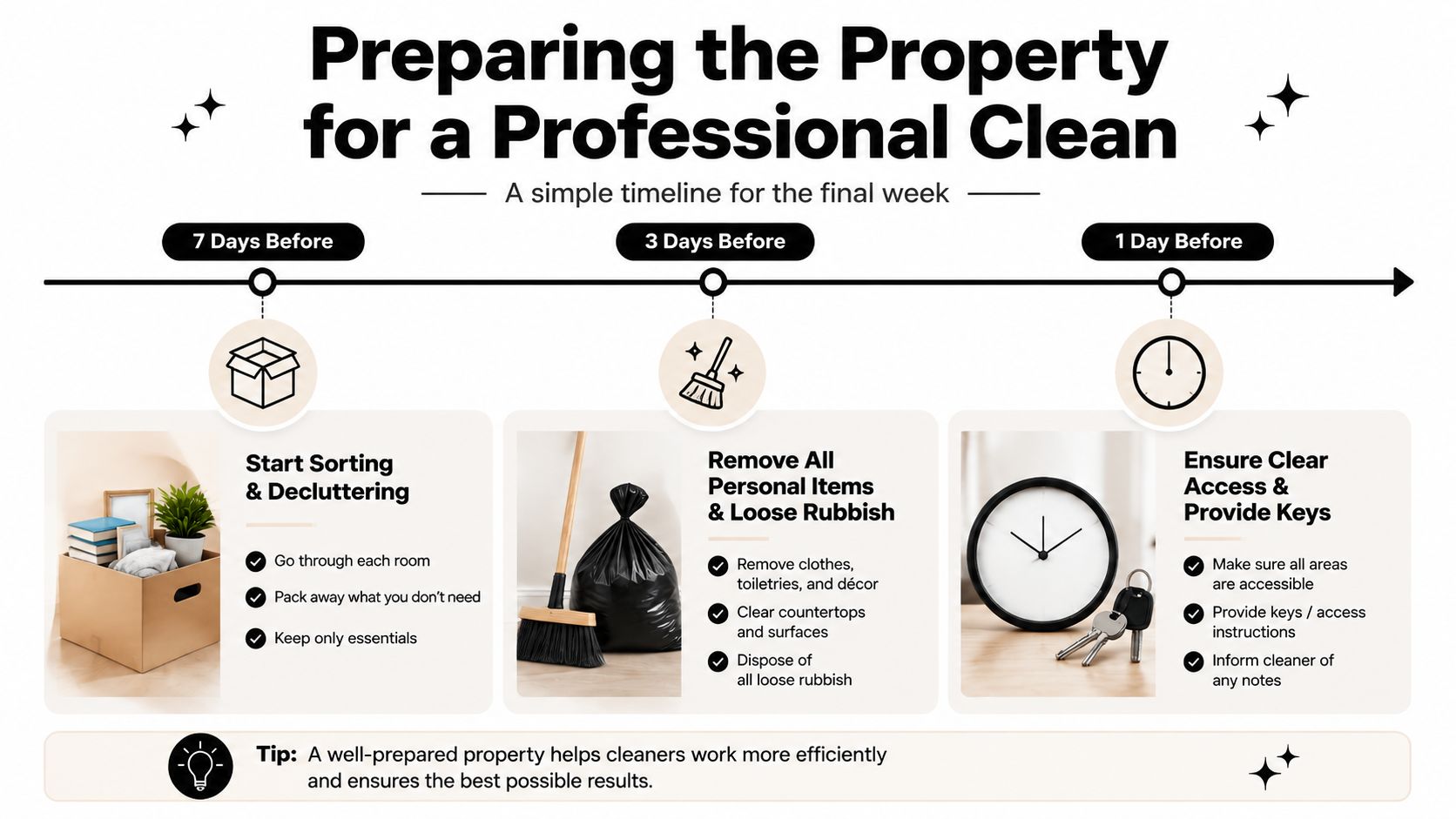
The final week should be organised, not improvised
Seven days before the clean, sort through what's staying, what's going, and what needs disposal. Three days before, remove personal belongings, clear cupboards you're vacating, and defrost any freezer that needs attention. The day before, make sure keys, parking, access instructions, and utilities are ready so the team can work without interruption.
Practical rule: A clear property gets a better clean. Cleaners can't properly detail a room if they're moving boxes every few minutes.
Landlords should use the same logic between tenancies. The cleaner should follow the move-out, then the inventory, then the next handover, in that order. That sequence cuts down void time and stops a half-finished property from becoming a scheduling headache.
Don't leave small access problems until the last minute
Meter cupboards, locked bedrooms, loft access, and blocked hallways all slow things down. So do pets, broken lights, and disconnected water or power where a machine is needed. The goal is simple, give the cleaning team a clear canvas and they'll get closer to the expected finish.
If you're renting, keep your receipts and photo record once the clean is done. If you're letting, keep the same file with the inventory and check-out notes. The paperwork is part of the job, not an afterthought.
Securing Your Deposit and Next Steps
The smartest way to think about end-of-tenancy cleaning is as protection for a financial asset. Your deposit isn't a bonus, it's money you want back without argument. If the inventory is clear, the clean is documented, and the property is returned to the right standard, the handover gets a lot easier.
Use a simple rule set. Check the inventory, book a reputable local team, keep all receipts, and photograph the finished result before keys are returned. That's the cleanest route through a deposit dispute, and it works because it relies on evidence instead of optimism.
For tenants and landlords in Hale, a properly managed end-of-tenancy clean should be fast, documented, and fitted to the property's actual condition. If you want that handled by a local team with the right equipment, book a quote with Atticus Cleaning Services and make the handover easier to defend.
Atticus Cleaning Services handles end-of-tenancy cleaning, carpet care, and rubbish removal for Hale properties that need a defensible handover. If you want a local team to match the inventory standard, keep the paperwork tidy, and reduce the risk of deductions, visit Atticus Cleaning Services and request a transparent quote.