

In Manchester, end of tenancy cleaning usually costs between £200 and £400 for a standard property. That cost often makes sense when you compare it with deposit deductions and the much stronger deposit return outcomes tied to professional cleaning.
If you're reading this while packing boxes, chasing meter readings, and trying to pin down a check-out date, you're in the same position as a lot of tenants and landlords across Manchester. The last clean tends to get left until late, then suddenly it becomes the detail that decides whether a handover feels smooth or turns into a dispute.
The important thing to understand is that end of tenancy cleaning in Manchester isn't about making a property look generally neat. It's about matching the condition recorded at check-in, apart from fair wear and tear. That's a very different standard. A wiped worktop and a vacuumed carpet might feel clean enough on moving day, but inventories are usually won or lost on grease in the oven, dust on skirting boards, limescale on taps, crumbs in drawers, and grime around extractor fans.
From a cleaning manager's point of view, the pattern is consistent. People miss the hidden areas, underestimate how long kitchens and bathrooms take, and assume “good enough” will pass. Sometimes it does. Often it doesn't.
Table of Contents
- Securing Your Deposit in Manchester
- The Ultimate Manchester End of Tenancy Cleaning Checklist
- How Much End of Tenancy Cleaning Costs in Manchester
- The Atticus Cleaning Process and Guarantee
- How to Prepare for Your Tenancy Clean
- Frequently Asked Questions
Securing Your Deposit in Manchester
Moving out is already expensive. Van hire, overlap rent, storage, key returns, and time off work all add up. Cleaning is one of the few parts of the move where spending carefully can reduce a larger financial risk.
In Manchester, that matters. According to deposit return data for Manchester tenancies, 90% of tenants who hire professional end-of-tenancy cleaners receive their full deposit back, compared with only 40–50% of tenants who do the cleaning themselves. The same source notes cleaning costs in Manchester can range from £110 to £560, while average deductions for insufficient cleanliness are £150 to £300.


That's why experienced tenants don't treat end of tenancy cleaning as a cosmetic job. They treat it as part of deposit protection. Landlords and agents do the same from the other side. They're checking whether the property has been returned ready for the next tenant, not whether the outgoing tenant was short on time.
Why cleaning disputes happen so often
The problem usually isn't the obvious mess. Bags are gone, surfaces are mostly wiped, and the place looks empty. The problem is detail.
Common trouble spots include:
- Kitchen grease: inside ovens, behind hobs, extractor filters, cupboard tops
- Bathroom build-up: limescale around taps, shower screens, grout lines, toilet edges
- Dust transfer: skirting boards, sockets, door frames, radiator tops
- Internal glass and frames: visible smears show up fast in inventory photos
- Floor finish: carpets may look acceptable until traffic lanes, edges, or stains are checked properly
Practical rule: If a clerk can photograph it easily, they can flag it easily.
The most useful mindset is simple. Clean for inspection, not for appearance. That means working from the inventory standard backwards. If you want a practical sense of what agents often focus on, this guide to what landlords expect from end of tenancy cleaning is a helpful reference point.
Where the money decision really sits
A lot of tenants ask whether they should save money and do it themselves. Sometimes that works, especially in a small, well-kept flat with plenty of time before key handover. But DIY only works if you can clean to the same condition standard the inventory will be judged against.
If you can't, the cheaper route often stops being the cheaper route.
The Ultimate Manchester End of Tenancy Cleaning Checklist
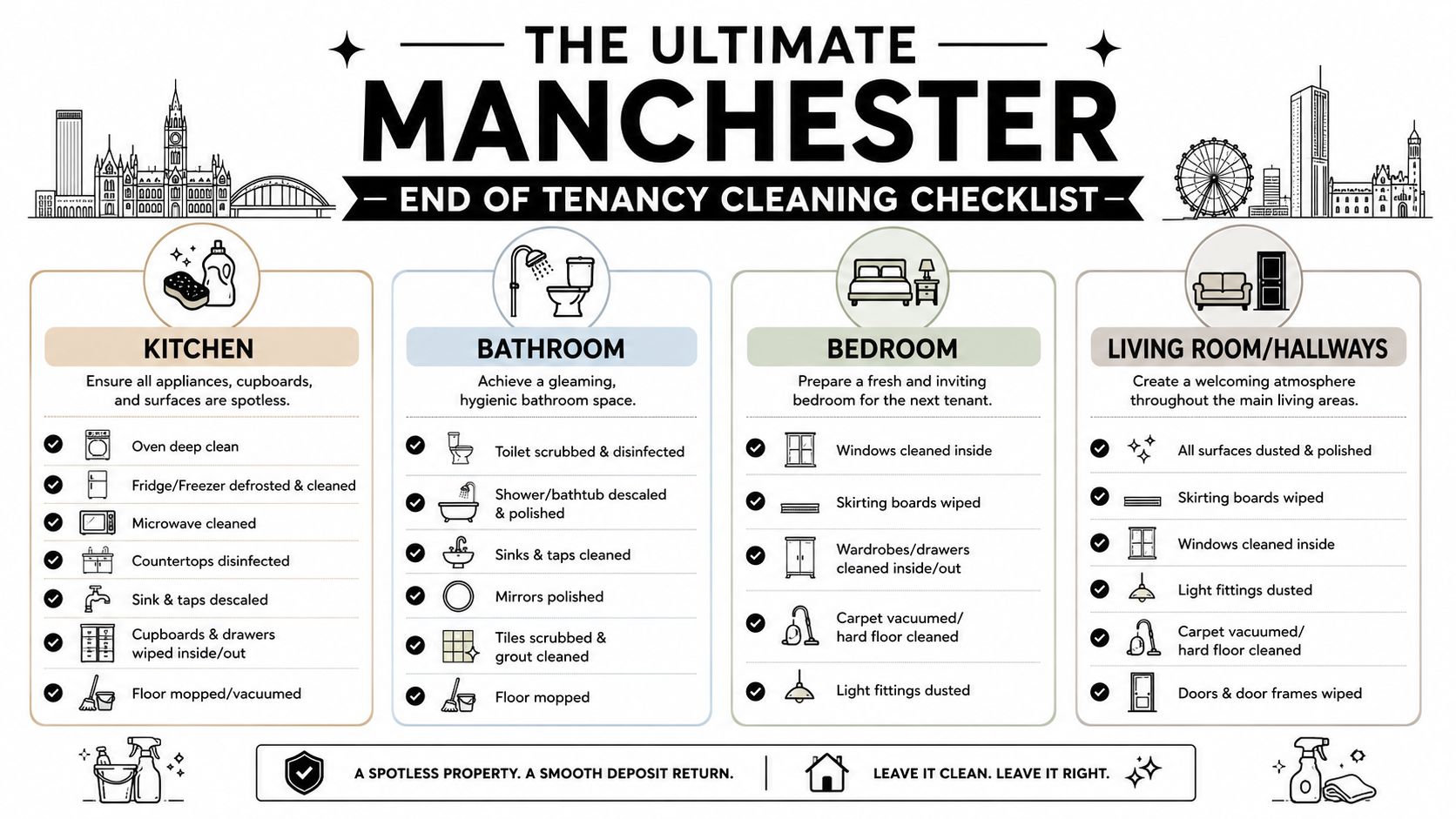
A proper tenancy clean is closer to restoration than routine housekeeping. The easiest way to think about it is this: you're trying to return the property to the closest possible version of the check-in snapshot.
What a checkout standard really means
A tidy property is not automatically a check-out ready property. Tidying removes clutter. A tenancy clean removes residue, grease, dust, soap scum, and built-up grime from the places an inventory clerk will inspect closely.
That's why detailed room-by-room work matters. If you want a fuller look at the scope of the job, this breakdown of what end of tenancy cleaning involves gives a useful picture of the standard people usually mean when they say “professionally cleaned”.
Room by room checklist
The kitchen nearly always decides whether a clean feels convincing.
- Oven and hob: degrease trays, shelves, glass, control knobs, splashback, and the area around burners
- Extractor area: wipe the canopy, remove grease from external surfaces, clean filters if accessible
- Cupboards and drawers: empty fully, then wipe inside and out, including handles and top edges
- Fridge and freezer: defrost if needed, clean seals, shelves, drawers, and the floor area beneath
- Sink and taps: descale, polish, and clear staining around plugs and joints
- Worktops and wall edges: remove residue where crumbs and grease collect
- Flooring: vacuum first, then mop properly into corners and under movable appliances
Bathrooms need a different approach. They don't usually look terrible until light catches limescale, streaks, and soap film.
- Toilet: clean bowl, seat, hinges, flush plate, and surrounding floor edges
- Shower or bath: descale screens, taps, tiles, grout lines, and seals
- Sink and vanity: polish taps, clear splash marks, wipe drawers and cupboard fronts
- Mirrors and chrome: leave dry and streak free
- Ventilation points: remove surface dust from extractor covers
- Floor: mop after everything else so loosened dust and hair are removed at the end
Before the video, it helps to see how these standards translate into a real move-out clean in practice.

Living rooms, bedrooms, and hallways are often faster, but they're where a lot of avoidable marks get missed.
| Area | What to check |
|---|---|
| Skirting boards | Wipe dust, hair, and scuff residue |
| Doors and frames | Clean handles, edges, finger marks, and top rails |
| Windows inside | Glass, sills, tracks, and frames |
| Wardrobes and drawers | Empty fully and wipe inside and out |
| Light fittings | Remove dust and cobwebs safely |
| Floors | Vacuum edges and corners, then clean hard floors thoroughly |
The easy misses that cause problems
Ovens, extractor fans, inside cupboards, and internal windows cause more check-out comments than tenants expect.
There are also a few details that separate a rushed clean from a complete one:
- Radiators: dust sits on top and drops down the wall
- Sockets and switches: fingerprints show clearly
- Behind doors: hidden until an inventory clerk opens them
- Window ledges and tracks: obvious once sunlight hits them
- Bins: they need cleaning, not just emptying
If you're doing the clean yourself, work in that order. High dust first, detailed wet work second, floors last.
How Much End of Tenancy Cleaning Costs in Manchester
Price matters, but the useful question isn't just “what does it cost?”. It's “what level of work is included, and what condition is the property in before anyone starts?”.
What the local price range looks like
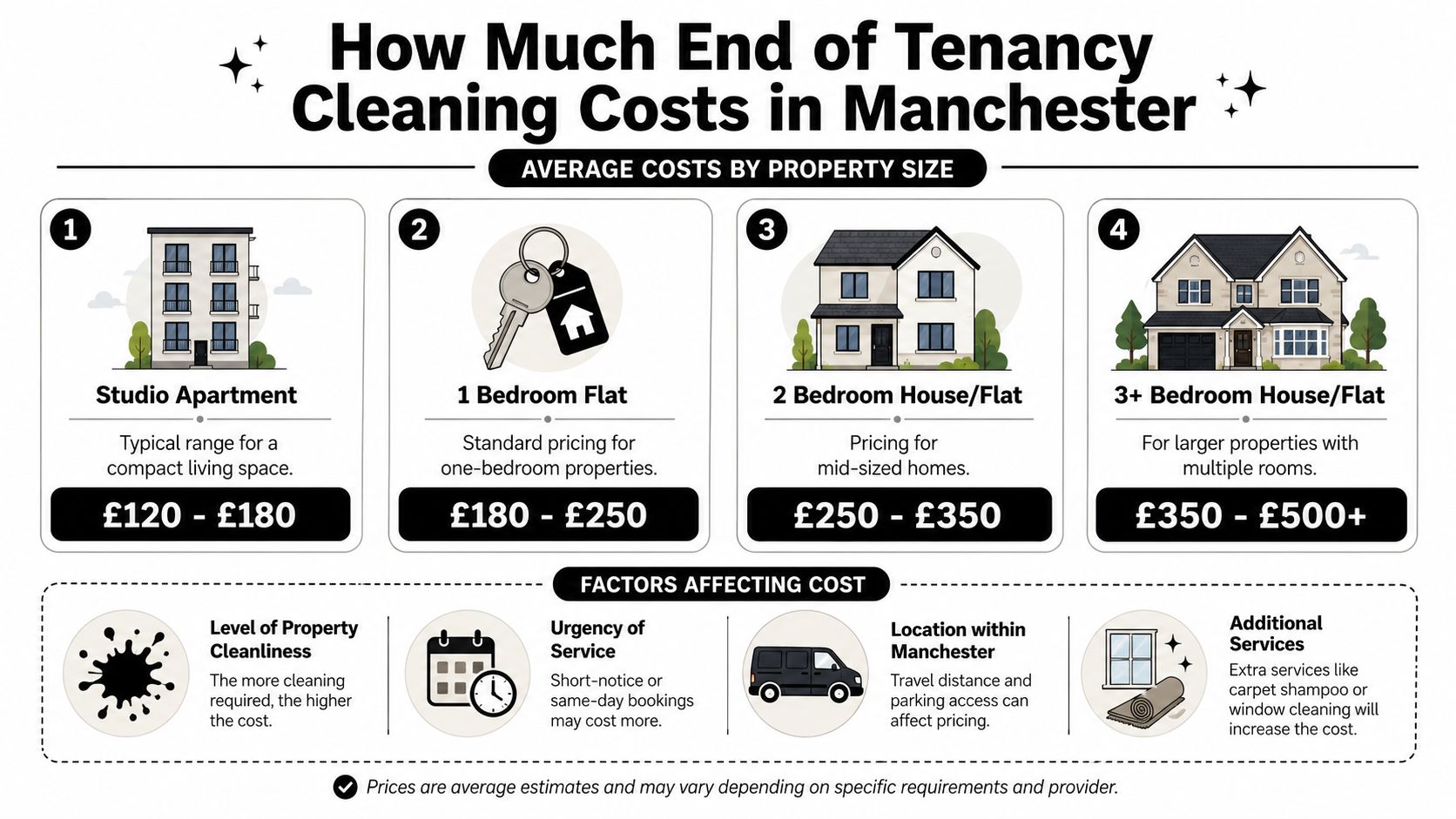
For a standard property, professional end of tenancy cleaning in Manchester typically falls between £200 and £400, with prices around 5% higher than the UK average, according to this Manchester end of tenancy cleaning cost guide.
The same source gives a useful local benchmark:
- 2-bedroom house nationally: £260
- 2-bedroom house in Manchester: £200–£240
That local comparison is a reminder that headline figures can be misleading if you don't know what is and isn't included. Some quotes cover only the main deep clean. Others also include common extras or build in more detailed appliance work.
A second local pricing reference from Greater Manchester tenancy cleaning benchmarks places the market at £150 to £400, with two-bedroom flats at £200–£250 and three-bedroom houses at £300–£400. The same source notes add-ons such as carpet cleaning at £25–£45 per room and oven cleaning at £45–£85.
What pushes a quote up or down
The biggest pricing factors are practical, not mysterious:
- Property size: more rooms mean more surfaces, more internal glass, and more floor area
- Condition on arrival: grease, limescale, pet hair, and neglected appliances all add labour
- Add-on services: carpets and ovens are common extra-cost items in the market
- Access and timing: if the property isn't empty or ready, the clean takes longer
Cost check: The cheapest quote often excludes the very tasks that trigger deposit comments.
If you're weighing DIY against hiring help, compare like with like. A tenant who spends a full day cleaning but still leaves the oven, extractor, carpet edges, and internal windows below standard hasn't really saved money. That comparison is covered well in this piece on DIY vs professional end of tenancy cleaning in Manchester.
A sensible quote should tell you what's included, what counts as an extra, and whether internal windows, ovens, carpets, or rubbish removal are part of the price.
The Atticus Cleaning Process and Guarantee
A typical Manchester handover goes wrong in small, expensive ways. The flat looks clean at a glance, then the inventory clerk opens the oven, checks the shower screen, runs a finger along the skirting, and notes grease, scale, dust, and carpet edges. That is often where deposit deductions start.


How a professional tenancy clean should run
The process needs to be tight from the first enquiry. In practice, the standard of the booking stage usually predicts the standard of the clean.
The first job is to assess the property properly. Bedroom count matters, but it never tells the full story. A well-kept two-bed in Didsbury is a different cleaning job from a heavily used two-bed in Fallowfield with grease build-up, hard-water staining, and pet hair through the stairs and landing. If that difference is missed at quote stage, it usually causes problems on the day.
The scope should then be confirmed in plain terms, including:
- Whether the property is fully empty
- Whether the oven needs to be cleaned
- Whether carpets need hot water extraction
- Whether rubbish or unwanted items need to be removed
- Whether access, keys, parking, or agent handover arrangements could affect timing
On site, the work should follow a logical order. Dry work first, then wet detailing, then floors as the final pass. That matters because re-contaminating cleaned areas is one of the common reasons a rushed tenancy clean falls short. Good equipment matters too. Sebo vacuums are reliable for dust removal and carpet edges, and hot water extraction is the correct method where carpets need more than surface vacuuming.
What to look for in the service
Landlords and agents are not paying for nice-smelling rooms. They are checking whether the property has been returned to an acceptable standard for the next tenant. A good tenancy cleaning service is built around that standard and around the practical reality of deposit protection.
Look for a provider that offers:
- Clear quoting: a defined list of what is included, rather than a vague promise of a deep clean
- Staff who know check-out inspections: especially kitchens, bathrooms, internal glass, sockets, skirtings, and appliance interiors
- The right machines for the job: proper vacuuming and carpet equipment where needed, not only sprays and cloths
- Useful add-ons: oven cleaning, carpet cleaning, and licensed rubbish removal where the property is not ready for handover
- A written re-clean policy: a clear route to fix genuine misses raised by the inventory or managing agent
Atticus Cleaning Services follows that model across Manchester and North Cheshire. The service includes internal window cleaning as standard on tenancy cleans, offers discounted carpet cleaning when booked with the main clean, and can arrange licensed rubbish removal where required. For tenants, that reduces the risk of paying several contractors separately. For landlords and agents, it means one coordinated handover standard instead of patchwork results.
The guarantee and why it matters
A guarantee only has value if it is specific and usable. In end of tenancy work, that usually means a defined re-clean promise tied to the original scope of work, not a vague assurance after the team has left.
That protection matters because deposit disputes often turn on evidence and timing. If an agent flags missed cleaning shortly after check-out, a fair re-clean process gives the issue a practical route to resolution before it turns into a deduction argument. It also shows that the service is structured around check-out standards rather than a one-visit domestic clean.
A tenancy clean should be managed as part of the deposit return process, because that is how landlords, agents, and inventory clerks judge the result.
How to Prepare for Your Tenancy Clean
Even a strong cleaning team can only work efficiently if the property is ready. Most delays and missed details start before the first vacuum comes out.

What to do before the cleaners arrive
The property should be empty. Not mostly empty. Empty. Bags, food, laundry, bedding, coat hangers, bathroom items, and balcony bits all slow the job down and stop surfaces being cleaned properly.
A few essentials make a big difference:
- Remove all personal belongings: cleaners need full access to cupboards, wardrobes, and floors
- Defrost the fridge and freezer if needed: especially if power is being disconnected
- Leave electricity and hot water on: without them, parts of the clean can't be completed properly
- Make keys and access clear: avoid a late start caused by callouts and lock confusion
What helps the clean go smoothly
Timing matters. Try to schedule the clean after removals and before the final inventory. If tradespeople are still patching walls or carrying items through the property, the finish won't hold.
It also helps to leave any check-in inventory, agent notes, or problem areas in writing. If the oven was heavily used, the shower screen has stubborn scale, or a room needs extra attention, say so at the start.
The better the brief, the cleaner the result.
Frequently Asked Questions
Do landlords have to accept a DIY clean
Yes, they have to judge the condition, not whether you hired a company. Under the Tenant Fees Act 2019 guidance explained here, landlords in England can't legally require tenants to hire professional cleaners, but tenants still have to return the property in the same condition as the move-in inventory, excluding fair wear and tear.
That's the key point. A DIY clean is acceptable if it matches the recorded starting condition. If it doesn't, the issue is the result, not who did the work.
What evidence matters in a cleaning dispute
The most important evidence is comparative evidence. The starting inventory, dated photos, and a detailed check-out report carry much more weight than general opinions about whether the property looked clean.
Another useful explanation of this point appears in this guide to deposit protection mechanics beyond the Tenant Fees Act, which notes that landlords still need photographic evidence and itemised costs for legitimate claims, and that deposits have had to be protected in government-approved schemes since April 2007.
If you're a tenant, take your own photos before cleaning, after cleaning, and on handover day. If you're a landlord or agent, keep your reporting consistent and specific.
Is professional cleaning still worth it if it is not legally required
Often, yes. Legal compulsion and practical risk are different things.
Professional cleaning is worth considering when:
- The property is larger or has multiple bathrooms
- The oven, carpets, or shower areas need deeper work
- You're short on time before check-out
- The inventory at move-in was detailed and the standard was high
For landlords, a proper end of tenancy clean also shortens the gap between occupancies because the property is ready for viewings, maintenance follow-up, or re-letting sooner.
What standard should landlords actually expect
Landlords should expect the property to be returned to a condition that matches the move-in record, not a better-than-new finish. The legal framework doesn't allow claims for natural deterioration or betterment.
That matters in real life. A worn carpet isn't a cleaning issue if the wear is ordinary use. A greasy carpet edge in the kitchen probably is.
When should the clean be booked
Book the clean for after the property is emptied and before the inventory or key return, with enough time to deal with any follow-up. Last-minute bookings aren't impossible, but they leave less room if anything else on the move slips.
What do tenants most often overlook
Kitchens first, then internal windows, then the small detail work. Drawer runners, cupboard tops, extractor covers, skirting boards, plug sockets, and radiator tops are the recurring misses.
Those areas don't take the longest to clean. They're just easy to forget.
If you need a practical quote for your move-out, Atticus Cleaning Services handles end of tenancy cleaning across Manchester, Altrincham, Hale, Sale, and North Cheshire, with carpet cleaning, upholstery care, and licensed rubbish removal available where needed. If you already know your property size, condition, and move date, that's usually enough to get pricing started quickly.