

Treating a house clearance sale as a race to empty the property is incomplete advice. Removing everything quickly can destroy resale value, create avoidable waste liability, and leave a property dirty or poorly documented when an agent, buyer, tenant, or executor needs it ready.
The practical question is different: what should be sold, what should be reused, what must be recycled or controlled, and what needs licensed disposal? That decision matters in Greater Manchester, where a clearance may involve a sale, probate administration, tenancy turnover, refurbishment, or a vacant-property handover. The housing cycle creates recurring demand for this work. HM Land Registry records residential transactions in England and Wales back to January 1995, and a current mirror reports around 30.9 million recorded sales, with about 884,000 UK homes changing hands in the most recent fully reported year from February 2024 to February 2025. Those figures are reported in the HM Land Registry property sales data mirror.
In 2026, the job also sits within a changing waste framework. Separation requirements have key provisions coming into force on 31 March 2026, followed by the Digital Waste Tracking regime on 1 October 2026, as set out in the relevant waste legislation. A successful clearance therefore leaves more than an empty building. It leaves a property that is cleaner, easier to market, and supported by a defensible record of what happened to its contents.
Table of Contents
- Why a House Clearance Sale Is More Than Just Emptying a Property
- Sorting and Inventorying Contents Before the Sale
- Valuing Items and Setting Realistic Prices
- Marketing the Sale to Reach Serious Buyers
- Legal Waste Disposal and Compliance Requirements
- When to Handle Clearance Yourself Versus Hiring Professionals
- Post-Sale Cleanup and Property Handover
Why a House Clearance Sale Is More Than Just Emptying a Property
The most popular advice is also the costliest shortcut: take everything out, load the van, and worry about value or disposal later. That approach works only when the contents have no meaningful resale value, no sensitive documents, no controlled materials, and no deadline beyond “empty”. Real properties rarely fit that description.
A house clearance sale is better understood as property preparation with an asset-recovery stage. The contents affect how rooms photograph, how easily prospective buyers understand the layout, and how quickly a landlord can present the property for letting. A crowded lounge may need selective removal rather than total emptying. A probate property may need an inventory and agreed decisions before anyone touches the contents. A vacant property may require rapid removal, but speed still doesn't justify sending reusable furniture or electrical equipment into a residual waste stream.
The market context supports that wider view. GOV.UK transaction statistics report 297,640 seasonally adjusted UK residential transactions in April to June 2026, compared with 276,210 in the same period of 2024 to 2025, according to the official residential property transactions statistics. More moves create more occasions where properties must be emptied, cleaned, repaired, photographed, and handed over in a presentable condition.
The cheapest quote can become the expensive option
A low clearance price may exclude sorting, resale handling, specialist disposal, cleaning, or documentation. If those tasks emerge later, the property owner pays through extra collections, delayed marketing, or a failed handover.
Practical rule: Price the whole property-readiness job, not just the number of van loads.
The 2026 rules make this more important. In England, clearance waste from vacated premises isn't treated in the same way as ordinary household waste. You need a clear route for reusable goods, recyclable materials, electrical items, hazardous materials, bulky contents, and residual waste. Guidance on the householder and carrier duty of care also matters where a property contains a large volume of mixed or difficult contents.
A well-managed clearance gives the next professional, whether that's an estate agent, cleaner, surveyor, landlord, or executor, a property they can work with. Emptying is only one milestone. Market readiness is the result.
Sorting and Inventorying Contents Before the Sale
Don't advertise a sale before you know what you're selling. A quick inventory prevents two common failures: valuable or sensitive items disappearing into the disposal pile, and low-demand goods taking up time that should be spent preparing the property.
Start at the entrance and work room by room. Photograph shelves, cupboards, loft areas, garages, sheds, and outbuildings before moving contents. Use a spreadsheet or notes app with a simple reference such as “kitchen cupboard three” or “rear bedroom wardrobe”. Record the item, condition, quantity, likely route, and any decision that needs approval from an executor or property owner.
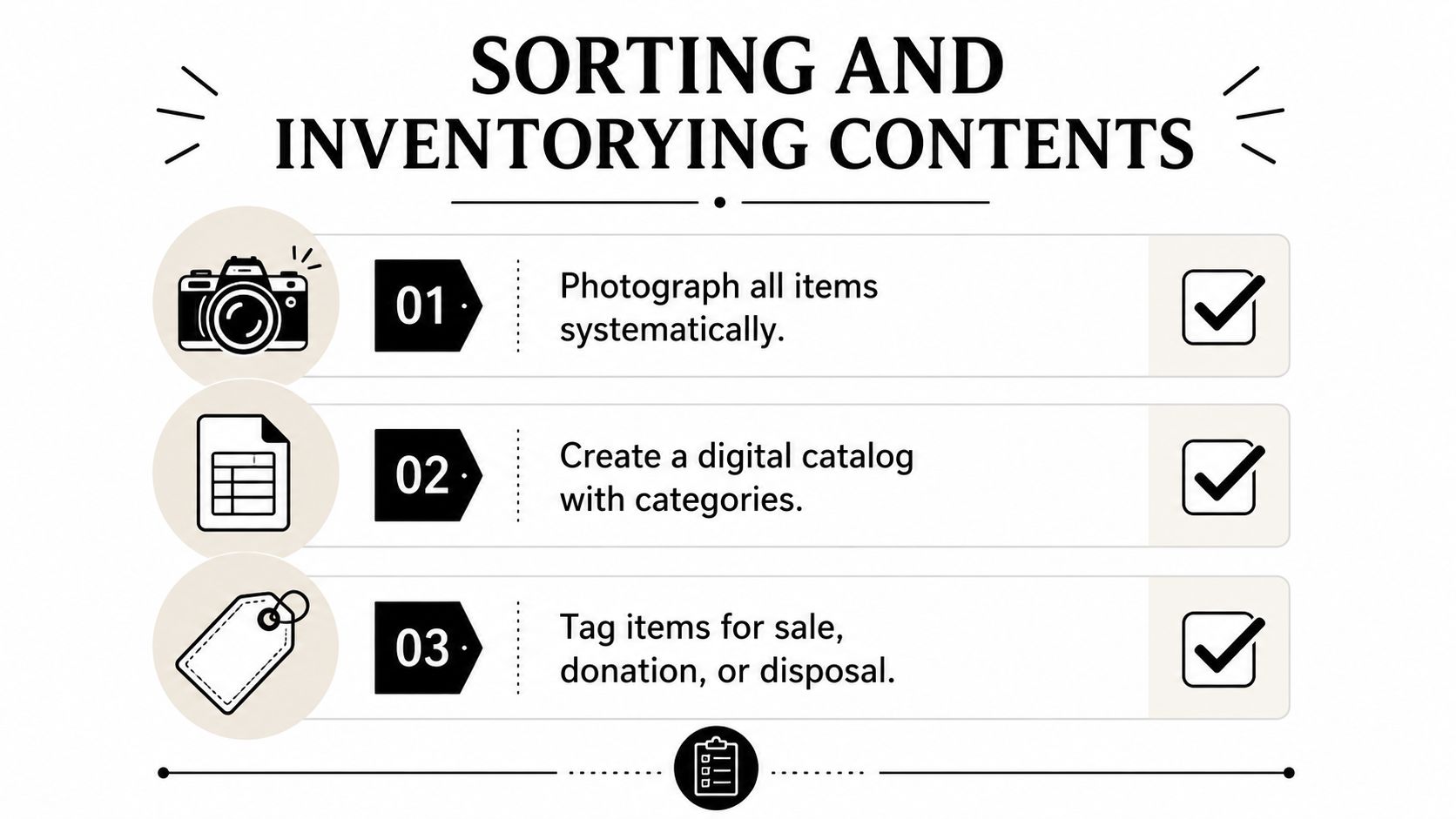

Use four practical streams
A useful first pass separates contents into these routes:
- Sell: Individual furniture, branded appliances, working electronics, tools, quality cookware, collectibles, and unusual decorative pieces deserve closer inspection. Photograph labels, maker's marks, model numbers, and faults.
- Reuse or donate: Sound everyday furniture, books, clothing, kitchenware, and children's items may have a better outcome through donation or local reuse than through a slow sale.
- Recycle: Cardboard, clean metals, timber, glass, paper, and suitable plastics should be kept away from mixed residual waste where a proper recycling route exists.
- Controlled disposal: Paint, chemicals, gas cylinders, batteries, fluorescent tubes, medical sharps, asbestos-containing materials, and damaged electrical equipment require advice or a specialist route. Don't place them in an ordinary van load without checking the disposal requirements.
Separate value from sentiment
Original purchase price isn't a valuation. A dated three-piece suite may have sentimental importance but little buyer demand, while a modest-looking tool chest, vintage lamp, or boxed collectible may deserve a specialist opinion. Hold back jewellery, watches, silverware, artwork, important papers, keys, passports, and personal photographs until the authorised decision-maker confirms what should happen.
For an estate, use a second sign-off process. Beneficiaries should identify keepsakes before the sale or clearance team arrives. For a landlord or agent, photograph notable damage and meter readings separately from the inventory. That record protects the owner and gives the removal team a clear brief.
The final inventory should show what left, where it went, and what remains. That makes pricing more disciplined and disposal documentation far easier.
Valuing Items and Setting Realistic Prices
The wrong question is, “What did this cost new?” The useful question is, “What can this item realistically return after handling, transport, platform fees, storage, and the cost of dealing with it if it doesn't sell?”
Auction benchmarks provide a sensible planning reference. One UK auction performance source reported a 74% sale success rate across 2,500 lots in 2024, with individual events commonly landing between 70% and 80% sold, as reported by the UK Auction House Performance Index. That means even a strong sale plan must allow for unsold inventory. Price for conversion, not optimism.

Match the channel to the item
A clean, working Dyson vacuum, a recognisable furniture brand, or a current games console may suit a local marketplace listing. A box of mixed kitchenware probably won't justify individual photography, messaging, and collection arrangements. Grouping similar low-demand pieces into a single lot reduces handling and gives buyers a clearer proposition.
Bulky furniture needs particular care. A matching dining table and chairs may attract more interest as a set than as separate listings, but a heavy wardrobe with difficult access can become a disposal liability if the asking price ignores collection effort. Include dimensions, access information, condition, and whether the buyer must dismantle or collect.
Build a net-recovery view
Use a simple worksheet with five columns:
- Expected sale price.
- Selling or auction costs.
- Handling and transport.
- Time allowed before markdown.
- Fallback route if unsold.
That final column changes decisions. An item with a possible high price may still be poor value if it needs storage, repeated viewings, or specialist transport. Conversely, a modest bundle can be worthwhile if it leaves the property quickly and avoids another removal trip.
Price against recent realised results, not asking prices. State whether the price is firm, negotiable, or subject to collection. Avoid sentimental descriptions such as “worth a fortune” unless a qualified valuer supports the statement.
Unsold stock is not neutral. It still occupies space, consumes attention, and eventually needs a lawful route out of the property.
For antiques, jewellery, art, silver, rare books, or specialist collections, obtain an independent valuation before disposal. For ordinary contents, conservative pricing and a defined sale window usually produce a better result than holding the entire clearance hostage to one ambitious listing.
Marketing the Sale to Reach Serious Buyers
A clearance sale needs a channel plan, not just a post saying “everything must go”. Buyers decide whether to enquire from the photographs, the description, the price, and the collection terms. If any of those are vague, serious buyers move on.
Start with the items most likely to attract attention. List recognisable furniture, tools, appliances, electronics, collectibles, and garden equipment separately. Put mixed household goods, books, kitchenware, or low-value decorative items into sensible bundles. Local marketplaces work well for collection-led sales, while auction houses or specialist platforms are more appropriate for items whose value depends on provenance, condition, or a specialist audience.
Write listings that answer collection questions
A useful listing includes:
- Item identity: Brand, model, material, approximate age where known, and dimensions.
- Condition: State working faults, stains, chips, missing parts, and signs of wear.
- Collection: Give the area, access restrictions, loading details, and acceptable collection times.
- Price structure: Say whether the price is firm, negotiable, or for the complete lot.
- Evidence: Add clear photographs in daylight, including labels and defects.
Don't use one dark photograph for an entire room. Don't hide damage until collection. Honest descriptions reduce wasted appointments and make buyers more confident that the seller understands the contents.
Create urgency without undermining value
Set a collection window and publish a closing date. If a buyer fails to collect, move to the next enquiry rather than allowing one uncertain arrangement to delay the property. For a room-based sale, numbered lots or labelled furniture make handover quicker and reduce disputes.
Social media groups and community noticeboards can reach local buyers who can collect bulky items. Auction houses can handle cataloguing and payment, but the net return depends on their terms and the likelihood of a lot selling. Use specialist routes selectively. A modest item rarely benefits from a complex sales process, while an unusual collection may be lost on a general marketplace.
The marketing objective is a clean, controlled exit for saleable contents. Once an item has consumed more time than its likely return, move it to reuse, donation, recycling, or licensed disposal.
Legal Waste Disposal and Compliance Requirements
Waste compliance belongs in the clearance brief from the start, not as paperwork handled after the property is empty. In England, the householder should check that a private waste collector appears on the Environment Agency register. Anyone transferring waste must take reasonable care to confirm that the carrier is authorised. The official Waste Duty of Care Code of Practice explains these responsibilities.
The practical risk is straightforward. If an unlicensed operator removes a load and later fly-tips it, the original householder, landlord, agent, or business may still face enforcement consequences. Handing waste to another party does not automatically end the duty of care.
Apply a documented chain of custody
Before collection, request the operator's business details, waste-carrier registration, insurance information, and a written description of what the quotation covers. Clarify whether disposal charges, labour, loading, and separate handling are included. On collection, keep a waste transfer note or equivalent record identifying the waste, its quantity or description, the carrier, destination, and collection date.
For controlled waste, ask what additional documentation or specialist contractor is required. This matters when a clearance includes paint, chemicals, asbestos-containing materials, or other items that cannot enter ordinary mixed waste.
The 2026 changes place greater emphasis on segregation. Separate reusable goods, recyclable materials, mixed waste, WEEE, and hazardous items before loading wherever practicable. The separation provisions are scheduled to take effect from 31 March 2026, while the Digital Waste Tracking regime is scheduled to follow on 1 October 2026, according to the legislation establishing the requirements.
Treat a suspiciously cheap quote as a warning
A quotation that excludes disposal charges can become expensive once mattresses, electrical equipment, paint, or mixed waste require separate handling. An operator who will not provide registration details or a transfer note is passing the compliance risk to you.
Compliance check: Never choose a clearance operator solely because the van can arrive fastest or the quote is lowest.
Photograph the contents before clearance, the separated waste streams, collection paperwork, invoices, and final disposal information. Record what was removed and where it was sent. Retention requirements depend on the waste type and applicable rules, so ask the carrier which records you must keep.
A clear audit trail protects the owner and gives agents, executors, and property managers evidence that the property was cleared responsibly. It also supports a clean handover, particularly where the building must be made ready for sale, letting, probate, or renovation.
When to Handle Clearance Yourself Versus Hiring Professionals
DIY clearance makes sense when the contents are limited, ordinary, and easy to move, and the owner has a flexible timetable. You can sort a small flat with non-specialist items, sell selected goods locally, donate usable contents, and take appropriate materials to authorised recycling or household waste facilities. The work is manageable when one person can make decisions and the property doesn't contain heavy, hazardous, or emotionally complicated items.
Professional help becomes more defensible when the property is large, the contents are mixed, or the deadline is fixed. Probate clearances need careful coordination. Hoarded properties may contain contamination, blocked access, concealed valuables, or unsafe materials. A landlord preparing for a new tenancy may lose more through delay than through the clearance fee itself.

Compare the work, not just the headline price
| DIY clearance | Professional clearance |
|---|---|
| Suits small volumes and straightforward contents | Suits large estates, hazardous materials, or tight deadlines |
| Requires your own vehicle, labour, sorting, and disposal planning | Can coordinate labour, vehicles, segregation, and disposal routes |
| Gives you direct control over every sale decision | Reduces physical effort and can shorten the route to a market-ready property |
| May appear cheaper before time and repeat trips are counted | Quote should include scope, labour, disposal, and documentation |
Ask professional operators whether they sort for reuse, identify items requiring specialist handling, provide disposal records, and include cleaning. Check access, stairs, parking, outbuildings, lofts, and garden contents before accepting a quote. A written scope is more useful than a vague promise to “take everything”.
In Greater Manchester, Atticus Cleaning Services offers house clearance and sorting, disposal of unwanted items, and cleaning after clearance. It's one option to compare with local auctioneers, waste specialists, and independent clearance firms. The practical value lies in matching the provider to the property, as outlined in this guide to whether professional house clearance is worth the cost.
Don't hire a clearance team to make unresolved decisions for you. Agree what is excluded, identify valuables, settle beneficiary instructions, and confirm the handover standard first. Professionals can remove and process contents efficiently, but ownership decisions remain with the owner, executor, or authorised agent.
Post-Sale Cleanup and Property Handover
The property isn't ready because the last chair has left. Floors may be marked, cupboards may contain debris, walls may show furniture rubs, and kitchens and bathrooms may need detailed cleaning before photography or inspection. In end-of-tenancy work, a basic sweep often falls short of the condition expected by landlords and letting agents.
The final stage should connect cleaning, condition reporting, and documentation. Start with a room-by-room walkthrough while the property is empty. Photograph floors, walls, ceilings, windows, kitchen appliances, sanitaryware, meters, garden areas, and any defects that existed before or appeared during clearance.
Use a final handover checklist
- Remove clearance residue: Sweep and vacuum floors, clear cupboards, remove fixings or packaging, and check lofts, sheds, garages, and bins.
- Clean critical rooms: Degrease kitchen surfaces, clean bathrooms, wipe doors and skirting boards, and address odours before viewings.
- Check presentation: Arrange internal window cleaning, carpet care, and upholstery treatment where the condition warrants it. These details can influence how the property appears in photographs and during inspections.
- Record condition: Complete a final report with dated photographs, meter readings, keys, remotes, alarm information, and known defects.
- Prepare documents: Keep sale or donation records, waste transfer notes, invoices, access arrangements, and any specialist disposal paperwork together.
For Manchester and North Cheshire properties, coordinate the clearance and cleaning dates rather than booking them as unrelated jobs. Cleaning too early means dust and debris return during removal. Cleaning too late can delay photography, viewings, a tenancy start, or a solicitor's request for vacant possession.
A deep-clean provider can also identify issues that a removal crew won't address, such as ingrained carpet soil, internal glass marks, residue inside ovens, or neglected high-level surfaces. Atticus Cleaning Services describes its deep-cleaning work in Manchester as part of a wider property restoration approach.
The handover is complete when the property is empty, clean, inspected, documented, and accessible to the next authorised person. That standard turns a clearance sale from a removal exercise into a controlled property transition.
If you're preparing a house clearance sale in Manchester or North Cheshire, ask Atticus Cleaning Services about coordinated clearance, responsible waste handling, and post-clearance cleaning. Request a written quote that covers sorting, removal, documentation, and the final condition needed for sale, letting, probate, or handover.