

You're probably doing this under pressure. The office has complaints about kitchens, washrooms, and dusty meeting rooms. Senior management wants the problem fixed without blowing the budget. Every cleaner you speak to says they're reliable, flexible, and thorough, but the quotes don't line up and half of them are vague.
That's normal in Manchester. What matters is how you buy the service.
If you're procuring your first cleaning contract, don't start by asking who's cheapest. Start by deciding what clean means in your building, how you'll verify it, and what evidence you expect when standards slip. That's the difference between hiring a cleaner and putting a managed service in place.
Table of Contents
- Why a Professional Clean Is Non-Negotiable for Manchester Offices
- Defining Your Office Cleaning Needs Before You Search
- The Mandatory Vetting Process for Any Cleaning Company
- Evaluating Quotes and Understanding Manchester Pricing
- Questions to Ask and How to Ensure Consistent Quality
- Partnering with Atticus Cleaning for Your Manchester Office
Why a Professional Clean Is Non-Negotiable for Manchester Offices
A poor clean shows up fast. Overflowing bins, tea stains in the kitchen, washrooms that smell wrong by mid-morning, fingerprints on the entrance glass. Staff notice it. Visitors notice it. Your directors notice it the moment they walk a client through reception.
Manchester offices don't get much leeway on presentation. If you're competing for staff, hosting clients, or managing shared space with hybrid teams coming and going, a dirty office feels unmanaged. It creates friction you don't need. Dirty offices also affect employee wellbeing and business reputation in obvious day-to-day ways.
This isn't a niche service either. The UK cleaning industry directly employs over one million people, with commercial cleaning as the largest component, and the workforce grew by 0.8% in 2025 while the number of businesses fell slightly, which points to a consolidating market where dependable established operators matter more for consistency and cover arrangements (UK cleaning industry workforce statistics).
What a professional service changes
A proper office cleaning contract does more than empty bins. It gives you:
- Consistency: The same standards applied across kitchens, desks, washrooms, entrances, and meeting rooms.
- Accountability: Named contacts, documented tasks, and a clear route for fixing issues.
- Lower management drag: You stop chasing missed jobs and start checking outcomes.
- Better site confidence: Staff can walk into the office and assume basics are under control.
Practical rule: If cleaning creates more complaints than confidence, you don't have a low-cost contract. You have an unmanaged risk.
The real mistake new office managers make
They treat cleaning like stationery. It isn't. You can't judge it properly from a one-line hourly rate or a tidy sales email.
You're buying access control, keyholding discipline, washroom hygiene, chemical handling, waste removal practices, and the professionalism of people working in your building when your team isn't there. If the supplier gets those basics wrong, the mess is only the visible part of the problem.
Defining Your Office Cleaning Needs Before You Search
Most bad cleaning contracts start before the first quote comes in. The office manager asks for “a daily clean”, three companies price three different things, and everyone pretends the scope is clear. It isn't.

Start with the building, not the quote form
Walk the site properly. Don't do this from memory.
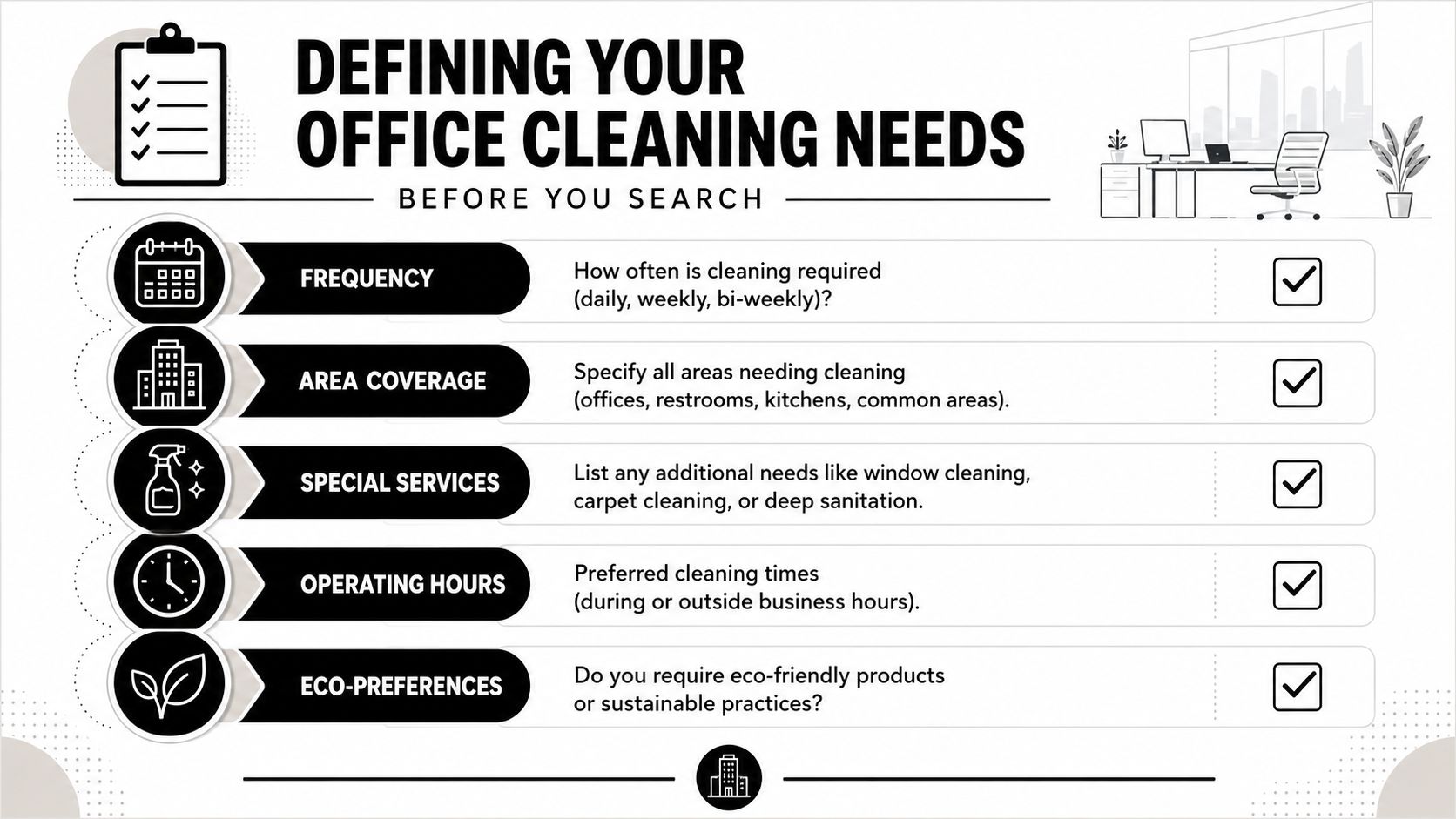
List every area that needs cleaning and note how each space is used. A boardroom used twice a month isn't the same as a meeting suite used all day. A staff kitchen on a busy floor will need far more attention than a small breakout point used by a handful of people. If you're not sure whether you need daily or less frequent support, this guide on daily vs weekly office cleaning for your business is a useful practical reference.
Use a simple room-by-room audit:
- Front of house: Reception desks, entrance mats, glass, handles, waiting areas.
- Core workspace: Desks, hard floors, carpets, bins, touchpoints, skirting, internal partitions.
- Welfare areas: Kitchens, tea points, sinks, appliances, tables, cupboard fronts.
- Washrooms: Toilets, basins, mirrors, dispensers, floors, odour control points.
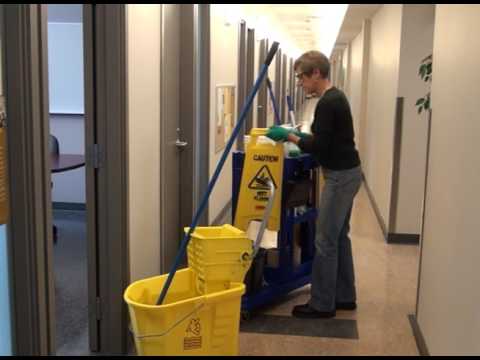
A short visual explainer can help if you're building your first brief for internal approval:
Split routine work from periodic work
Many office managers under-specify the job.
Routine work covers the obvious recurring tasks. Periodic work covers the jobs that keep the office from slowly deteriorating. If you fail to separate them, the quote looks cheaper but standards slide within weeks.
Examples usually include:
- Routine tasks: Bin emptying, vacuuming, mopping, washroom cleaning, kitchen wipe-downs, replenishment checks.
- Periodic tasks: Carpet cleaning, upholstery cleaning, internal glass, deep kitchen attention, high dusting, detailed washroom descaling.
- Specialist tasks: Hot water extraction for carpets, upholstery care, hard floor treatment, sensitive cleans after maintenance works.
Cleaners don't “miss” periodic tasks when they were never written into the contract. They simply weren't priced.
Write a usable cleaning specification
Your spec should be blunt and readable. One page is better than five pages of fluff.
Include these points:
- Premises details: Location, access arrangements, floor count, lift access, alarms, parking limits.
- Cleaning schedule: Which areas are cleaned daily, weekly, or on another cycle.
- Timing: In-hours or out-of-hours. If in-hours, note spaces where noise matters.
- Consumables: State whether you expect supply management or cleaning only.
- Standards: Define what “done” looks like in kitchens, washrooms, desks, and floors.
- Reporting: Require issue logging for damage, leaks, low stock, and hygiene concerns.
If you do this first, quotes become comparable. If you skip it, you'll spend weeks arguing about tasks you assumed were included.
The Mandatory Vetting Process for Any Cleaning Company
If a cleaning company can't produce the right paperwork quickly, stop there. You're not being difficult. You're filtering out operators who create avoidable risk.
Documents you should ask for immediately
Ask for these before you compare personalities, promises, or presentation decks.
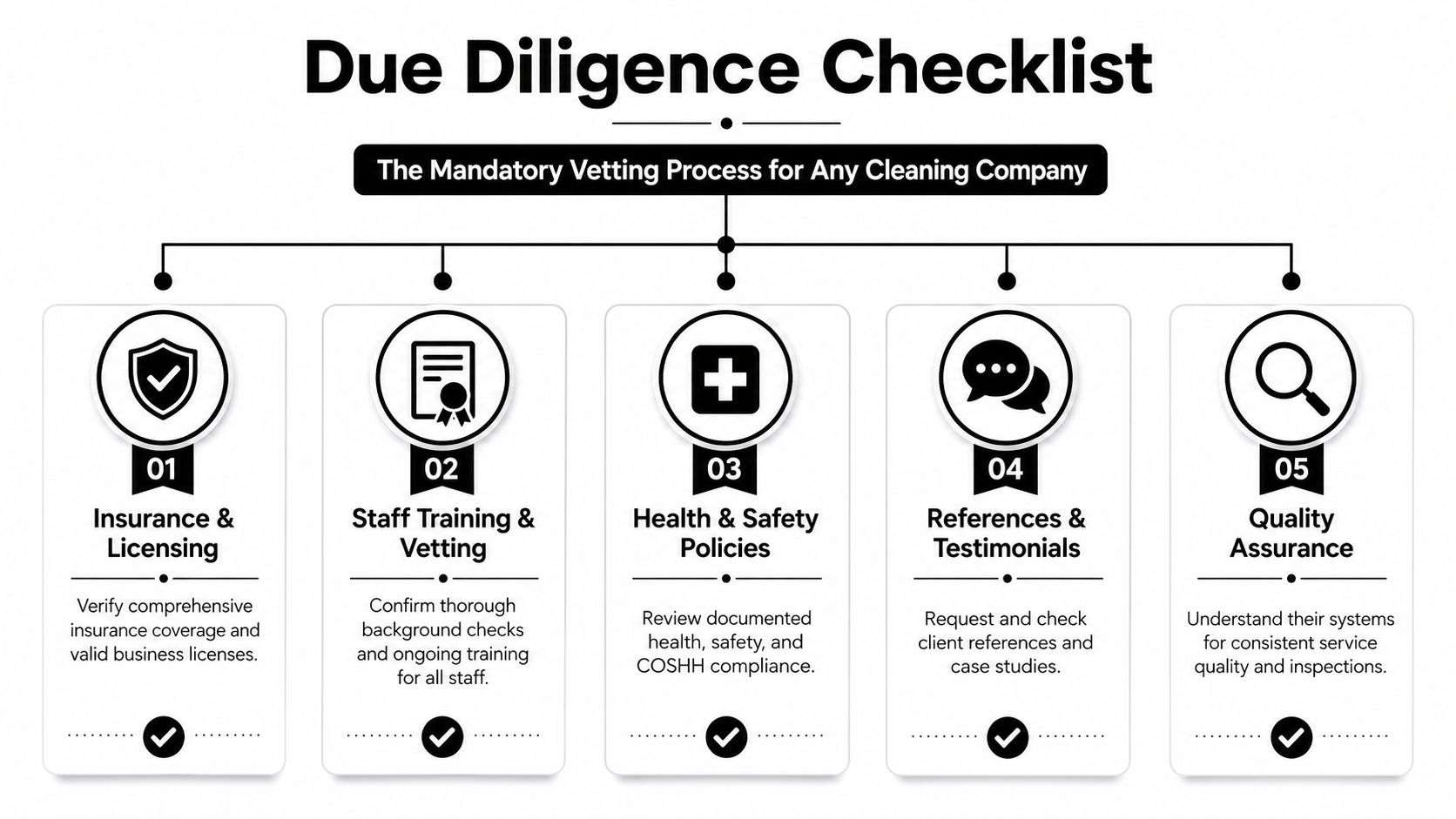
- Insurance evidence: You want current Public Liability and Employer's Liability documents. Check the dates. Check the business name matches the entity you're contracting with.
- Health and safety paperwork: Ask how they manage COSHH, site risk assessments, accident reporting, and lone working if they clean out of hours.
- Staff vetting and training process: Ask how cleaners are inducted, supervised, and refreshed on standards. If they work in secure offices, ask about DBS policy where relevant.
- Waste handling position: If they remove rubbish as part of the service, ask whether they hold the appropriate waste carrier permissions for lawful disposal.
- Supervision model: Find out who inspects the work, how often they visit, and how issues are recorded.
A serious contractor won't act surprised by any of this.
Why hygiene transparency now matters more than promises
Post-pandemic, office managers are rightly less interested in slogans and more interested in proof. In Manchester, 73% of office managers now demand verified cleaning logs and hygiene audits, yet only a small share of local providers actively advertise those transparency measures, which gives you a clear way to separate organised companies from basic labour-only suppliers (Manchester office cleaner listings and transparency gap).
That matters because “cleaned” and “verified clean” aren't the same thing.
Ask to see:
- Cleaning logs signed by staff or supervisors
- Inspection records with dates and actions raised
- Escalation records showing how complaints are closed out
- Verification methods for high-touch areas, washrooms, and shared kitchens
- Handover reporting after deep cleans or periodic specialist work
If a supplier says quality is checked but can't show you the record, assume the checking is informal and inconsistent.
How to test whether a company is organised
Don't rely on references alone. Anyone can produce a friendly testimonial.
Instead, test their operational discipline during procurement:
| Check | What to ask | What good looks like |
|---|---|---|
| Site survey | Did they inspect properly? | They asked detailed questions about layout, use patterns, and access |
| Scope confirmation | Did they restate your requirements clearly? | You receive a written scope, not a vague promise |
| Communication | How quickly and clearly do they respond? | Direct answers, tidy documentation, no chasing |
| Problem handling | What happens if standards drop? | Defined escalation and inspection process |
| Continuity | What if the cleaner is absent? | Named cover process, not “we'll sort something” |
A chaotic tender process usually leads to a chaotic contract.
One practical example. A supplier who asks about alarm codes, keyholding, washroom replenishment responsibility, and site restrictions is thinking like an operator. A supplier who only asks square footage is probably selling on price.
Evaluating Quotes and Understanding Manchester Pricing
Inexperienced buyers often get trapped. A low total price looks efficient until you realise the quote excludes periodic work, supervision, consumables management, or any meaningful quality control.
What a fair Manchester quote looks like
For Manchester offices, the average hourly rate for professional office cleaners is approximately £18.50, slightly above the UK average, with typical local rates ranging from £16 to £20 per hour depending on the space and service requirements (Manchester commercial cleaning price guide).
That benchmark matters because it tells you when a quote deserves scrutiny.
If one bidder comes in well below that range, don't congratulate yourself yet. Ask what's been cut. Fewer hours? Less supervision? No periodic cleans? Cheaper labour with weak cover arrangements? Low bids usually hide one of those.
How serious cleaners build labour time
Professional pricing isn't guesswork. In commercial cleaning, production rates are the core method for estimating labour time and cost. Task-specific benchmarks such as 10 minutes per 200 sq. ft. for restrooms and 1 minute per 300 sq. ft. for standard office space are used to build realistic schedules, and periodic tasks like carpet extraction or burnishing must be included in workloading or the contract becomes underpriced and unstable (commercial cleaning production rates for bidding and estimating).
You don't need to do the maths yourself. You do need to ask whether the bidder has.
Ask questions like:
- How did you calculate hours for washrooms versus open-plan areas?
- What periodic tasks are priced separately and what's included in the base contract?
- Who covers absences and inspections?
- Is the quote based on a site survey or a rough estimate?
If they can't explain the build-up, the quote is weak.
Sample Quote Comparison
| Feature | Company A (Low Bid) | Company B (Mid-Range) | Company C (Premium) |
|---|---|---|---|
| Scope clarity | Vague wording | Clear routine scope | Clear routine and periodic scope |
| Site survey | Brief | Detailed | Detailed with written notes |
| Hygiene verification | Not specified | Basic checklists | Verified logs and inspection records |
| Cover for absence | Unclear | Stated | Stated with supervisor support |
| Contract detail | Minimal | Reasonable | Strong service level language |
| Overall risk | High | Manageable | Lower, if the service matches the paperwork |
Read the contract like a facilities manager
The price line isn't the contract. The clauses are.
Check these points before you sign:
- Notice period: Don't get trapped in a long notice term for a poor service.
- Service failures: Look for a rectification process, not just a complaint inbox.
- Extra works: Confirm how specialist jobs are approved and charged.
- Damage and breakages: Make sure reporting responsibilities are explicit.
- Consumables and exclusions: If it isn't written down, assume it isn't included.
A clean-looking proposal can still be a bad contract. Read what happens when things go wrong, not just when everything goes smoothly.
Questions to Ask and How to Ensure Consistent Quality
Most sales meetings for professional office cleaners in Manchester are too polite. The supplier talks about standards. The buyer nods. Nobody asks the uncomfortable operational questions that reveal whether the service will hold up on a wet Tuesday in February when the regular cleaner calls in sick.
Ask operational questions, not sales questions
You want answers that expose process, not polished language.
Try these:
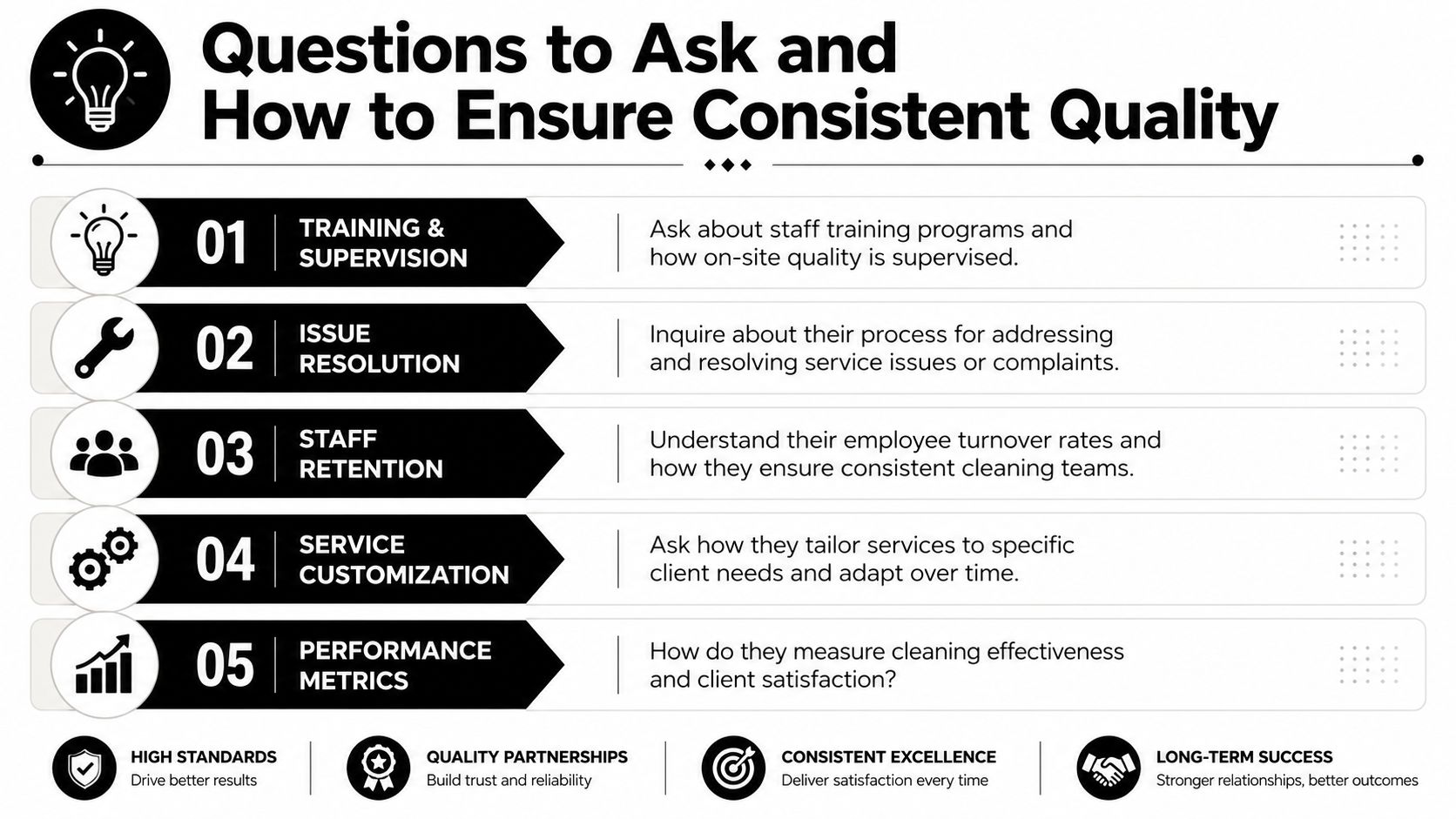
- Who checks the work and how is it recorded? If inspection is ad hoc, standards will drift.
- What training do new starters receive before working alone on site? You're looking for a real induction, not “they're experienced”.
- How do you handle cleaner absence? Good firms explain cover arrangements without hesitation.
- Who is my day-to-day contact? You need one accountable person, not a general office number.
- How do you respond when a client raises an issue? Ask for the exact steps.
The strongest answers are usually specific and slightly boring. That's good. Boring process keeps buildings running.
The answers that should make you pause
High staff turnover is one of the biggest warning signs in cleaning. It's strongly linked to inconsistent quality and client dissatisfaction, while firms that retain clients tend to reduce turnover by investing in competitive pay and ongoing training, which supports productivity and trust (cleaning service success metrics and staff retention).
So ask directly about retention and continuity. You don't need a rehearsed statistic. You need to know whether the team on your site will keep changing.
Watch for these red flags:
- “We can start tomorrow” without a proper handover: That usually means desperation or weak planning.
- No named supervisor: Problems will bounce around.
- No training detail: Standards rely on guesswork.
- Defensive answers about complaints: They probably have plenty.
- No interest in your building's problem areas: They're selling a generic package.
“How do you keep the same team on site?” is a better question than “Can you deliver a high standard?”
Set quality controls before day one
Don't wait for the first complaint to decide how the contract will be managed.
Agree these points up front:
- A written scope by area so nobody argues about whether a task was included.
- Inspection frequency with a simple record of what was checked.
- A snagging process for issues that need correction.
- A review rhythm between you and the account lead.
- A clear escalation route if quality falls off.
One option in the Manchester market is Atticus Cleaning Services, which provides bespoke office cleaning, trained staff, flexible scheduling, and specialist support such as carpet and upholstery care for commercial clients in Manchester and North Cheshire. The important point isn't the brand name. It's whether the supplier can show the same operational basics you've now been told to demand.
If you put those controls in place at the start, you won't spend the contract guessing whether standards are slipping. You'll know.
Partnering with Atticus Cleaning for Your Manchester Office
If you want a supplier that fits the procurement standards above, judge them on the same criteria you'd apply to anyone else. Ask for the scope. Review the documentation. Test the communication. Check how they verify work, manage cover, and handle specialist tasks.

For Manchester offices, office cleaning with the Atticus difference outlines a service built around bespoke cleaning plans, trained operatives, flexible scheduling, and a satisfaction-led approach. The wider business also handles carpet and upholstery care, rubbish removal in line with regulations, and other specialist cleaning work that often sits outside a basic office contract.
That matters if you're trying to reduce supplier sprawl. It's easier to manage one organised partner than a chain of separate contractors for routine cleaning, periodic carpet work, and occasional specialist jobs.
The buying process should also be simple. Request a quote. Arrange a site assessment. Review a clear price against a written scope. If the proposal matches your building's actual needs and the compliance checks are in order, then move forward.
There's also a straightforward commercial reason to enquire now. New contract clients can access up to 50% off the first three months. That doesn't replace due diligence, but it does make a properly specified switch easier to justify internally.
If you want a cleaning contract that's clear, verifiable, and easier to manage, speak to Atticus Cleaning Services. Ask for a site assessment, insist on a written scope, and compare the proposal against the standards in this guide before you sign.