

Daily Office Cleaning: A Practical Guide for UK Offices
July 29, 2026
End of Tenancy Cleaning in Manchester: 2026 Guide
August 5, 2026
You're standing in a Greater Manchester hallway, looking at a property that has got away from everyone. Maybe it's a relative's house in Sale, a rental in Altrincham, or a long-empty home in Stockport, and the first thought is usually the same, how bad is this really, who do I call, and how do I deal with it without making things worse? That mix of guilt, urgency, and fear of judgement is exactly why people search for hoarder cleaning services. The right team doesn't treat it like a scandal. They treat it like a difficult, practical job that needs discretion, planning, and proper waste handling.
Table of Contents
- When a Home Has Become Too Much to Handle
- What Hoarder Cleaning Services Do
- How Common Hoarding Really Is in the UK
- Health, Safety, and Biohazard Protocols That Matter
- Timelines, Costs, and Credentials to Check
- Who Pays and When Staged Intervention Beats a Full Clearance
- What a Real Engagement Looks Like in Greater Manchester
- Getting Started with Atticus Cleaning Services
When a Home Has Become Too Much to Handle
A daughter opens her father's front door in Trafford and instantly knows this isn't a weekend tidy-up. The hallway is blocked, the kitchen isn't usable, and the whole place carries that stale, heavy smell that tells you this has been building for years. What hits first isn't just the mess, it's the shame, the worry about what neighbours have seen, and the fear that saying the wrong thing will make the resident shut down completely.
Why people hesitate for too long
Most families wait because they hope a small clear-out will solve it. It usually won't. Once clutter starts affecting movement, hygiene, or access to rooms, the job stops being about tidying and becomes about safe recovery of the space.
Landlords and agents get stuck for a different reason. They're balancing tenancy, damage, and complaints while trying not to inflame an already sensitive situation. In Greater Manchester, that can mean a property sitting unusable while everyone argues about responsibility.
Practical rule: if you're already thinking about skips, waste removal, or how to get a room back into use, you've moved beyond ordinary cleaning.
The point of a professional intervention is not to humiliate anyone or “sort out” a person's life in one hit. It's to make the home workable again, one controlled decision at a time. That matters whether the priority is a safe return for a tenant, a dignified intervention for a family member, or a property that has to be handed back in usable condition.
What makes this feel so hard
People usually aren't struggling with just objects. They're dealing with memories, grief, fear, or a long period of avoidance. That's why a blunt approach often backfires.
The better approach is calmer and more practical. Keep the conversation about access, safety, disposal, and what happens next. Once those basics are handled, the job stops feeling impossible and starts feeling manageable.
What Hoarder Cleaning Services Do
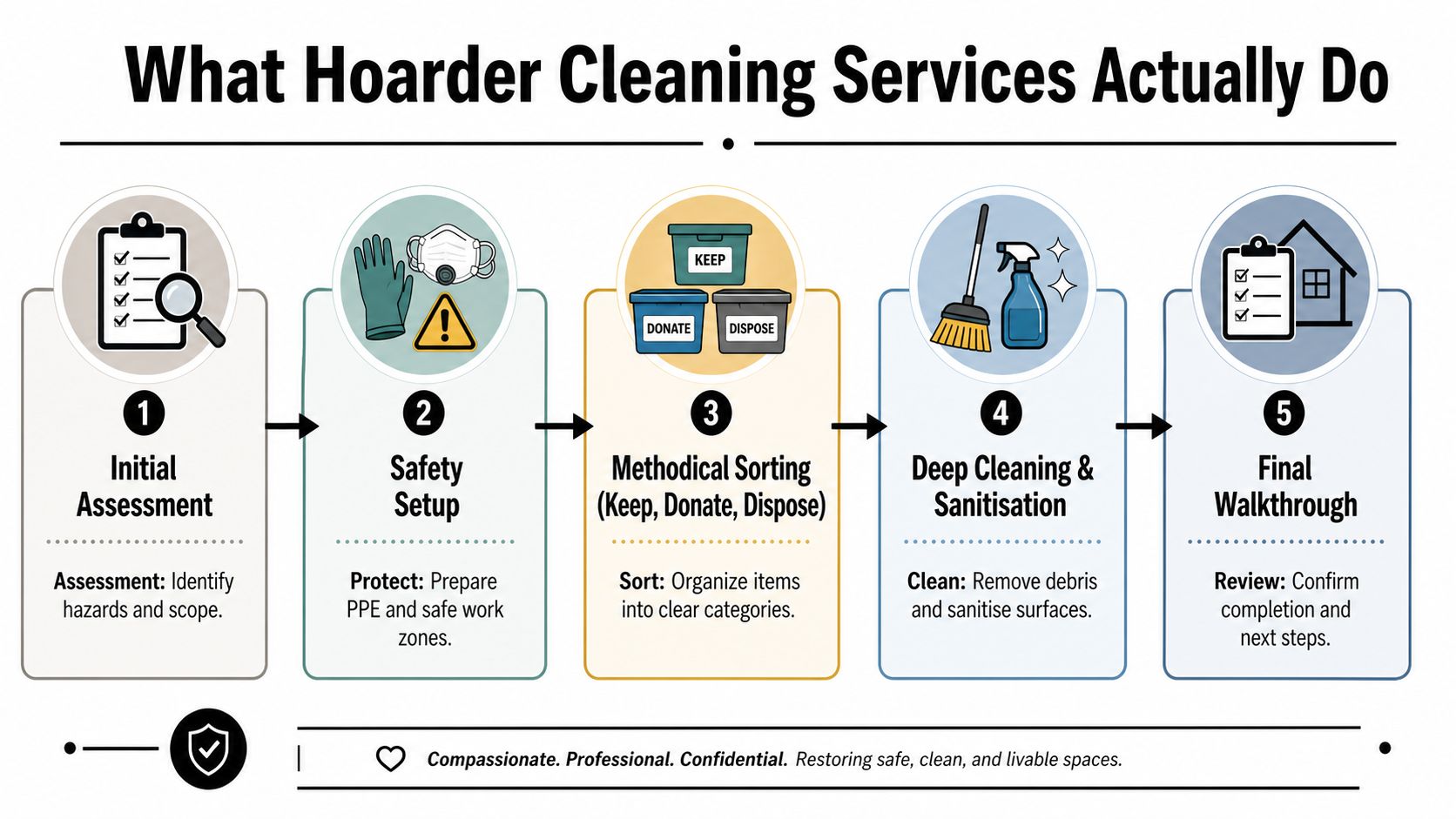
A proper hoarder cleaning service is not the same as a deep clean or a quick house clearance. The work starts with a site assessment, then moves into safety controls, careful sorting, removal, cleaning, and a final check that the property can be used again. In practice, that means the crew should work methodically, room by room, sort and remove items in order, then clean and sanitise the space after the clutter is out. The property also needs ventilation during the work, and badly soiled soft furnishings such as carpets may need full removal rather than a surface clean.
The workflow is controlled, not rushed
The first pass is about identifying what is there and what makes the space unsafe. After that, the team works through the home in a set order, usually room by room and top to bottom, so dust, debris, and contaminated material do not get dragged back into areas that have already been cleared. That discipline matters in real homes across Greater Manchester, especially where access is tight, the property is still occupied, or a landlord needs the space handed back in usable condition.
Sorting is usually done into practical categories, often keep, donate, and dispose, with the resident involved where that is possible and appropriate. That is how you avoid needless loss and keep the process calm enough for everyone involved. Once the items are out, surfaces can be properly checked and cleaned, which is the point where the home starts to feel like a room again instead of a storage problem.
A room is not clean when the clutter disappears. It is clean when the surfaces underneath have been checked, cleaned, and made safe again.
Where the job stops and specialist remediation starts
Hoarder cleaning can overlap with trauma cleaning or biohazard remediation, but they are not the same job. If the property has visible contamination, bodily fluids, pest waste, or mould hidden under the clutter, the response needs to become more technical, with specialist products and protective measures. At that point, the cleaner is no longer just removing rubbish, they are managing contamination and disposal risk.
That is why the right provider should be able to explain exactly what they will do, what they will not touch, and when another specialist is needed. If they cannot separate those things clearly, keep looking.
How Common Hoarding Really Is in the UK
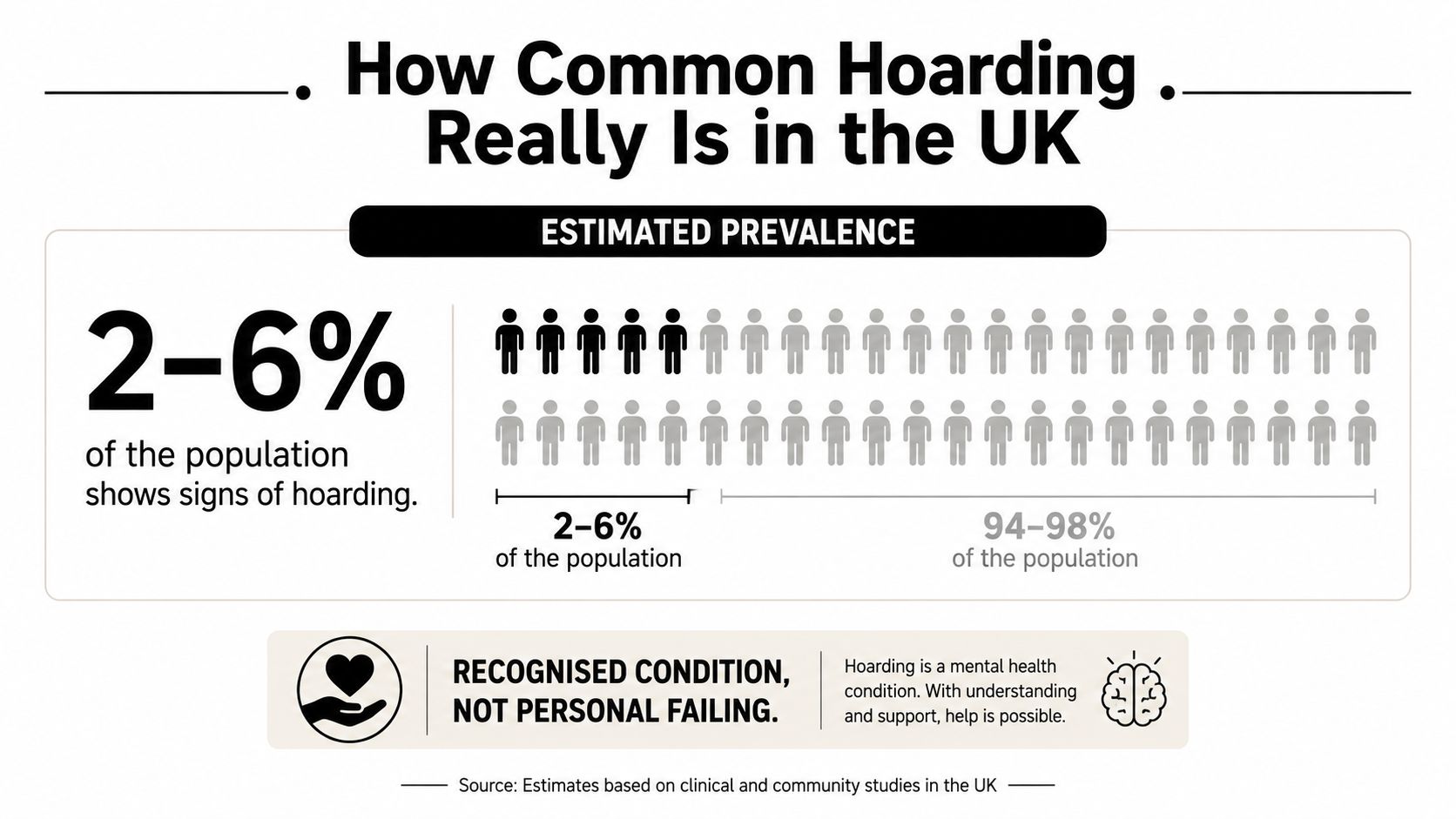
Hoarding is common enough that local housing, care, and family teams see it again and again. UK-facing guidance from Hoarding Cleaning Services UK says around 2% to 6% of people show signs of hoarding behaviours, and that recent reports suggest about 1.4 million people in the UK are currently living with hoarding disorder. That is why landlords, letting agents, housing teams, and families keep running into the same problem.
Local service data backs up the national picture
A 2024 Worcestershire County Council assessment found 153 hoarding-compatible cases among 5,478 adult social care assessments carried out between 1 April 2022 and 30 December 2023, which equals 2.8% of all assessments. The same report notes a commonly cited prevalence estimate of 2.5% of the population, and says that applying that rate to Worcestershire would imply about 15,342 affected people.
That matters in Greater Manchester because it shows this is not limited to a few isolated properties. It turns up in council referrals, housing management, and family intervention work all the time. If you manage properties, you are likely to meet it sooner or later.
Why those numbers change how you respond
The service need is real even when the presentation varies. The Worcestershire report also notes that a UK study it reviewed found an unweighted prevalence of 1.3%, which shows estimates move around depending on method and setting. That does not weaken the case for specialist help. It strengthens it, because it shows a measurable demand across different care and housing pathways.
For a landlord in Manchester or a family in Oldham, the takeaway is plain. You are not dealing with a one-off oddity. You are dealing with a recognised condition that often spills into property risk, safeguarding concerns, or tenancy recovery.
Health, Safety, and Biohazard Protocols That Matter
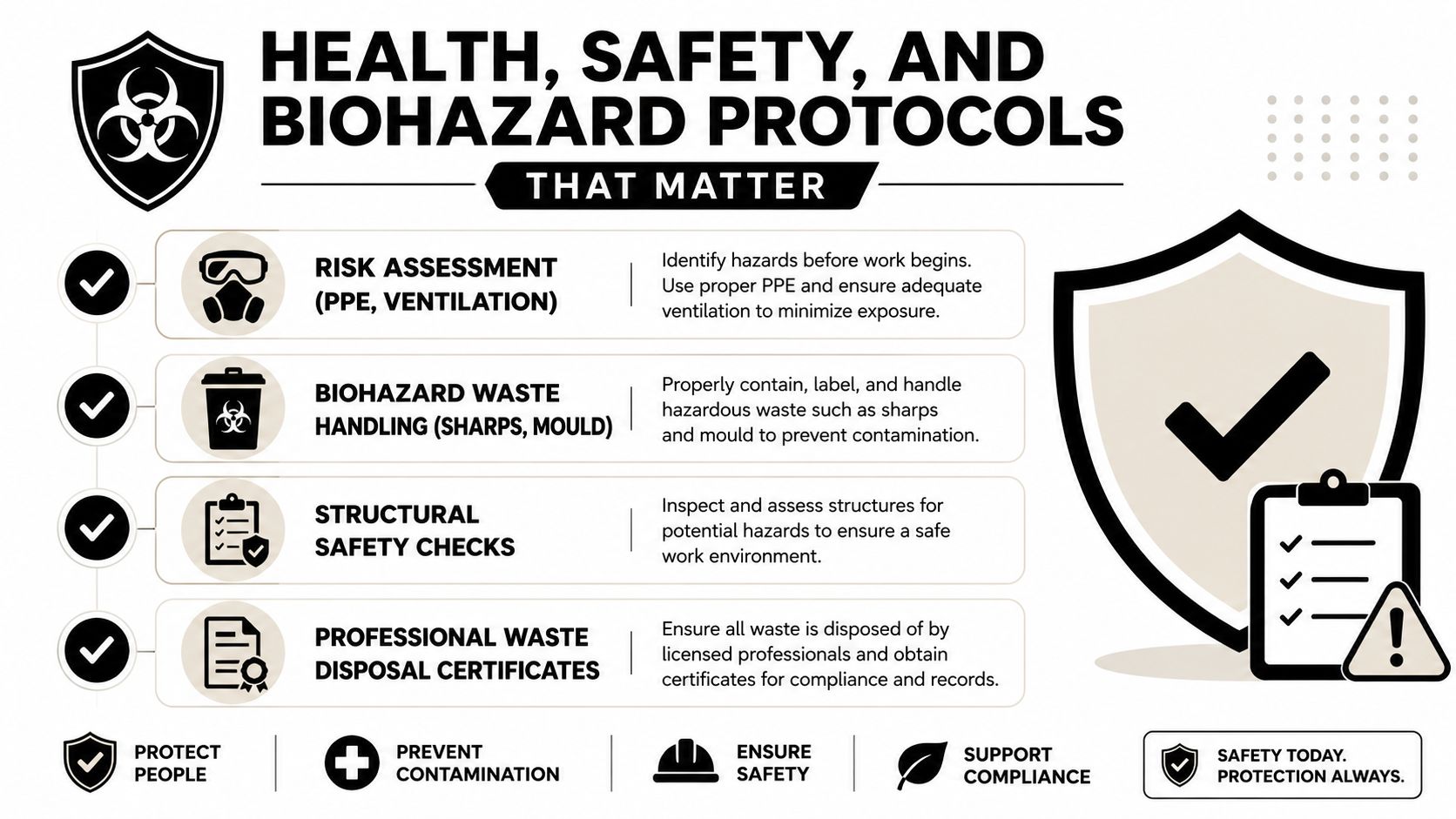
A hoarder clean-up in the UK should be handled as managed waste-handling and biohazard-control work. Crews need to control the space before they start, not just begin hauling items out. That means proper PPE, planned ventilation, safe access routes, and a clear decision on what stays, what goes, and what must be treated as contaminated. A safety infographic titled Health, Safety, and Biohazard Protocols outlining four key steps for professional cleaning procedures. The point is simple, if the team is casual about containment, they are not ready for the property.
What should happen before a single item is moved
The first job is risk assessment. A proper team checks for sharp hazards, unstable stacks, blocked exits, poor air flow, and any sign of contamination before anyone starts lifting bags or boxes. That is the stage where dust, pests, damp patches, and waste need to be identified, because once movement starts, they spread fast through the rest of the home.
If a company only talks about “getting it cleared”, that is the wrong mindset.
After that, the safe approach is to work in a controlled sequence, with barriers, PPE, and disposal routes already set. UK guidance for respectful hoarding work stresses that the job should be handled carefully and with the resident in mind, not rushed through as if it were ordinary decluttering. CPD Online guidance on safe, respectful hoarding intervention covers that approach well. For anyone dealing with a Greater Manchester tenancy, a family home, or a property linked to care and safeguarding concerns, that standard matters because the risks are practical, not theoretical.
Once the visible clutter is out of the way, hidden contamination often shows itself. Mould, rodent droppings, and human waste can sit under piles, behind furniture, or in soft furnishings, and each one changes the job completely. Specialist remediation may be needed, with PPE, specialist products, and deep cleaning of surfaces, floors, walls, fixtures, and fittings. Hashtag Clean guide to hoarder cleaning lays out that kind of follow-through clearly. The Home Office style issue is usually not the clutter itself, it is what the clutter has trapped and hidden.
The questions you should ask a provider
Ask this directly: “What do you do if you find mould, pest waste, or human waste after the clutter is removed?”
If they cannot answer that plainly, stop there.
You should also ask about:
- PPE and containment: what protective gear they use, and how they stop dust and waste from moving into clean areas.
- Waste disposal: how they separate general rubbish from contaminated material.
- Soft furnishings: whether damaged carpets or upholstered items will be removed rather than just treated on the surface.
- Certificates and records: what proof you will get that waste has been handled properly.
That is the level of detail a local authority, landlord, family member, or housing manager in Greater Manchester should expect before work starts.
For a broader specialist clean after the clearance, Atticus Cleaning Services is one example of a provider working in the right category when contamination is part of the brief.
Timelines, Costs, and Credentials to Check
No sensible provider can quote a hoarder job off a single photo and pretend that's enough. The timeline depends on property size, how far the clutter has spread, access for waste removal, and whether the resident is staying in the property during the work. A small flat with clear access is a different job from a terraced house where every room is affected and waste has to be moved through narrow stairs.
What drives the quote
The price usually follows the labour involved, the amount of waste to remove, the equipment needed, and whether the job crosses into biohazard territory. If specialist cleaning is needed after the clearance, that's another layer of work. If the property needs repeat visits, the quote should say so clearly.
Don't let anyone hide behind vague “from” pricing. You need a quote that tells you what's included, what counts as an extra, and whether waste disposal is already covered. If you're comparing broader clearance work as well, this guide on whether professional house clearance is worth the cost is a useful frame for judging whether the price matches the scope.
Credentials that actually matter
A provider should be able to prove they're licensed and insured to remove rubbish in line with government and local authority rules. They should also have trained staff, clear disposal processes, and vehicles that don't advertise the job to the whole street. Discretion matters in Greater Manchester as much as anywhere else.
Non-negotiable: if they can't explain their insurance, waste handling, and disposal process without hesitation, don't book them.
Look for a team that can handle the handover professionally, not just the labour. In practice, that means clear scheduling, a written scope, and a final walkthrough so you know what's been done and what still needs attention. That's the difference between a tidy outcome and a half-finished one.
Who Pays and When Staged Intervention Beats a Full Clearance
This is the question many avoid asking until the last minute. Who pays for hoarder cleaning in the UK depends on why the work is happening and what risk is on the table. UK-facing guidance is fragmented, and in many cases local authority and NHS-linked support focuses on housing risk, safeguarding, or hoarding referrals rather than private cleaning logistics (Mental Health SF on hoarding referrals and physical decluttering).
The funding landscape is messy, so start with the right call
If the property is occupied and the resident is vulnerable, adult social care, housing officers, or NHS-linked support may be part of the pathway. If the issue is tenancy damage, a landlord or letting agent may end up carrying the cost, especially when a unit has to be turned around quickly. If none of those apply, self-funding through a private contractor is usually the most direct route.
The point is to call the right person first. A housing officer, social worker, or landlord will often know whether the case needs referral support, tenancy enforcement, or a private clean. That's faster than assuming a full clearance is the only option.
Why a staged approach often wins
A staged intervention is often the smartest move because it protects the tenancy and lowers the chance of a bigger enforcement problem later.
That's the contrarian bit people miss. The most valuable service is not always the final, dramatic clear-out. Often, it's a phased clean that gets access back, reduces immediate risk, and gives the resident a chance to stay involved rather than being overwhelmed by one massive loss event.
A staged plan works especially well when:
- The resident is still engaged: they can make keep, donate, and dispose decisions without shutting down.
- The landlord wants retention, not eviction: gradual progress can stabilise a tenancy.
- The property only needs partial recovery: you don't have to clear everything to make a home safe.
That's the sensible way to think about hoarder cleaning in Greater Manchester. Don't start by asking for the biggest possible job. Start by asking what level of intervention will solve the immediate problem without creating a bigger one.
What a Real Engagement Looks Like in Greater Manchester

A landlord in Altrincham calls about a rental that's become difficult to inspect, and the conversation starts without fanfare. No drama, no judgement, just a straightforward description of the property, the access issues, and the level of urgency. The first step is a confidential enquiry, followed by an on-site assessment so the crew can see the full scope instead of guessing from a few photos.
After that, the client gets a written quote and an agreed plan. That's when the practical decisions happen, what can stay, what needs to go, how much waste is involved, and how the work will be staged if the whole property doesn't need clearing in one go. A decent provider also explains the timeline plainly, so nobody is left wondering when the team will arrive or how long they'll be there.
What the day itself feels like
The crew turns up in a controlled arrival window, works discreetly, and gets on with the job without turning the street into a spectacle. In a real Greater Manchester clearance, that means protecting the hallway, managing waste removal properly, and keeping the client informed without demanding constant attention. Internal window cleaning and the final finish matter here, because a property isn't useful again until people can see through it and move around it.
There's a useful example of that style of work in this Manchester deep-clean journey case study, which reflects the same basic principle, clear scope, careful execution, and a proper handover at the end.
By the close of a sensible engagement, the property should be left habitable or lettable, depending on the brief. No shortcuts, no vague promises, just a clean, functional space and a client who knows exactly what was done.
Getting Started with Atticus Cleaning Services
If you're dealing with a hoarded property in Greater Manchester, start with the facts, not the panic. Work out whether the job needs a full clearance, a staged intervention, or specialist cleaning after the clutter comes out. Then choose a team that is licensed, insured, discreet, and clear about disposal and scope.
Atticus Cleaning Services handles specialist cleaning, house clearances, and internal window cleaning as part of its work, alongside rubbish removal in line with government and local authority regulations. The process is simple, request a quote, agree the scope, and let a trained team take over the difficult part with the right equipment and a calm approach.
If you need a direct, practical plan for a difficult property, speak to Atticus Cleaning Services and ask for a quote that matches the actual condition of the home. They work across Manchester and North Cheshire, including Altrincham, Hale, and Sale, and can help you move from uncertainty to a clear, workable schedule.