
You know the job is being done badly when you start noticing it before anyone else does. The bins are empty, but the desks still have dust. The toilets look “done” at a glance, then you spot streaks, dull fittings, and the same complaint from staff or tenants that keeps coming back every week. That's usually the point where contract cleaning services stop being an admin line item and start being a management problem.
In Manchester and across North Cheshire, that problem is often not the act of cleaning itself, but the way the contract was put together. Price was chased, scope was vague, the team changed twice in a month, and nobody ever defined what “good” looked like. A proper cleaning contract solves that by turning cleaning into a managed service with clear outcomes, regular attendance, and accountability that you can inspect instead of hope for. The wider sector is not niche either, it sits inside the UK's facilities management market, which the British Institute of Facilities Management estimated at about £112 billion in annual contribution to the UK economy in 2019, with outsourced services taking a major share of that spend Mordor Intelligence's contract cleaning market overview.
Table of Contents
- What Contract Cleaning Services Mean for Your Business
- Types of Contract Cleaning Services Available in Manchester
- Understanding Service Level Agreements and Output Specifications
- Cost Models and Pricing Structures Explained
- The Hidden Cost of Poor Contracting and Workforce Instability
- How to Select and Onboard the Right Cleaning Contractor
- Your Contract Cleaning Hiring Checklist and Next Steps
What Contract Cleaning Services Mean for Your Business
A lot of office managers first meet cleaning contractors after a bad month. The cleaner turns up late, standards drift, someone in the building starts doing informal complaints, and suddenly you're tracking toilet paper, spill response, and bin cycles as if they were your main job. That is the point where a casual arrangement starts costing more than it should, because you are paying in time, interruptions, and re-cleans as well as money.
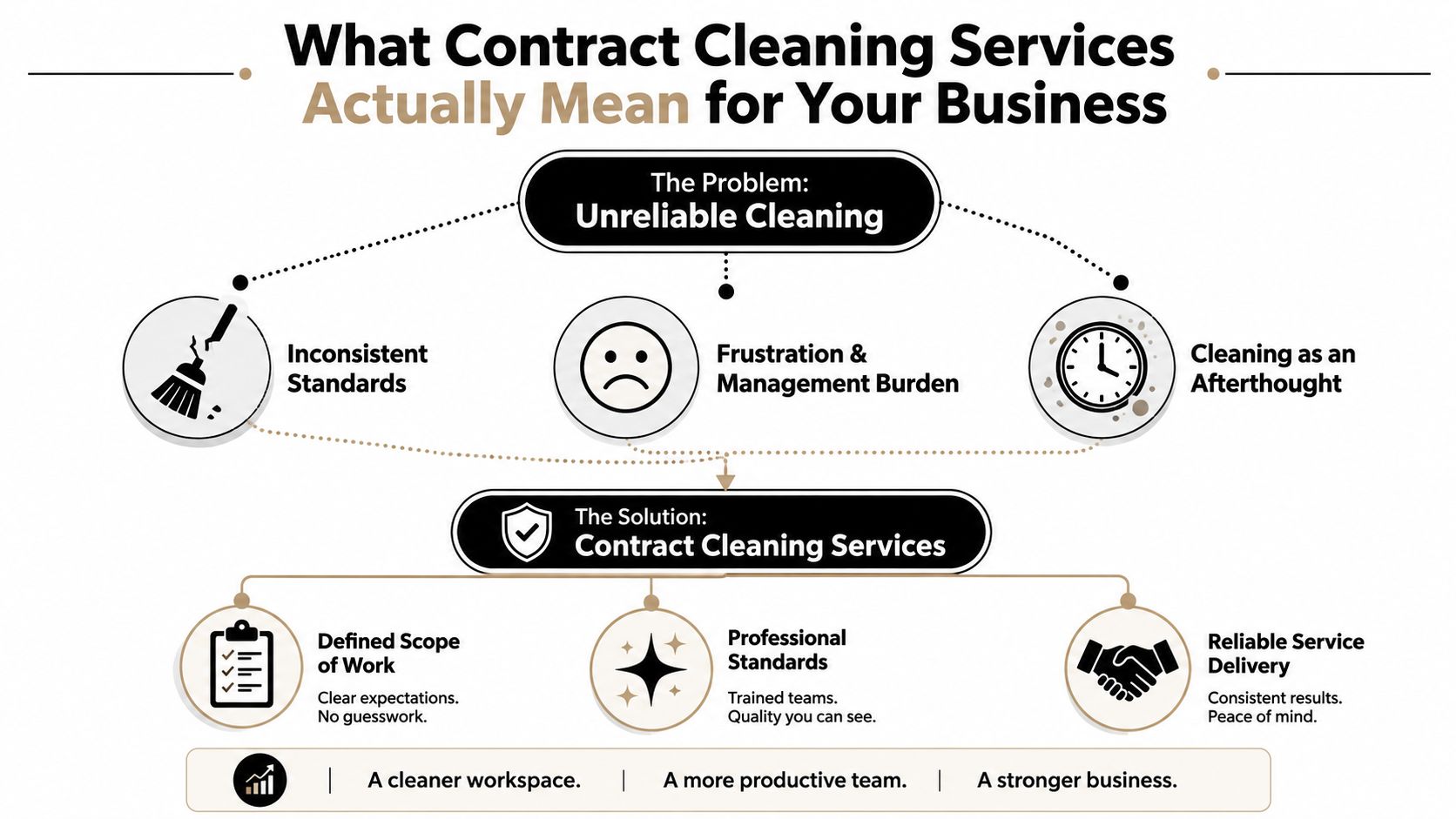

At its simplest, contract cleaning services are an ongoing agreement for defined cleaning outcomes, not a one-off tidy-up or a person paid casually to “keep an eye on things”. The contract turns cleaning from a variable nuisance into a managed service, where the buyer knows the areas, frequency, and standards that should be delivered. In practice, that matters because outsourced building services now run through recurring procurement, compliance, and service levels, rather than informal trust.
What changes when the work is contracted properly
A proper contract puts responsibility in writing. If the office floor, reception, or shared kitchens are not right, you are not chasing a favoured cleaner by text message, you are referring back to a scope of work and an agreed standard. That makes the relationship firmer for both sides.
Manchester offices and apartment blocks feel this difference quickly. In a city-centre building, a contract usually needs predictable attendance before opening hours or after staff leave. In student accommodation, the same contract logic applies to recurring turnaround cleans, where consistency matters more than whoever happens to be available that day. In commercial properties, the value is not just hygiene, it is less management drag and fewer small failures that steal time from other work.
Practical rule: if you cannot describe the expected result in plain English, you probably do not have a contract worth enforcing.
The biggest shift is away from “hours on site” and towards “condition on completion”. That is why contract cleaning sits closer to facilities management than to hiring help by the hour. You are buying a controlled outcome, not a vague effort.
Types of Contract Cleaning Services Available in Manchester
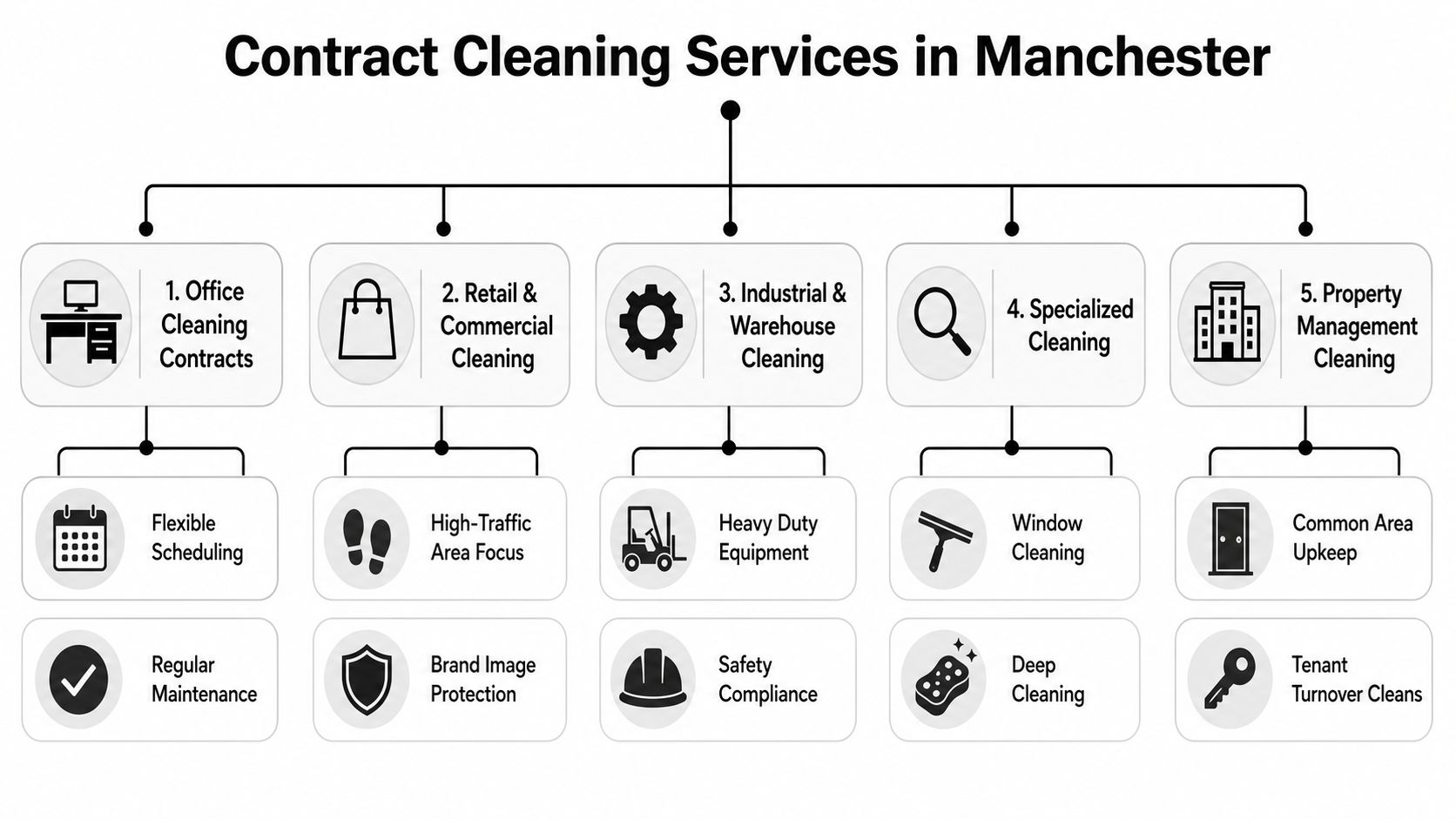
A contract that looks fine on paper can still fail in practice if it ignores how the building is used and who is doing the work. A city-centre office, a serviced apartment in Salford Quays, a student block near the universities, and a retail unit in Hale all need different cleaning rhythms, different access arrangements, and different checks on attendance. The right contract starts with the building type, then fits the service around it.
Office, property, and end-of-tenancy work
Office cleaning contracts suit businesses that need regular attendance outside working hours, especially where desks, touchpoints, washrooms, and kitchens have to be ready before the first staff member walks in. In a building with real footfall, the same team learning the layout and the awkward spots usually gives better results than a rotating cast of names on a rota. It also makes supervision simpler, which matters when you are trying to spot whether the contractor is stable or just underbidding to win the job.
End of tenancy cleaning is a different job entirely. Landlords and letting agents in places like Altrincham, Sale, and central Manchester need a property turned around quickly so it can return to lettable condition, and that usually means clear handover standards rather than loose promises. The contract is event-based rather than ongoing, but it still needs structure, especially when internal windows, waste handling, and carpet care are bundled into the same scope. For an office-specific example of how recurring commercial cleaning is presented, Atticus Cleaning Services' Manchester office cleaners page shows the kind of service structure buyers often compare against.
Specialist and higher-risk cleaning
Carpet and upholstery cleaning is often sold as an extra, yet in offices, managed properties, and student accommodation it is one of the most common specialist add-ons. Global contract-cleaning research shows floor and carpet cleaning held a 32.2% revenue share in 2024, which fits the way many commercial interiors are fitted out, with soft flooring and fabric furnishings still common Grand View Research. That does not mean every building needs it, only that it is a serious part of the contract mix wherever carpets are part of the asset and the turnover of people is high enough to justify it.
Trauma or specialist cleaning sits in another category altogether. These jobs depend on training, equipment, disposal controls, and calm site management, and a contractor that handles daily office maintenance well may still be the wrong fit here. It is a different service with different risk, different paperwork, and a much lower tolerance for weak process. Facilities teams in Manchester learn this quickly after one bad handover, because the issue is rarely the clean itself, it is whether the contractor can keep the right people available, trained, and steady enough to do the job properly.
The strongest contractors are usually the ones who know where they draw the line, and say so early.
Understanding Service Level Agreements and Output Specifications
A cleaning contract works properly only when it measures the finished result. A buyer does not get much value from a rota that says three cleaners attended for four hours if the toilets still look worn, the bins were not emptied properly, or the shared areas were missed. The question is whether the building is left in the condition you agreed.
Manchester University's cleaning specification shows how output-based contracts work in practice. It sets expected outcomes for areas such as windows and glazed screens, waste bins, stairs and handrails, and WC interiors and exteriors, with toilets required to be free of dirt, marks, and scale, and seats and lids finished to a shine that matches the underlying surface Manchester University output specification. That wording helps because it gives both sides something visible to inspect and challenge.
How to read a cleaning SLA
Start with the outcome, then check the frequency, the exclusions, and the escalation route. A vague promise to “keep the premises clean” gives you very little to work with when you need to challenge a missed washroom deep clean or a stairwell that has been left behind. A stronger SLA sets out which areas are included, how often each task runs, and what happens if standards slip.
The technical detail matters as much as the visible finish. UK public-sector and housing-style specifications often require contractors to follow manufacturers' instructions and applicable regulations for chemicals and disposal, which protects surfaces as well as people. The same Manchester University output specification also points in that direction Manchester University output specification. In plain terms, that is not paperwork for the sake of paperwork. It stops one contractor from using a product that damages flooring, stains upholstery, or creates a disposal issue.
What to ask before you sign
- How are areas measured? Ask whether the contract is built around rooms, floors, or task lists.
- How is quality checked? Look for visible-condition inspections, not just attendance logs.
- Who owns consumables? If the contract depends on products, bins, and paper goods, the logistics need to be explicit.
- What happens on failure? The agreement should say how complaints are logged and corrected.
If a contractor cannot explain the standard in terms your own team would use, the SLA is too weak.
Cost Models and Pricing Structures Explained
Cleaning quotes often look simple until you compare what's included. One provider gives a fixed monthly fee. Another quotes per visit. A third builds the price around scope, floor area, or task type, then adds products and equipment separately. Those are very different commercial models, even if the headline number looks similar at first glance.
| Contract Cleaning Cost Models Comparison | How It Works | Best For | Watch Out For |
|---|---|---|---|
| Fixed monthly fee | A set amount covers agreed services over the contract period | Offices and multi-site premises that need predictable budgeting | Scope creep if exclusions aren't written clearly |
| Per-visit pricing | You pay each time the cleaner attends | Deep cleans, end-of-tenancy work, and irregular bookings | Costs can rise fast if visits increase |
| Task-based pricing | Individual tasks are priced separately, such as carpet care or washroom work | Buildings with mixed cleaning needs | Easy to under-specify the job and get surprises later |
| Scope-led variable pricing | The quote reflects the size and complexity of the site | Properties with clear area definitions and stable usage patterns | Hard to compare like-for-like unless every bidder uses the same scope |
Equipment and extras change the real price
Some contracts include products and equipment, while others make them add-ons. That difference matters more than buyers expect. A contractor supplying suitable cleaning products and equipment of acceptable quality, with vacuum cleaners in sufficient number and kept functional, is a different proposition from one who treats everything as an extra Labour Department tender specification. If you're comparing quotes, ask what's on site and what gets billed later.
I'm wary of quotes that look cheap only because the contractor has hidden service inputs. The first invoice tells the truth.
Where businesses get caught out
Introductory offers can be useful, but they should never distract from the contract mechanics. Bundled services, like carpet work with tenancy cleans, may help if the building needs both. What you want to avoid is a quote that underprices the core service and then leans on extras, call-outs, or consumable markups to recover the margin.
The Hidden Cost of Poor Contracting and Workforce Instability
The cheapest cleaning contract can become the most expensive one on paper and in frustration. Low-cost procurement often pushes contractors into fragile staffing patterns, thin supervision, and fast turnover. That doesn't just affect morale inside the contractor's team, it shows up as missed areas, inconsistent attendance, and repeated complaints from your own staff or tenants.
The UK Equality and Human Rights Commission has already flagged how contractual and procurement practices in outsourced cleaning can drive insecure work, fragmented responsibility, and weaker access to sick pay, pensions, and other protections EHRC research on contractual and procurement practices. For buyers, the lesson is blunt. If the contractor's workforce is unstable, service quality usually is too.
What to look for before you award the job
- Supervision: Ask who checks the cleaners, and how often.
- Attendance resilience: Find out how sickness or absence gets covered.
- Training: Don't accept “fully trained” as a slogan. Ask what they train on.
- Staff retention: Stable teams learn the building faster and miss less.
The hidden cost shows up in repeat visits, complaints, and management time. In office environments, that can spill into reputation and employee experience, especially when poor cleaning becomes visible to clients or staff. For a practical local angle on that relationship, see how dirty offices affect employee wellbeing and business reputation.
Why paying a bit more can be cheaper
A contractor who pays attention to continuity, sick cover, and basic support often delivers fewer failures. That's because the same people learn where the problems are, how access works, and which parts of the building need extra attention. In practice, you're not just buying labour, you're buying a team that can stay reliable long enough to matter.
How to Select and Onboard the Right Cleaning Contractor
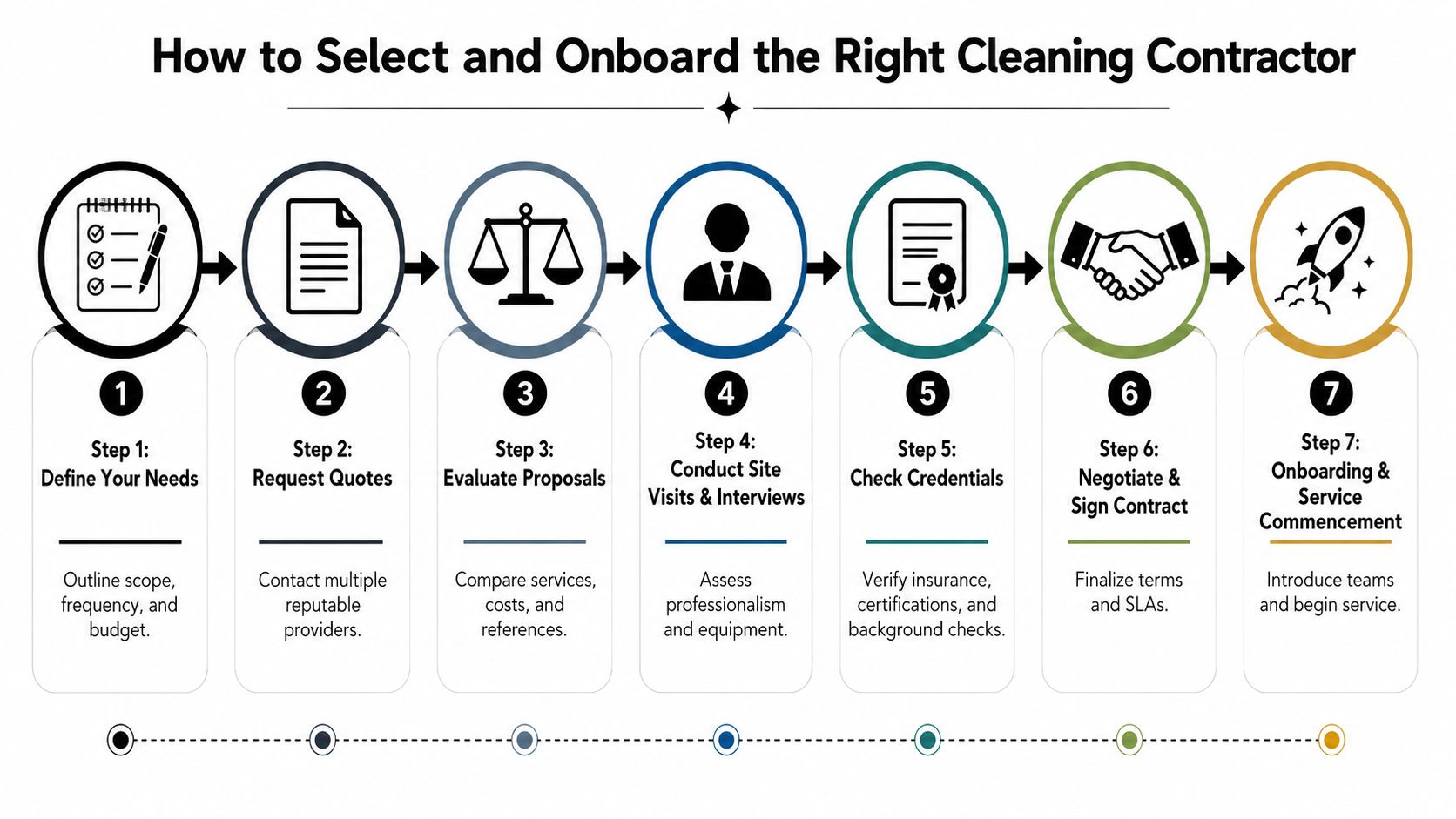
The first mistake most buyers make is treating supplier selection like a price-only exercise. The better approach is to treat it like a controlled appointment to a role that touches access, hygiene, reputation, and continuity. That means checking the basics before you chase a quote.
The selection process that actually works
Start by defining the site and the standard. If it's a city-centre office, mention access windows, keyholding, and any after-hours constraints. If it's North Cheshire residential or mixed-use property, travel time, parking, and handover arrangements matter more than people expect because they affect punctuality and consistency.
Then ask for proof, not promises. Insurance should be verified. Waste disposal arrangements should be clear where relevant. References need to come from similar Manchester properties, not just generic praise from a completely different building type. Equipment should be inspected, because a contractor's machines tell you a lot about how seriously they treat the job.
Contract clauses worth insisting on
A good agreement doesn't need to be over-lawyered, but it does need to be specific. Make sure it covers complaint handling, termination notice, keyholding rules, and a satisfaction or remediation process. If the contractor says they'll “sort it out if needed”, that isn't a clause, it's a hope.
Use the first walkthrough to test fit. Ask who will attend the site, how escalation works, and what happens if the allocated team changes. A contractor that communicates clearly at this stage usually communicates clearly later too.
For a local office-focused buying route, how to choose your ideal office cleaners in Manchester is worth reading alongside your shortlist. It helps you pressure-test the basics before you sign.
Onboarding without the usual chaos
Once you've chosen the contractor, the onboarding should feel organised. The site team should be introduced, the access method should be agreed, and the complaint route should be written down where staff can use it. A simple first-week review catches most early misunderstandings before they become habits.
The contractor's first few cleans tell you more than the sales meeting ever will. Watch for punctuality, consistency, and whether they notice details without being chased.
Your Contract Cleaning Hiring Checklist and Next Steps
Before you ask for quotes, clearly define the job. List the areas, the attendance pattern, any sensitive zones, and the standards that would make you call the contract a success. If you manage multiple sites, standardise that list now, because inconsistent briefs produce inconsistent results.
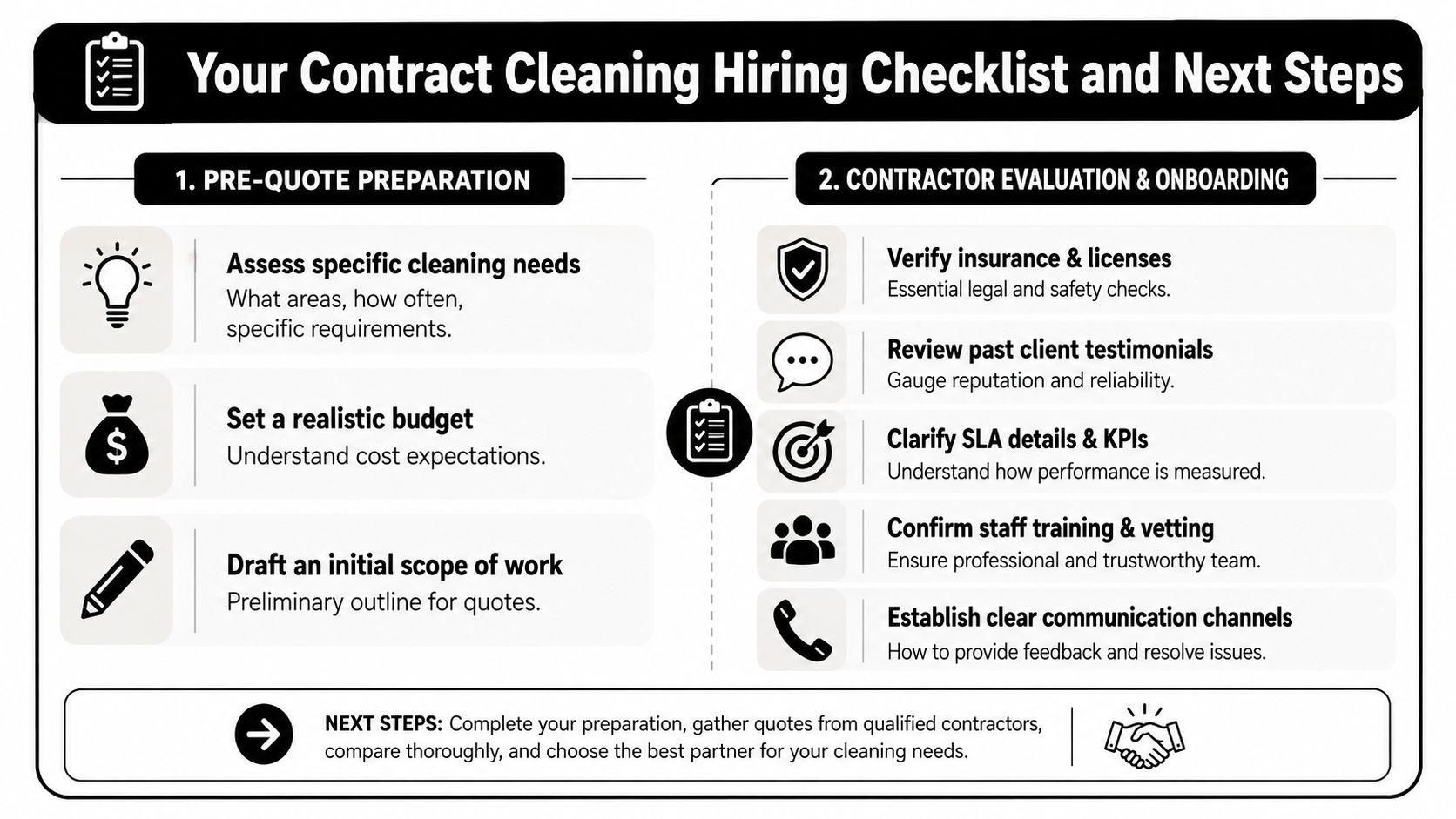
Quick checklist before you shortlist anyone
- Clarify the scope: Know exactly what should be cleaned, and how often.
- Check the contract model: Decide whether you need a fixed fee, a per-visit setup, or a task-led agreement.
- Ask about workforce stability: Find out how the contractor handles supervision and absence cover.
- Verify references: Choose examples that match your own building type.
- Read the SLA carefully: Make sure the outcomes are measurable and the remedies are clear.
Office managers usually need recurring attendance and fast issue resolution. Landlords and letting agents usually need turnaround speed and reliable finish quality. Property managers handling multiple sites need a contractor who can standardise reporting without flattening local differences.
If you're comparing providers, get one quote built around your own brief and one written comparison against the same scope. That's the cleanest way to see where the differences really are. Atticus Cleaning Services offers office cleaning, end of tenancy cleaning, specialist carpet and upholstery work, and licensed waste removal for Manchester and North Cheshire, so it's one option worth considering if your contract needs that mix of recurring and specialist support.
If you're ready to stop managing cleaning by complaint, visit Atticus Cleaning Services and request a quote based on your actual site, your actual hours, and your actual standard. A tight contract now saves a lot of avoidable chasing later, and the right provider will make that process straightforward from the first walkthrough.