

Monday, 8:15am. Reception glass is marked, the bins are still full, the kitchen smells off, and your first visitor is due in half an hour. You email the cleaning company and get the reply facilities managers in Manchester know too well: the cleaner was scheduled, but nobody can tell you who attended, what was completed, or why the obvious jobs were missed.
That is the test of an office cleaning service. Cleaning quality matters, but reliability matters just as much. If attendance cannot be verified and missed tasks are only discovered after staff arrive, you are not buying a managed service. You are buying uncertainty.
Manchester offices put cleaning teams under real pressure. Long opening hours, shared amenities, heavy footfall, meeting rooms that turn over quickly, and washrooms that need consistent attention all expose weak supervision fast. A provider can sound organised during the sales process and still fall apart once the contract starts. The gap usually shows up in the same places: patchy standards, poor communication, and no clear record of whether the shift happened at all.
Good providers deal with that properly. They use clear task schedules, site checks, named accountability, and attendance records a client can verify without chasing. That is one of the clearest differences between a cheap quote and a dependable contract, and it is where better-run firms such as Atticus tend to stand apart.
A neglected office affects morale, visitor confidence, and trust in the people responsible for the building. If you want more context on that wider impact, this guide to how dirty offices affect employee wellbeing and business reputation is a useful companion to this article.
Table of Contents
- Why Your Manchester Office Needs More Than Just a Mop and Bucket
- Decoding the Menu of Professional Cleaning Services
- What High Standards and Flexible Contracts Really Mean
- A Realistic Guide to Office Cleaning Prices in Manchester
- How to Vet and Choose Your Cleaning Partner
- Navigating Cleaning Compliance and Waste Removal Rules
- Common Questions and Taking the Next Step
Why Your Manchester Office Needs More Than Just a Mop and Bucket
Monday, 8:15am. The first client is due in at nine. Reception looks passable until the light catches fingerprints on the glass, the kitchen bin is already full from Friday, and one washroom has no hand towels. That is how confidence in a cleaning contractor starts to slip. Not because of one dramatic failure, but because nobody seems accountable for the basics.
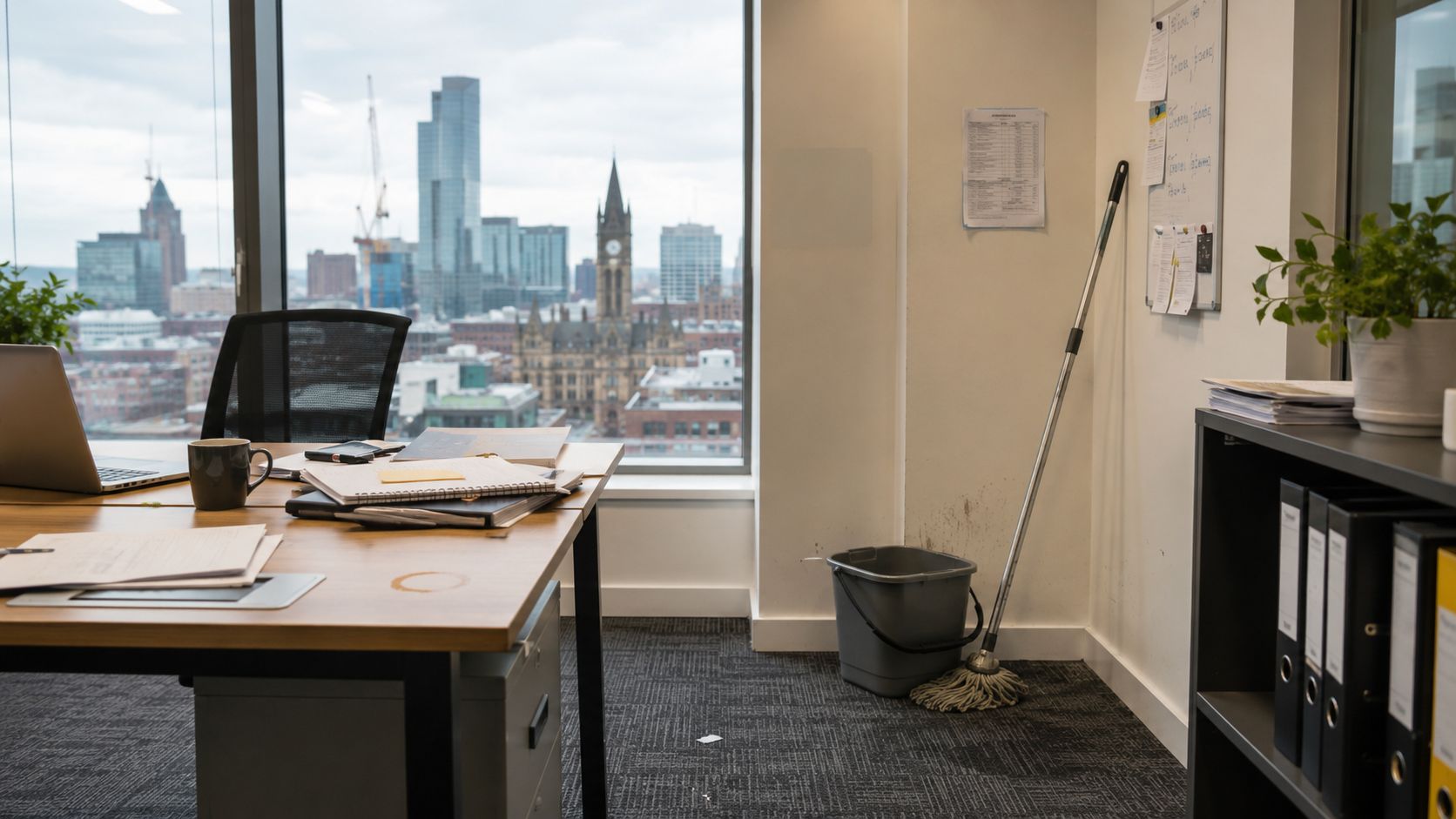

The difference between surface cleaning and managed service delivery
A cleaner can complete tasks. A proper office cleaning service manages an environment.
That difference matters in Manchester offices, where reception, meeting rooms, kitchens and washrooms all take different levels of use across the day. The issue is rarely whether someone owns a mop and bucket. The issue is whether the provider has a clear specification, site checks, cover for absence, and a way to prove the job happened when it was meant to.
This is the point many office managers miss until they have been let down a few times. The risk is not poor technique. It is poor control.
A reliable contractor should be able to answer simple questions without hesitation. Who checks standards on site. How are missed tasks recorded and corrected. What happens if the scheduled cleaner calls in sick at short notice. How do you verify attendance without chasing by email the next morning.
If those answers are vague, expect a vague service.
Cleanliness also affects more than appearance. It shapes how staff feel about the workplace and how visitors judge the business before a meeting even starts. How dirty offices affect employee wellbeing and business reputation covers that wider impact in more detail.
What people notice first, and what it tells you about the contract
Staff and visitors do not inspect a building like an auditor. They notice friction. A sticky floor in the kitchen. Smears on the front door. An empty soap dispenser at 10am. Chairs in a meeting room left askew after yesterday's booking.
Those details point to whether the contract is being actively managed or left to run.
In practice, weak delivery usually shows up first in these areas:
- Front entrance and reception: Glass, floors, handles, mats and touchpoints set the tone within seconds.
- Kitchens and break areas: Food debris, full bins, stained worktops and neglected sinks trigger complaints quickly.
- Washrooms: Odour, consumables, splash marks and floor condition tell staff whether standards are being maintained consistently.
- Meeting rooms: Cups, crumbs, marks on tables and poor room resets make the office look badly run.
The best providers build accountability into the service. Attendance is logged. Supervisors inspect. Issues are closed out, not argued over. That is one reason Atticus stands out. Clients are not left wondering whether the cleaner attended or whether standards slipped last week. They get a service with visible oversight, clear reporting, and fewer surprises.
Decoding the Menu of Professional Cleaning Services
A lot of cleaning contracts start going wrong at the scope stage. The office manager asks for “general cleaning”, the contractor prices for a basic evening visit, and three weeks later the complaints start. Carpets still look tired, meeting rooms are not being reset properly, and nobody is clear whether the kitchen fridge fronts or internal glass were ever included.
The fix is simple. Define the service by outcome, frequency, and proof of delivery.
A good starting point is understanding what to expect from a professional office cleaning service, then checking exactly how each task will be signed off, inspected, and reported back to you.
Daily cleaning is maintenance
Daily or routine office cleaning keeps the building presentable and usable. It is the backbone of most contracts, but it only works if the schedule matches how the office is used. A twenty-person office with light footfall needs something different from a busy sales floor with constant client traffic and packed washrooms.
Typical routine tasks include:
- Bins and liners: Emptying waste, replacing liners, and checking for overflow.
- Washrooms: Cleaning toilets, sinks, mirrors, floors, and touchpoints, plus restocking consumables if that sits within the contract.
- Kitchens: Wiping worktops, cleaning sinks, removing obvious residue, and managing waste points.
- Floors and surfaces: Vacuuming, mopping, and dusting agreed areas.
- Meeting rooms: Clearing cups, wiping tables, and resetting the room for the next booking.
The detail that often gets missed is attendance verification. If a provider says kitchens are cleaned daily, you should be able to see when that happened, who attended, and whether a supervisor checked the result. Without that, “daily” can mean almost anything.
Deep cleaning is a reset
Deep cleaning deals with the grime that routine visits do not fully remove. It usually covers skirting, vents, descaling, internal glass, edges behind furniture, detailed washroom work, and other neglected points that slip when cleaners are under time pressure.
It earns its keep in a few common situations:
- taking over a new office
- recovering from poor standards under the previous contractor
- preparing for a client visit, audit, or landlord inspection
- resetting the building before a routine contract starts
Deep cleans also expose whether a contractor understands specification properly. Some will price low, then treat deep cleaning as a quick once-over. A serious provider will break down what is included, how long it will take, what equipment is needed, and what “finished” looks like.
Manchester Cleaning Services at a Glance
| Service Type | Best For | Typical Frequency | Key Tasks |
|---|---|---|---|
| Regular office cleaning | Occupied offices needing ongoing upkeep | Daily, several times weekly, or tailored schedule | Bins, washrooms, kitchens, vacuuming, mopping, dusting, meeting room resets |
| Deep cleaning | Offices with built-up dirt or after poor maintenance | Periodic or one-off | Detailed sanitising, hard-to-reach areas, descaling, edges, internal glass |
| End of tenancy cleaning | Landlords, agents, tenants, office exits | One-off at handover | Full property clean, presentation reset, readiness for next occupier |
| Carpet and upholstery care | Offices with stained, tired or high-use soft furnishings | Periodic or as needed | Hot water extraction, stain treatment, fabric refresh |
| Specialist cleaning | Unusual, sensitive or high-risk situations | As required | Situation-specific cleaning using appropriate methods and controls |
End of tenancy cleaning is different again. It is less about keeping an office running day to day and more about handover condition. That usually means a fuller presentation clean, with more attention on marks, residue, neglected corners, and anything a landlord or incoming occupier will pick up straight away.
Carpet and upholstery cleaning sits in its own category because it needs proper machinery, stain treatment knowledge, and enough drying time to avoid creating a different problem. It should be planned, not bolted onto an evening clean because somebody noticed the boardroom chairs looking grubby.
Specialist cleaning covers the jobs that need tighter controls. That might include high-level work, contamination issues, or sensitive environments where method statements and supervision matter as much as the cleaning itself.
The main point is this. If the service list is vague, the contract will be vague. Strong providers set out the tasks, frequencies, exclusions, inspection process, and attendance records clearly from the start. That is the difference between buying cleaning and buying a service you can hold to account.
What High Standards and Flexible Contracts Really Mean
A contract can look fine on paper and still fail at 7am when the bins are full, the toilets were skipped, and nobody can tell you whether the cleaner attended at all. That is the part many buyers miss. High standards are not just about how the office looks after a good visit. They are about whether the provider can prove the service happened, show who checked it, and fix misses without an argument.
High standards show up in consistency and proof
Anyone can deliver a strong first week. The test is week nine, during staff absence, poor weather, or a busy period when your building is under pressure.
You see the truth in the repeat details. Finger marks left on glass doors. Dust holding on skirting behind desks. Washroom corners that were wiped last month, not this week. Tea points that look passable from the doorway but sticky up close. Those are not minor faults. They usually point to rushed rounds, weak supervision, or a spec that nobody is checking properly.
A good provider puts four things in place:
- A written cleaning spec tied to the site, not a generic checklist copied across every building.
- Attendance records you can verify, so there is no debate about whether the shift was covered.
- Regular inspections with named responsibility, including what was checked and what failed.
- A correction process with timescales, so issues are closed out rather than explained away.
That last point matters. Plenty of firms promise responsiveness. Fewer can show a simple audit trail from complaint to revisit to sign-off.
Flexible contracts should protect you, not the provider
Flexibility is often sold as a vague willingness to "work around you". In practice, it should mean the contract reflects how your office is used and gives you a clear route to change the service when that use changes.
That could mean early morning cleans instead of evening access. It could mean heavier washroom and kitchen attention on office-heavy days, with lighter touch work elsewhere. If you manage a multi-tenant site, it may mean different access arrangements, separate consumables controls, and tighter reporting because more people notice when standards slip.
There is a trade-off here. Rolling agreements give you a cleaner exit if service drops. Fixed terms can support steadier staffing and sharper introductory pricing. Neither works in your favour if the contract is loose, the visit times are unclear, and attendance cannot be verified.
That is why I always look beyond the price and the scope. I want to know who covers absence, how missed visits are reported, whether supervisors inspect out of hours, and what evidence lands in the client's hands without being chased.
Atticus Cleaning Services is one Manchester provider that makes that side of the service visible, including a current office cleaning contract offer with introductory savings. The offer only has value if the schedule, inspection process, and reporting are clear from day one. Cheap months at the start do not help if standards drift and nobody owns the problem.
A Realistic Guide to Office Cleaning Prices in Manchester
A quote looks fine until the first missed visit, the bins are still full at 8am, and your team is asking who is supposed to fix it. Price only makes sense when it is tied to delivery. In office cleaning, the actual cost sits in labour hours, supervision, cover for absence, and whether the provider can prove the work happened.

Manchester prices vary widely, and for good reason. A tidy open-plan office with one kitchen and predictable occupancy is cheaper to maintain than a busy site with several washrooms, client-facing meeting rooms, and heavy footfall through reception. The mistake is treating cleaning as a flat-rate commodity. It is a staffing service with quality control layered on top.
If you are comparing live quotes, an office cleaning contract with introductory savings can be worth a look, but the discount is the easy part. Check what sits behind it. I would rather see a clear schedule, named responsibilities, and evidence of attendance than a low monthly figure with gaps all over the scope.
What pushes a quote up or down
Four factors usually change the price more than anything else.
- Office layout and size: More floor area means more labour, but layout matters too. Open areas are faster to clean than offices, break-out rooms, and partitions that need detail work.
- Visit frequency: Daily cleaning costs more than three visits a week, but lower frequency can create its own problems if kitchens, washrooms, and touchpoints are heavily used.
- Intensity of service: Consumable checks, washroom resets, finger-mark removal, and regular touchpoint cleaning all add time.
- Extra tasks: Carpet cleans, internal glass, floor treatments, and one-off deep cleans are often priced separately from routine visits.
Cheap quotes usually go wrong in familiar ways. The labour allowance is too low, periodic tasks are left out, or management time is missing altogether. That is how a low headline price turns into complaints, chasing, and extra call-outs.
How to read a quote without getting caught later
Compare the assumptions, not just the total.
Ask for the quote to spell out the following:
| Quote item | What to check |
|---|---|
| Labour coverage | Number of visits, shift length, start times, and who covers sickness or holidays |
| Included areas | Reception, kitchens, washrooms, meeting rooms, desks, touchpoints, and internal glass |
| Periodic tasks | Carpets, deep cleans, high dusting, hard floor maintenance, and how often each task is done |
| Consumables and waste | Whether supply, restocking, sanitary services, or waste removal sit inside the price |
| Management and proof | Who inspects, how attendance is recorded, how missed visits are flagged, and what reporting you receive |
One line in a quote can save months of friction later. If attendance recording, supervision, and absence cover are vague, the price is incomplete.
A good quote is specific enough to hold the provider to account. That is the standard to judge against.
How to Vet and Choose Your Cleaning Partner
Most buyers often stay too shallow. They check the website, skim a few reviews, ask for a quote and hope the rest sorts itself out. That approach misses the one issue that causes more trouble than almost any other. Can the provider prove the cleaner attended and completed the shift?
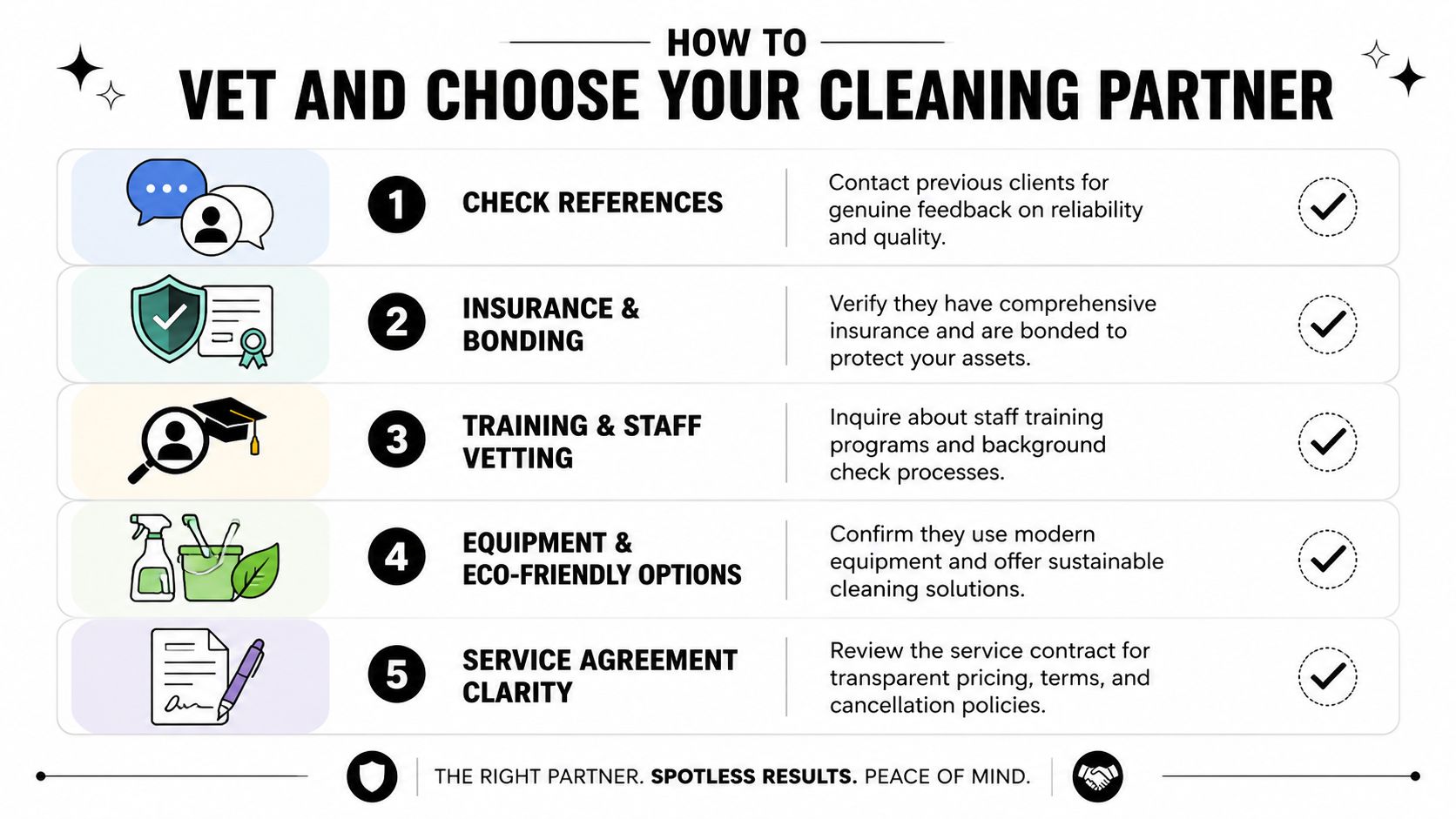
Reviews matter, but management systems matter more
A warm testimonial tells you someone had a good experience. It doesn't tell you what happens on a rainy Wednesday when the assigned cleaner is off sick and your office still needs to open clean the next morning.
The accountability gap is bigger than many buyers realise. UK industry data says 68% of office managers in Greater Manchester report losing service hours due to unannounced staff absences, as explained in this guidance on what to ask a commercial cleaning service. That's exactly why attendance monitoring matters.
A reliable contractor should be able to explain:
- How attendance is verified: digital clock-in, site-based app check-in, or another electronic method
- Who sees missed attendance alerts: supervisor, manager, or account lead
- What cover system exists: named float staff, area support, or rescheduled intervention
- How service completion is evidenced: checklists, audits, photos where appropriate, or site logs
If attendance can't be verified, service can't be guaranteed.
The video below gives a useful general look at choosing a cleaning company.

Questions that expose weak providers quickly
A serious vetting conversation shouldn't feel awkward. Any competent contractor should expect it.
Ask these directly:
How do you confirm cleaners were on site for the booked shift?
If the answer is vague, that's a warning sign.Who checks standards after the first month?
Weak providers often front-load effort, then disappear.What training do cleaners receive for offices, washrooms and chemicals?
You want process, not “they've done this for years”.What happens if the assigned cleaner is absent at short notice?
Listen for a specific cover plan.Can you show me the service schedule in writing before I sign?
Verbal promises cause most contract disputes.
Also check the practical basics:
- Insurance: Ask to see current cover.
- Staff vetting: Confirm how recruitment and referencing are handled.
- Equipment: Commercial-grade kit matters. Domestic vacuums on commercial sites are rarely a good sign.
- Communication: You need one accountable contact, not a general phone number nobody answers.
What doesn't work is choosing solely on personality, the lowest quote, or a long task list with no evidence of supervision behind it.
Navigating Cleaning Compliance and Waste Removal Rules
Many office managers don't want to become experts in cleaning law, and they shouldn't have to. They do need to know whether the provider operates safely and can handle regulated basics properly.
What your provider should already be handling
Under UK law, businesses must comply with the Health and Safety at Work etc. Act 1974, COSHH regulations, and the Management of Health and Safety at Work Regulations 1999, as outlined in this guide to workplace cleaning standards and legal duties. In practical terms, that means cleaning-related hazards should be assessed, chemicals should be handled correctly, and work should follow defined procedures rather than guesswork.
For office cleaning, that usually includes:
- Risk assessments: Identifying slip risks, chemical handling issues, storage concerns and task hazards.
- Defined procedures: Standard operating methods for washrooms, kitchens, touchpoints, waste and equipment use.
- Waste handling: Routine waste removal and lawful handling where licensed removal is required.
- Safe products and storage: Correct labelling, dilution, storage and staff awareness.
A professional cleaning company should make this feel routine, not complicated. If you find yourself writing the cleaning method for them, they're probably not the right contractor.
The practical test is simple. Ask what documents and procedures they already use on office contracts. Competent firms answer clearly. Weak ones respond with general assurances.
Common Questions and Taking the Next Step
Choosing among Manchester office cleaners gets easier once you stop treating cleaning as a commodity. The right contract isn't just a list of tasks. It's a system for showing up, doing the work properly, and proving it happened.
Practical questions clients ask
How often should a small office be cleaned?
That depends on footfall, kitchens, washrooms and how client-facing the space is. A small office with heavy daily use may need more attention than a larger but quieter one.
Is window cleaning included?
Not always. Internal glass is often easier to include than external window cleaning, which may need separate access planning and pricing.
Should desks be cleaned every visit?
Only if the service specification says so and the desk policy allows it. In many offices, cleaner access depends on whether surfaces are clear.
Do I need a deep clean before starting a regular contract?
Not in every case. If the office is already in good shape, regular maintenance may be enough. If standards have slipped, a reset first usually prevents disappointment.

The best next step is to ask for a site-specific quote and push for clear answers on attendance verification, supervision, scope and cover arrangements. That's where reliable providers separate themselves from companies that promise a lot in the sales call.
If you need a cleaning partner that works to a defined schedule, supports accountability, and can tailor office cleaning around your building's real use patterns, Atticus Cleaning Services is a practical place to start. Request a free, no-obligation quote, review the service scope carefully, and make sure the proposal covers the standards, reporting and attendance transparency your office needs.