

You've got a cleaner booked for Monday morning, tenants moving into a flat on Tuesday, and an office inspection later that week. Then the cleaner cancels, the replacement doesn't know the building, and the promised “deep clean” turns out to mean a quick vacuum and a wipe around the taps. In Manchester, that failure is rarely caused by a lack of available providers. It's usually caused by choosing a company that can sell a service but can't reliably staff it.
The right question isn't which of the Manchester cleaning companies offers the lowest quote or the longest service list. Ask whether the provider can deliver the same standard every week, cover sickness and holidays, protect access credentials, and respond when a tenancy turnaround or urgent clean lands at short notice. That's the difference between buying cleaning and buying dependable property support.
Table of Contents
- Understanding the Manchester Cleaning Market
- Essential Checks Before You Hire
- Matching Services to Your Specific Needs
- Why Staffing Reliability Matters More Than Price
- Pricing Expectations and Questions to Ask
- Red Flags and Your Final Decision Checklist
Understanding the Manchester Cleaning Market
Manchester is a crowded market for cleaning services. One business-data source identifies 185 cleaning services in the city, representing 1.6% of all UK cleaning-service businesses indexed in its dataset, while a Manchester-specific register lists more than 1,000 active facilities, cleaning and grounds-maintenance companies on Companies House for Manchester. The figures come from different datasets, so they shouldn't be treated as a single definitive count. They do show the practical reality, though. Buyers have plenty of choice, and quality varies sharply.
The city's demand is equally varied. Offices around Spinningfields and MediaCityUK need scheduled access, secure key handling, consistent touchpoint cleaning and reliable consumables management. Landlords in Fallowfield and Salford face rapid tenant changes, student accommodation deadlines and the need to return properties to a lettable condition without repeated visits. A provider that performs well in a small office may still struggle with a same-week, inventory-aligned tenancy clean.
Manchester also sits within a substantial national industry. British Cleaning Council research values the UK cleaning, hygiene and waste sector at almost £72 billion in 2023, compared with £67.7 billion in 2022, and records about 1.51 million people employed in the sector in 2025, approximately 5% of the UK workforce. The same review records 78,915 businesses in 2025, up from 77,535 in 2024. You can review the underlying industry figures in the British Cleaning Council's 2025 report.
A crowded market creates a staffing problem
A long list of services doesn't prove operational strength. Some firms win work with a low introductory price, then rely on a rotating pool of cleaners who don't know the site, the alarm process or the client's priorities. Standards decline because every new worker starts by guessing.
The national business structure supports that concern. Earlier Office for National Statistics data on UK cleaning activities recorded 12,540 enterprises in general cleaning of buildings, 2,245 in window cleaning services and 1,095 in specialised cleaning services as of March 2021. Those sub-sectors include very different business models, from small independent operators to larger facilities providers.
| Manchester Cleaning Market Snapshot | Value | Implication for Buyers |
|---|---|---|
| Cleaning services identified in Manchester | 185 | Compare staffing, supervision and continuity, not just availability |
| Share of indexed UK cleaning-service businesses | 1.6% | Manchester is a concentrated urban market with strong competition |
| Active Manchester facilities, cleaning and grounds-maintenance companies | More than 1,000 | Check exactly who will deliver the work and whether subcontractors are involved |
| UK cleaning, hygiene and waste sector value in 2023 | Almost £72 billion | Cleaning is a major commercial sector, not an informal afterthought |
| UK sector businesses in 2025 | 78,915 | Buyers need a structured procurement process |
For commercial contracts, start by comparing the provider's contract cleaning services against your actual schedule, access requirements and cover expectations. The company that explains who arrives when the regular cleaner is absent is usually more useful than the company that promises “complete cleaning solutions”.
Essential Checks Before You Hire
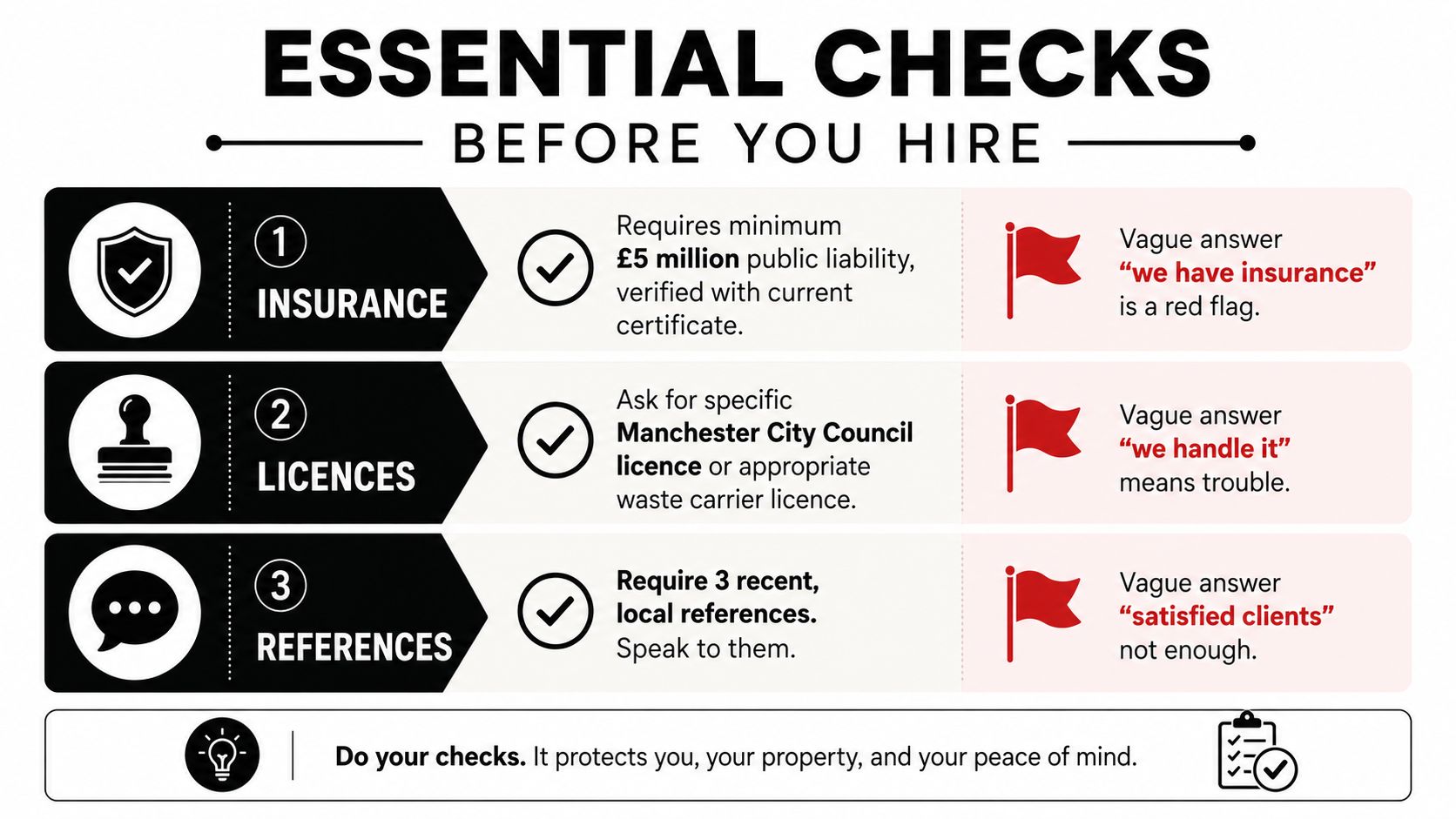
A cleaning company should be able to produce its documents without hesitation. You don't need a complicated procurement department, but you do need evidence that the business understands liability, staff safety, chemical handling and access control.
Check insurance before discussing price
Ask for a current public liability insurance certificate, not a sentence in an email saying “we're fully insured”. For commercial work, many buyers set a minimum of £5 million public liability cover, while residential work is often assessed against £2 million, depending on the property and risk profile. These are buyer benchmarks, not universal legal thresholds, so match the limit to the premises, contract and insurer requirements.
Request the certificate before work begins and check:
- The named business: It should match the contracting entity on the quotation and agreement.
- The policy dates: An expired certificate is no evidence of current cover.
- The activity description: It should reasonably cover cleaning and any specialist work being proposed.
- The insurer and policy number: You can ask the provider to confirm the policy if anything looks unclear.
- Employers' liability insurance: This matters when the company employs staff, and you should ask for evidence rather than assume it exists.
A vague answer such as “our office has all the paperwork” is a warning. So is a certificate issued to a different business name.
Ask how the company controls chemical risk
For commercial sites, ask how the provider manages COSHH, the Control of Substances Hazardous to Health. You should receive or be shown relevant product safety information, risk assessments, storage arrangements, dilution instructions and staff training procedures. A cleaner who can't explain where chemicals are stored, how labels are maintained or what happens after a spill isn't ready for a busy office, care setting or managed block.
Licensing depends on the work. If the provider removes rubbish, ask for the appropriate waste-carrier documentation and a clear explanation of what happens to the waste. “We handle it” isn't a sufficient answer.

References reveal the operating model
Ask for three recent local references that resemble your site. Don't ask only whether the referee was happy. Ask whether the same team attended, how absences were covered, whether invoices matched the quote, how quickly complaints were resolved and whether the provider completed remedial work without an argument.
Named case studies carry more weight than anonymous testimonials, but verify them independently. Call the client using a number found on its own website, not only the contact details supplied by the cleaning company. If the provider won't identify a supervisor, refuses a reference or pressures you to sign before checks are complete, keep looking.
For student housing and secure offices, ask whether relevant staff undergo DBS checks where the role and client requirements justify them. Also establish how keys, alarm codes and access cards are issued, recorded and returned.
Practical rule: If a company can't explain its documents and absence-cover process before winning the contract, it won't become more organised after winning it.
Matching Services to Your Specific Needs
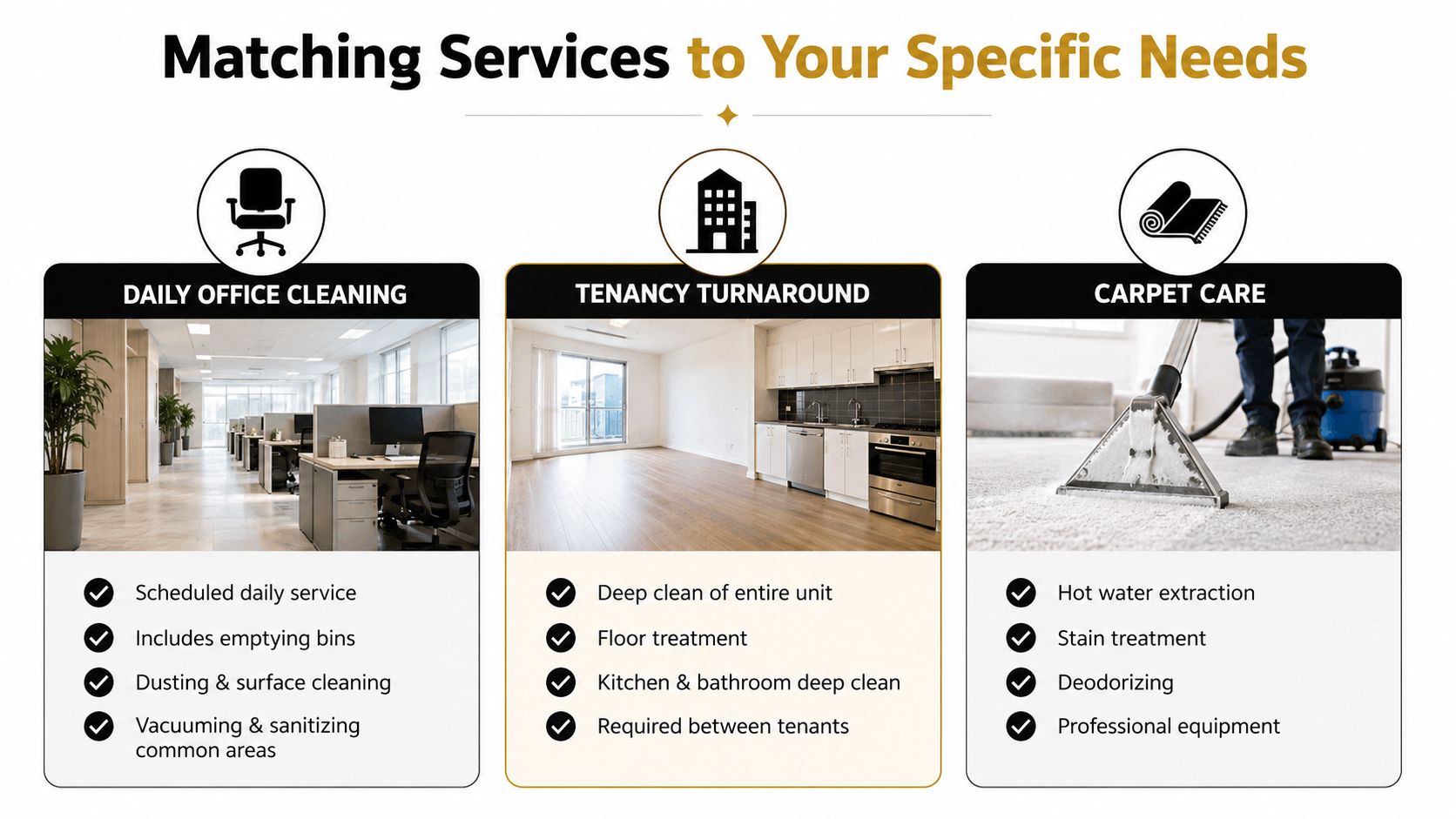
Different cleaning jobs fail in different ways. A daily office contract breaks down through missed tasks, poor access management and weak supervision. An end-of-tenancy clean fails when the team works without an inventory-led checklist. Carpet care goes wrong when a general cleaner uses unsuitable equipment and leaves flooring wet for too long.
Daily office cleaning
Your office specification should identify the frequency, working hours, rooms, touchpoints, waste arrangements and consumables. A credible schedule should cover desks and communal surfaces, kitchens, washrooms, bins, floors, high-touch points and any internal glass included in the agreement. It should also state who orders or replenishes toilet rolls, hand soap, bin liners and other supplies.
Out-of-hours access deserves its own procedure. Ask who holds keys, how alarm issues are escalated and whether a named supervisor checks the site. If your staff work late, the cleaning team needs a practical arrangement for unfinished areas rather than a rigid promise that doesn't reflect the building's use.
A useful guide to what to expect from a professional office cleaning service should help you turn broad promises into a written scope.
Tenancy turnarounds
End-of-tenancy cleaning is deadline work. The provider should inspect or review the property details, agree what “ready for letting” means and work from an inventory-aligned checklist. That checklist should separate kitchen appliances, cupboards, bathrooms, floors, skirting boards, windows, internal doors and marks requiring specialist treatment.
Ask whether the team handles rubbish, internal windows, carpet cleaning and minor additional tasks, or whether those items are subcontracted. Also clarify what happens if the check-out report identifies an overlooked area. A company that offers a defined callback process is safer than one that treats every complaint as a new charge.
Student properties need especially clear scheduling. A late team can delay inspections, repairs, viewings and move-in arrangements, so get the booking window, completion deadline and access assumptions in writing.
Carpet and upholstery care
Carpet cleaning is specialist work, even when it appears on a general service menu. Hot water extraction can provide a deep clean but requires proper pre-treatment, suitable equipment and an agreed drying plan. Dry-cleaning methods may reduce moisture, but the right choice depends on fibre type, staining, traffic and the manufacturer's guidance.
Ask the provider to explain its process before anyone starts:
- Inspection: How will the technician identify fibre type, colourfastness and existing damage?
- Treatment: Which products are used for grease, drink spills, odours and set-in stains?
- Equipment: Does the company own professional equipment or pass the work to another contractor?
- Drying: What ventilation, access and occupancy arrangements are required?
- Expectation setting: Which stains may remain after treatment, and how will that be recorded?
One provider may handle offices, tenancy work and carpets directly. Another may coordinate all three but subcontract the specialist element. Neither model is automatically wrong. The mistake is failing to ask who carries responsibility when the subcontracted work falls short.
Why Staffing Reliability Matters More Than Price
Most contracts don't unravel because the client objects to a modest price difference. They unravel because the cleaner doesn't arrive, the replacement has no site briefing, the supervisor is unreachable and the same defects appear week after week.
The labour pressure is substantial. The British Cleaning Council's 2025 review says the industry directly employs over 1,008,700 staff, while vacancy levels remain high after reaching 1,247,000 vacancies at the end of 2021. Industry commentary also reports cleaning-role turnover can reach 200% to 400%, and describes labour shortages as a central constraint. Those figures don't mean every provider has the same retention problem. They do mean you should treat staffing resilience as a procurement issue, not an HR detail.
What resilience looks like in practice
A reliable provider can explain its cover system without resorting to slogans. You want named cleaners where possible, a site supervisor, written task instructions and an onboarding process for anyone joining the rota. The replacement cleaner should know the building before arriving alone, not learn the alarm code from a hurried telephone call.
Ask these questions during the sales meeting:
- Who covers sickness on a weekday morning?
- How far in advance do you tell clients about planned holiday cover?
- Does a replacement receive a site induction?
- Who checks the work when a new cleaner joins?
- What happens if the company can't provide cover at all?
- How do you record missed tasks and remedial visits?
A strong answer includes people, timings and escalation steps. “We have a large team” tells you very little.
| Factor | Stable Staffing Provider | High-Turnover Provider |
|---|---|---|
| Regular attendance | Named or familiar team assigned to the site | Rota changes frequently |
| Absence cover | Planned backfill with site induction | Last-minute agency substitution |
| Quality control | Supervisor reviews standards and records issues | Client discovers defects after completion |
| Security | Access procedures are documented | New workers may receive rushed instructions |
| Communication | Clear escalation contact | Multiple contacts or unanswered messages |
| Long-term cost | Fewer missed cleans and repeat visits | Low quote offset by disruption and rework |
The cheapest hourly rate can become expensive when your staff spend time reporting defects, your facilities manager arranges emergency cover and your tenants wait for a property to be corrected. Compare the delivered service cost, not the number on the first page of the quote.
The best staffing question is simple: “Who will clean this site next Tuesday if the usual person calls in sick?”
A provider that answers clearly has probably thought about the operation. A provider that changes the subject is asking you to carry the risk.
Pricing Expectations and Questions to Ask
Pricing needs context. The available Manchester office-cleaning guidance places typical office work at £18 to £25 per hour, with the Manchester office cleaning cost guide linking the final figure to office size, cleaning frequency and service level. Use that as a benchmark for office quotes, not as a universal tariff for every property or specialist job.
End-of-tenancy work is usually priced per property rather than per cleaner-hour. Carpet and upholstery treatment also varies with the material, access, staining, furniture and drying requirements. A provider that gives a firm figure should still show what it has assumed.
Demand an itemised quote
A transparent proposal should separate, or at least clearly describe:
- Labour: Planned hours, team size and attendance frequency.
- Equipment: Vacuums, extraction machines, access equipment and specialist tools.
- Consumables: Products, bin liners, toilet rolls, hand soap and other agreed supplies.
- Supervision: Site inspections, quality checks and reporting.
- Specialist work: Carpet, upholstery, internal windows, rubbish removal or deep-clean tasks.
- VAT: Whether it applies and whether the displayed price includes it.
- Additional work: The rate or approval process for tasks outside the agreed scope.
A round figure with no assumptions may look tidy, but it makes comparison difficult. One supplier may include consumables while another bills them separately. One may include a supervisor's visit while another treats every inspection as chargeable time.
Questions that expose hidden costs
Ask whether the quote changes after an introductory period, whether there's a minimum contract term, and whether an early exit fee applies. Request a written fixed-rate period or a clear review mechanism. Don't accept a verbal promise that the price “should stay about the same”.
For a tenancy clean, ask what happens if the property is larger than described, heavily soiled or left with rubbish. For an office, ask what happens when you add rooms, increase touchpoint cleaning or need an urgent visit. For carpets, ask whether stain treatment, deodorising and furniture movement are included.
You can also use the carpet cleaning cost guidance from Atticus Cleaning Services as a prompt for the questions that should appear in a specialist quote. The purpose isn't to force every company into one price. It's to ensure you're comparing the same work.
| Service Type | Typical Rate Range | Pricing Model |
|---|---|---|
| Office cleaning in Manchester | £18 to £25 per hour | Hourly, adjusted for size, frequency and scope |
| End-of-tenancy cleaning | Varies by property and condition | Per-property quote |
| Carpet and upholstery treatment | Varies by material, condition and access | Per-job or itemised specialist quote |
Treat a quote far below the benchmark as a question, not an automatic bargain. Ask what has been excluded, how many cleaners will attend and whether the company is allowing enough time to complete the specification.
Red Flags and Your Final Decision Checklist
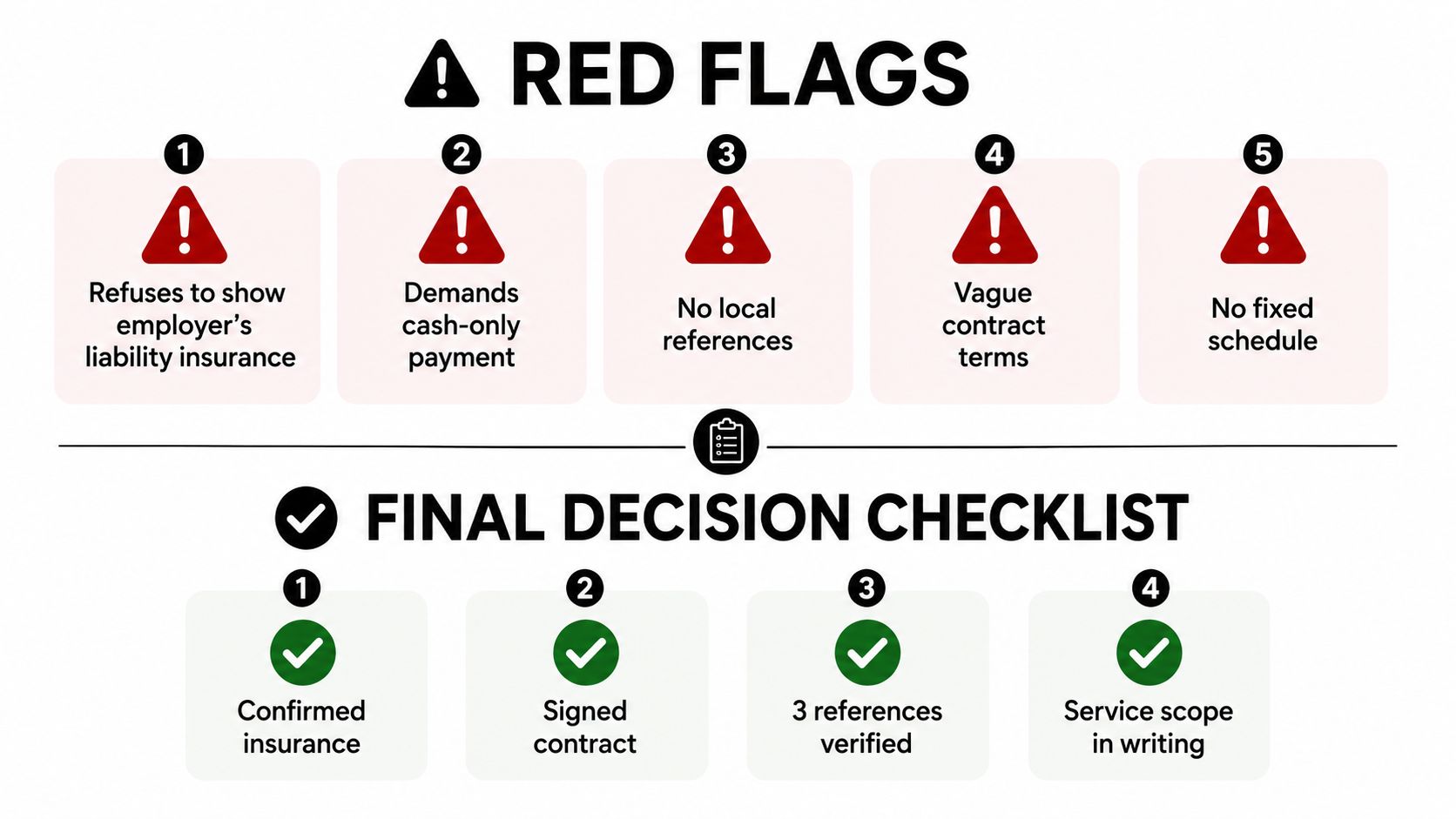
Some warning signs should end the conversation immediately. A company that won't show employers' liability insurance, cannot provide verifiable local references or refuses to identify a site supervisor is shifting operational risk onto you. Cash-only payment demands, vague contract terms and an unfixed schedule belong on the same list.
Disqualifying signals
- No insurance evidence: You receive reassurance instead of current certificates.
- Unverifiable references: The company offers anonymous praise or refuses independent contact.
- No named operational contact: Nobody owns the site after the sale.
- Pressure to sign: You're pushed into a long commitment without a trial clean.
- Unusually low pricing: The quote is far below comparable proposals with no clear explanation.
- No fixed attendance plan: The provider can't state when the team will attend.
- Unclear subcontracting: Specialist work is passed elsewhere without disclosure.
- Weak absence cover: The answer is “we'll do our best” rather than a defined process.
A practical shortlist test
For an office, confirm access control, out-of-hours attendance, consumables, touchpoint priorities and supervisor checks. For a landlord or letting agent, confirm the inventory checklist, completion window, internal windows, rubbish handling and callback procedure. For student accommodation, add access records, staff screening expectations, move-in deadlines and the process for handling multiple properties.
Every buyer should also confirm:
- Documentation: Insurance, COSHH procedures, relevant licences and waste arrangements.
- People: Named supervisor, regular team and sickness-cover plan.
- Scope: Rooms, surfaces, frequencies, equipment and exclusions written into the agreement.
- Price: Labour, supplies, VAT, specialist work, additional-task rates and review terms.
- Performance: Complaint response, remedial work, inspection records and cancellation terms.
Run a paid trial clean before signing a long contract. Walk the site with the supervisor, agree the pass standard and inspect the result under normal lighting. Check corners, skirting boards, washrooms, kitchen areas, touchpoints, bins, carpet edges and any agreed specialist tasks. For a recurring contract, test communication as well as cleanliness. Report a defect and see how quickly the company responds, who takes ownership and whether the correction is completed without friction.
Use a simple scorecard based on the written specification. Record attendance, completed tasks, visible quality, security compliance, communication and remedial response. The trial won't predict every future problem, but it will expose disorganisation before you hand over a long-term contract.

Manchester buyers should choose a cleaning partner that can prove continuity, not just promise a polished first visit. If you need commercial cleaning, end-of-tenancy work, student cleans, carpet care or specialist support with clear scheduling and trained teams, visit Atticus Cleaning Services to request a quote and discuss the cover your property requires.