

Hoarder Cleaning Services in Greater Manchester
August 3, 2026
A professional end of tenancy clean in Manchester typically costs £195–£440, and the average protected deposit of £1,175 means a failed clean can cost more in deductions than prevention would have. In plain English, you're usually better off paying for a proper clean than gambling on a cheap surface job and hoping the inventory clerk is lenient.
That's the reality most tenants face when the boxes are stacked in the hallway, the keys are due back, and the kitchen still has oven grease, limescale, and dust in places you didn't notice while living there. Landlords and agents don't judge the move-out on effort. They judge it on the condition recorded at check-in, and in the UK cleaning is the single biggest source of deposit disputes, appearing in over half of adjudicated cases handled by the Tenancy Deposit Scheme as set out in Manchester cleaning guidance.
Table of Contents
- Why End of Tenancy Cleaning Matters in Manchester
- What Manchester Landlords and Letting Agents Check
- A Room-by-Room Checklist of What Is Included
- Typical Costs in Manchester and What Drives the Price
- DIY Clean vs Hiring a Professional in Manchester
- Same-Day Move-Out Logistics and Booking Timing
- What Atticus Offers and How to Book in Manchester
Why End of Tenancy Cleaning Matters in Manchester
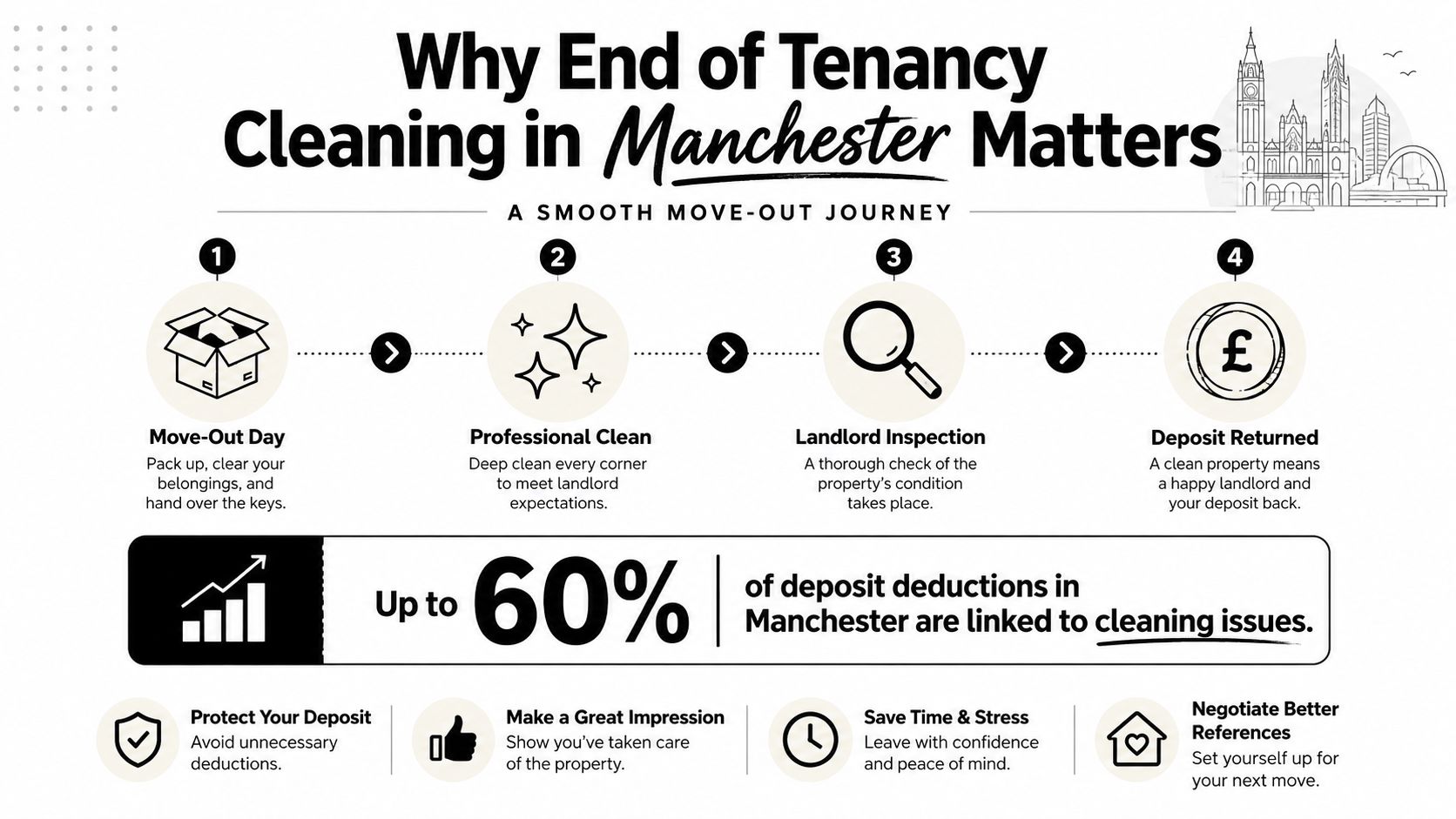
A Manchester rental can look fine at handover and still trigger a dispute once the inventory clerk starts checking the obvious trouble spots, oven glass, taps, grout, skirting boards, and the inside of cupboards. That is where tenants lose ground. End of tenancy cleaning in Manchester is a deposit protection move, because the cleaner the property is at checkout, the less room there is for the landlord or agent to argue for deductions.
The choice is simple. Pay for a proper clean, or risk losing money over avoidable marks and grime that show up during inspection. Atticus' guide to what landlords expect from end of tenancy cleaning sets out the standard clearly, and in practice that standard is usually stricter than tenants expect. If you try to wing it with a quick domestic clean, you are betting your deposit on a checklist you do not control.
Why Manchester renters get caught out
Manchester move-outs are usually rushed, and that is where people get exposed. Student lets, family homes, and agency-managed flats often need to be handed back the same day keys are returned, which leaves little time for retries if the first clean misses the mark. If the place is not ready, the landlord or agent can hold back sign-off, push the issue into deposit negotiations, or delay the reference a tenant needs for the next property.
The other problem is standards. A room can look tidy and still fail if there is grease behind the oven handle, limescale on shower fittings, dust on top of doors, or residue in places the eye skips over. That is why a DIY wipe-down often turns into a deduction argument later. The money spent on a proper end of tenancy clean is usually the better trade if it prevents a dispute, a delayed move-out, or a messy back-and-forth with the agent after checkout.
One more practical issue gets ignored in most Manchester guides. Same-day move-out cleaning needs scheduling discipline. If removal vans, key handover, and cleaners are not coordinated properly, the last job gets done in a hurry, and rushed work is exactly what inventory inspections punish.
What Manchester Landlords and Letting Agents Check
An inspection in Manchester starts with the inventory, not with your opinion of what looks clean enough. The property has to be handed back in the same cleanliness condition recorded at check-in, allowing only for fair wear and tear. That means the standard is set by what was documented when you moved in, as detailed in the Manchester checklist guidance.
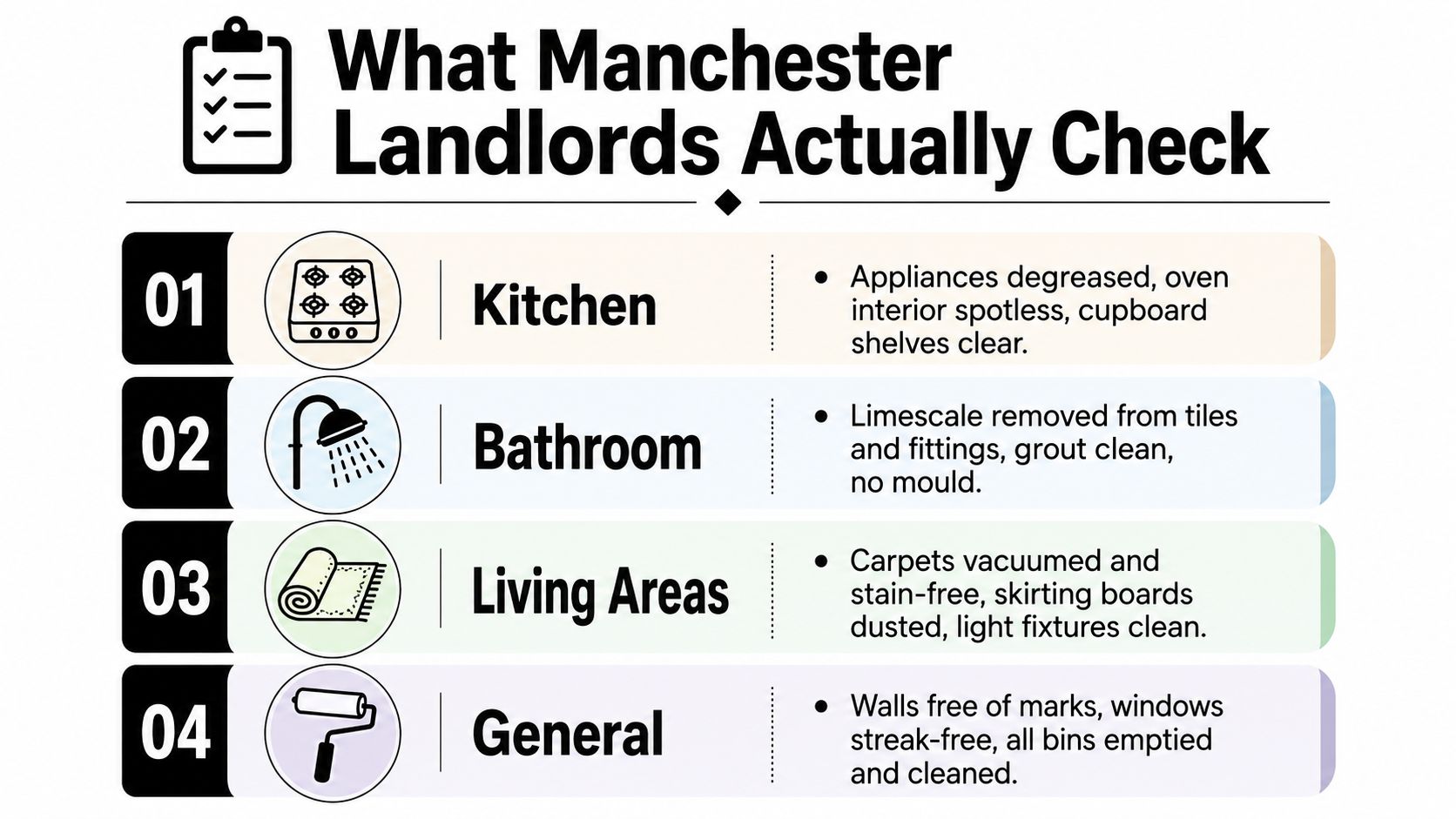
A kitchen is usually where tenants lose the argument first, because it can look decent from the doorway and still fail close inspection. Agents check inside cupboards, drawer interiors, appliance cavities, extractor filters, oven racks, and the glass on oven doors. In bathrooms, they look past the mirror and onto taps, grout, shower screens, sealant, and any limescale that has built up in low-visibility corners. Internal window tracks, skirting boards, switches, sockets, and other contact points matter too.
The inspection focuses on hidden dirt rather than visible tidiness
A single-pass domestic clean rarely survives an inventory inspection. A normal tidy-up focuses on surfaces you can see, while checkout standards focus on residue, grease, dust, and scale in places people usually ignore. A kitchen can shine on first glance and still fail because the extractor filter is greasy or the sink tap has mineral marks. The same applies to bathrooms where limescale clings to fittings after months of use.
The clean has to be room-by-room, not a quick sweep through the property. Kitchens need degreasing. Bathrooms need descaling. Living areas need dust removal from skirting and fixtures. Hallways, switches, and sockets need a proper wipe-down because those are the places agents often photograph when they raise a deduction. That is the standard landlords and agents work to, and it is the standard tenants need to budget for if they want to protect the deposit rather than argue over it later. A clear rundown of what landlords expect from end of tenancy cleaning is set out in this landlord-focused guide.
This is why checkout cleaning needs process, not enthusiasm. If you're missing the hidden surfaces, you're not matching the inventory standard. You're just cleaning for the camera angle.
The cleaner's job is to remove what the clerk will inspect, not only what guests would notice.
A Room-by-Room Checklist of What Is Included
The scope of a proper clean is broader than most tenants expect. You're not paying for a polish of the visible bits. You're paying to bring every room back to inventory condition, including areas that are easy to miss when you live there every day. In Manchester, that means kitchens and bathrooms get the heaviest treatment, while living areas, bedrooms, and circulation spaces still need proper attention.
What the base clean should cover
In the kitchen, the standard job is degreasing surfaces, cleaning inside cupboards and drawers, wiping shelves, and dealing with appliance interiors where accessible. Bathrooms need limescale removal, mould treatment where relevant, and a full clean of the shower, bath, basin, toilet, fittings, and tile lines. Living rooms and bedrooms should be vacuumed thoroughly, with skirting boards, ledges, radiators, and light fittings cleaned rather than just dusted.
Internal windows are typically part of the standard clean, and that matters more than people realise. A lot of checkout reports flag streaks, dirty frames, or tracks that were never touched. Bins also need emptying and cleaning. If rubbish is left behind, the job isn't complete.
What usually sits outside the standard quote
Carpet cleaning is normally an add-on, especially if the pile has visible traffic marks or stains. Oven-only deep cleans also tend to be priced separately when they're booked on their own. Rubbish clearance is another extra, usually relevant when the outgoing tenant has bulky items, broken furniture, or a rushed move-out. If your property needs those services, ask for them up front rather than assuming they're included.
| Area | Included as Standard | Optional Add-On |
|---|---|---|
| Kitchen | Degreasing, cupboards, drawers, appliance interiors, sink, taps | Heavy oven-only work if quoted separately |
| Bathroom | Limescale removal, fixtures, grout, mould treatment | Specialist stain or damage treatment |
| Living Areas | Vacuuming, skirting boards, ledges, switches, internal windows | Carpet cleaning |
| Bedrooms | Vacuuming, surfaces, wardrobes, internal windows | Carpet cleaning |
| Move-Out Clearance | Empty bins, remove loose debris | Rubbish removal, bulky waste clearance |
If you're pricing carpets separately, this carpet cleaning cost guide helps you judge whether the add-on is justified.
Typical Costs in Manchester and What Drives the Price
Manchester pricing is steady once you cut through the sales talk. A standard end of tenancy clean is usually quoted at £195–£440, with a local average around £315 based on Manchester pricing guidance. That sits close to the UK benchmark, and a separate guide puts the national average for a two-bedroom property at about £260, with Manchester roughly 2% below that level based on Manchester pricing guidance. For tenants, landlords, and agents, the point is simple, Manchester is not a cheap market, but it is predictable if you know what the quote is covering.
The price bands track property size. A studio or 1-bed flat commonly falls around £115–£195. A standard clean sits at £195–£440. If carpet cleaning is bundled in, the job can move into £275–£535 territory based on Manchester pricing guidance. That is why a quote can look manageable at first and then rise once the cleaner adds the parts the checkout report will punish if they are missed.
What pushes the quote up
Property size is the first driver. More rooms mean more floors, fixtures, skirting, windows, and touchpoints. Condition comes next. A lightly used flat cleans faster than a student house with built-up grease and heavy carpet wear. Access matters too. If cleaners are working around awkward key handovers, limited parking, or a narrow move-out window, the job slows down and the labour cost goes up.
Add-ons change the economics. Oven cleaning, carpet extraction, internal window work, and rubbish removal all add labour or equipment. Bundled jobs can still make sense because they reduce the risk of missing something that later appears in the inventory or checkout report. That is a deposit-protection decision, not just a cleaning one.
Budget discipline: if the clean is cheap but incomplete, the true cost appears in the deposit letter, not the invoice.
Compared with the £150–£300 range of cleaning deductions seen in Manchester, a properly scoped clean is usually the smarter spend Cleanifiq's Manchester guide. If you are choosing where to save, cut extras you do not need. Do not save by skipping the standard clean. If carpets are the only extra you are weighing, this carpet cleaning cost guide helps you judge whether the add-on is worth it.
DIY Clean vs Hiring a Professional in Manchester
You do not have to hire a cleaner by law. The duty is to return the property to the condition required by the tenancy agreement and inventory, not to tick a box that says “professional cleaner used”. That distinction matters because a lot of tenants waste money on a service they don't need, while others gamble on DIY when the property clearly needs specialist equipment and more time.
When DIY is enough
A meticulous DIY clean can work in a short-let studio, a lightly used one-bed flat, or a property with low traffic and minimal build-up. If you've got good cleaning gear, time, and an honest view of the state of the place, you can return a property to a decent inventory standard yourself. The key is evidence. Keep move-in photos, note any pre-existing marks in the inventory, and document fair wear and tear instead of trying to argue it later.
DIY also makes sense when the agent already acknowledged the condition during the tenancy, or when the outgoing state is close to the incoming one. In those cases, the money saved can be real.
When professional cleaning is the cheaper option
If the place has limescale in the bathroom, heavy kitchen grease, carpets that need extraction, or a long tenancy with visible build-up, a professional clean is usually the better bet. Once you factor in equipment hire, your time, and the risk of a £150–£300 cleaning deduction, a cheap DIY attempt can become the more expensive choice. That's especially true if the landlord then asks for a re-clean before releasing the deposit.
Use the checklist standard as your line. If you can match the inventory condition yourself, do it. If you're hoping the agent won't look closely, you're already on the wrong path.
Same-Day Move-Out Logistics and Booking Timing
Manchester move-outs go wrong when the day is left to chance. Furniture comes out late, rubbish sits in the hall, the cleaner turns up before access is clear, and the keys are still with the tenant when the inventory check starts. Plan the day around deposit protection, not around optimism. A standard end of tenancy clean can take several hours for an average property, so same-day timing has to be worked out before anyone starts lifting boxes.
The order that works
Get the furniture and loose belongings out first. Cleaners need clear floors, clear surfaces, and clear access to do the job properly. Clear the rubbish next, including anything the landlord will not want left behind. Then the clean can run without stops, and the final inspection can happen after the property has dried and been checked properly.
Month-end is where people get caught out. Carpet extraction gear gets booked early, especially when several tenants are leaving at the same time. The student-heavy areas around Fallowfield, Withington, and Rusholme get tight fast because turnover is concentrated and everyone is chasing the same slots. Leave it too late and you lose choice, then end up paying more for urgency or settling for a rushed job that misses the standard the agent will check against.
How far ahead to book
Book as soon as the checkout date is fixed. If carpets need cleaning, line that up with the end of tenancy clean instead of treating it as a separate job later. If rubbish removal is needed, sort that before moving day so the cleaners are not waiting around for a collection that never got arranged. The clean should sit in the middle of the move-out, after the property is empty and before the keys are handed back.
Operational rule: do not book cleaning around your moving stress. Book your move around the cleaning window.
For Manchester renters in busy student and agency areas, the sensible move is to reserve earlier than you think you need to. That keeps the handover calm, reduces the risk of missed access, and gives enough time for carpets to dry and for any final touch-ups before the inventory appointment.
If you want a service built around tenancy turnarounds, Atticus's end of tenancy cleaning service details are the place to look.
What Atticus Offers and How to Book in Manchester
Atticus Cleaning Services covers Manchester, North Cheshire, Altrincham, Hale and Sale, and the service is set up for tenancy turnarounds, not casual domestic touch-ups. On end of tenancy jobs, internal window cleaning is included as standard, and the team uses Sebo professional vacuums and hot water extraction for carpet care. When carpet cleaning is booked with an end of tenancy clean, there's an option for 50% off the carpet cleaning bundle, which matters when you're trying to keep the final bill under control Atticus end of tenancy cleaning details.

The practical handover
For full move-outs, Atticus also handles licensed and insured rubbish removal in line with government and local authority rules. That's useful when the clean is only one part of a bigger exit job, because it keeps the property turnaround in one place instead of splitting it across multiple suppliers. The booking flow is straightforward. Request a quote, approve the price, then the team turns up and completes the work to satisfaction.
If you're comparing options across Manchester, this is the right lens to use. Look for inventory-matched cleaning, internal windows included, carpet options that make sense, and a team that can handle the move-out sequence without creating more work for you. For a direct quote and service details, visit Atticus Cleaning Services and book the clean around your checkout date, not after the checkout panic starts.
If your move-out is coming up, get the inventory standard sorted now and don't leave the deposit to chance. Atticus Cleaning Services handles end of tenancy cleaning across Manchester with internal windows, carpet care, and rubbish removal available where needed. Visit Atticus Cleaning Services to request a quote and line up the clean before handover day gets messy.